Solo travel in Cusco: an honest practical guide
Cusco: Half-Day City Tour with Sacsayhuaman and Q’enco
Is Cusco safe for solo travel?
Yes — Cusco is one of the most well-established solo travel destinations in South America. The tourist infrastructure is mature, English is widely spoken in the main areas, and the backpacker community is large and well-connected. The main risks are petty theft in crowded areas, altitude sickness arriving without a companion to notice symptoms, and nightlife-related incidents that are easy to avoid with basic precautions.
Cusco is one of South America’s best solo destinations
Solo travellers have been passing through Cusco in large numbers since the 1970s backpacker trail from Buenos Aires to Machu Picchu first became established. The result is a city with an unusually mature infrastructure for independent travellers: hostels with active common rooms, organised day trips designed for solo bookings, well-signposted tourist routes, and a general awareness among local service providers of what solo travellers need.
This does not mean Cusco is without risk or complexity. Altitude affects solo travellers differently than group travellers — the absence of a companion to notice deteriorating symptoms is a genuine consideration. Petty theft in crowded areas is real. And several of the experiences that make Cusco special — multi-day treks, overnight stays in the Sacred Valley — require some upfront planning that can feel daunting from home. None of these are reasons to avoid solo travel here; they are reasons to prepare specifically for the solo experience rather than generic travel advice.
| Safety level | Well-established, mature tourist infrastructure |
| Main risks | Petty theft, altitude alone, nightlife scams |
| First-night budget | S/100–150 private room recommended |
| Best base | San Blas neighbourhood |
| Solo-friendly | Hostels, group day trips, multi-day treks |
Arriving alone: the altitude dimension
Arriving in Cusco at 3,400 m after a 90-minute flight from Lima is the part of the trip where solo travellers most benefit from extra preparation. The altitude affects nearly everyone to some degree in the first 24 hours; the question is whether you are in an environment where someone will notice if it becomes severe.
Tell your hostel or hotel how you feel when you arrive. Reputable accommodation in Cusco is well-practiced at this conversation. They will typically give you coca tea, note your room number, and check in that evening. This is not over-caution — it is what the experience of receiving thousands of altitude-affected arrivals has taught the industry.
Book your first night’s accommodation before you land. Arriving at Alejandro Velasco Astete Airport feeling altitude effects and needing to find a room is the version of this experience to avoid. Budget S/100–150 ($30–45) for a private room for the first night — even if you plan to move to a dorm later — so that you have a quiet space to rest if needed.
Do not plan any major activity for day one. A gentle walk to Plaza de Armas and the surrounding streets is fine; Sacsayhuamán (which involves a steep 45-minute climb from the city) is not a day-one activity. The altitude sickness guide covers everything you need to know about managing the first 48 hours.
Safety: the realistic picture
Cusco is safer than its South American peers. It is not crime-free. Knowing where the risks concentrate makes avoidance straightforward.
Petty theft is the primary risk. Pickpocketing and bag-snatching occurs most frequently in the San Pedro Market (particularly around the outside entrances), on the main tourist street Avenida del Sol, and on the minibus routes to the Sacred Valley. Use a money belt for your passport and primary cash. Keep small amounts in a pocket for market use. Do not leave cameras or phones on café tables on busy streets.
Fake taxis — unmarked private cars posing as taxis — are a risk for late-night journeys from bars. They are easily avoided by using only clearly marked authorised taxis (yellow with company name and licence number visible) or app-based services where available. Your hostel can call a reliable taxi for any time of night.
Scams at travel agencies targeting solo travellers are a consistent risk. The Peru travel safety guide covers the main patterns in detail. The short version: never book tours from people approaching you on the street, verify the agency has a physical address and licence, and be very sceptical of prices significantly below the market rate for Machu Picchu or Inca Trail bookings.
Nightlife-related risk concentrates around Procuradores Street (known as Gringo Alley) and the nearby bar area. Drink spiking incidents have been reported, particularly targeting solo travellers who accept drinks from strangers. The environment is manageable with basic sense: meet people through your hostel, go out with a group, do not accept drinks from people you do not know.
The solo social scene
Cusco has one of the most naturally social solo travel atmospheres in the Americas, for a simple reason: everyone is here for the same things, and the shared planning creates instant conversation.
Hostels as social infrastructure. The best Cusco hostels run communal dinners, organise group outings to day trips, and have staff who actively facilitate introductions. A few hours in a hostel common room during the first evening — comparing notes on Machu Picchu ticket booking, trail recommendations, and altitude experiences — typically produces travel companions for at least part of the remaining stay.
Day trips as group experiences. Sacred Valley full-day tours, Rainbow Mountain departures, and Humantay Lake trips run with groups of 8–16 people, typically a mix of nationalities and solo travellers. Eight hours together in a van and on foot through Andean landscape is usually enough to form genuine connections. A half-day Cusco city tour on day two or three is an efficient way to orient yourself and meet other travellers simultaneously.
Organised treks. Multi-day treks — the Inca Trail, Salkantay, Lares — put solo travellers in a group for 4–5 days. These trips are disproportionately populated by solo travellers, which creates a different dynamic from tours where most participants arrived as couples or families. Many long-term friendships begin here.
Independent versus organised: how to decide
Go independently if: You are comfortable managing online bookings and moderately complex logistics (train reservations, timed-entry citadel tickets, bus transfers), you want to spend as much time as you choose at each site without group constraints, and you have researched the key sites enough to understand what you are looking at without a guide.
Go on an organised tour if: You prefer logistics handled in a single booking, you want a guide’s interpretation at Machu Picchu or the major archaeological sites, or your available time in Cusco is genuinely short and you cannot afford a badly-planned day.
The hybrid approach — organise Machu Picchu as a structured day trip, manage city sites independently — is what many experienced solo travellers do. A half-day city tour is particularly useful on day two when you are partially acclimatised and benefit from transport between sites, but still want to explore San Blas and Qorikancha at your own pace in the afternoon.
Managing the logistics solo
Book Machu Picchu before you arrive in Peru. This is not general travel-planning caution — it is a practical necessity in dry season (May–September). Timed-entry tickets and train tickets sell out. The Machu Picchu complete guide covers the booking system; the day trip guide covers the solo day-trip logistics.
The Sacred Valley by colectivo. You do not need an organised tour for the Sacred Valley if you have a couple of days. Shared colectivos from Avenida Grau in Cusco depart regularly to Pisac (S/10–15), Urubamba, and Ollantaytambo (S/15–20). The Sacred Valley complete guide covers the independent approach.
Inca Trail permits for solo travellers. Inca Trail permits are sold per person and there is no minimum group size — solo travellers can book directly through a licensed agency and are assigned to a departing group. If you want a small-group experience, book early and specify your preference to the agency. The Inca Trail permits guide covers the booking process.
Money management. ATMs on and near Plaza de Armas charge standard fees (S/15–20 per withdrawal). Withdraw larger amounts on fewer occasions rather than multiple small withdrawals. Carry sufficient cash for day trips and market visits — many smaller vendors and colectivo operators do not accept cards.
The san blas neighbourhood: best base for solo travellers
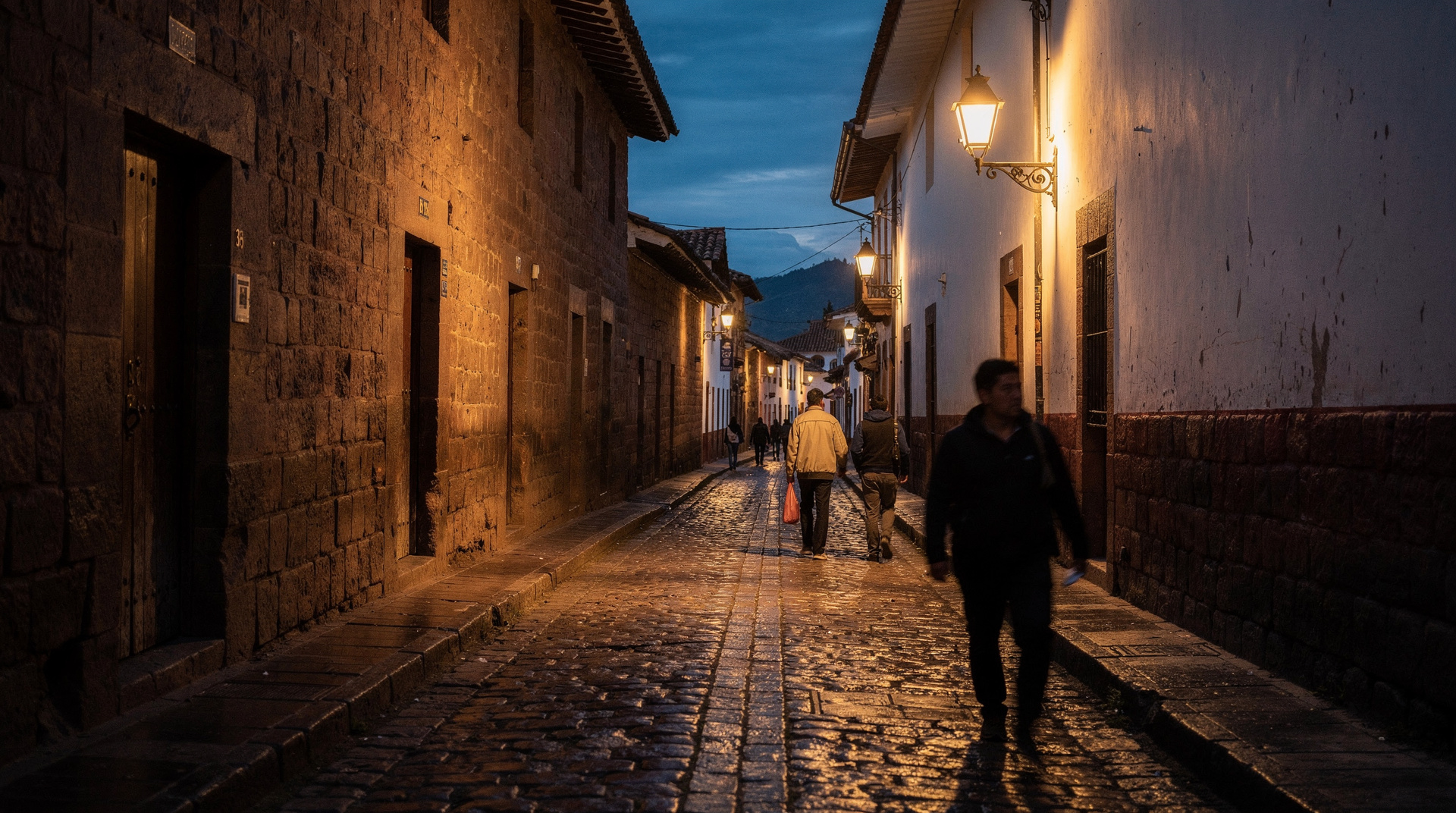
San Blas is consistently recommended by experienced solo travellers as the best neighbourhood to be based in Cusco. The reasons are practical and atmospheric: it is quieter than the immediate centre, the streets invite wandering, the artisan workshops and galleries create natural stopping points, and the hostels here tend to be the ones with the most active communities.
The 10-minute walk down to Plaza de Armas is manageable at altitude once acclimatised (day three onwards). For days one and two, the main archaeological sites and tour operators are within easy reach by short taxi.
What to prepare before you go
Travel insurance with altitude evacuation cover. Standard travel insurance often excludes high-altitude medical evacuation. Check your policy specifically for coverage above 4,500 m if you plan Rainbow Mountain (5,200 m) or any multi-day trek. Helicopter evacuation from altitude in Peru is not cheap without insurance.
An offline map. Maps.me with the Cusco region downloaded works reliably without data. The historic centre is walkable and signed for tourists, but the streets are genuinely confusing and an offline map makes day one much easier.
Acetazolamide (Diamox) if your doctor prescribes it. For solo travellers arriving from sea level directly to Cusco, a brief course of acetazolamide starting 24 hours before arrival is a reasonable medical precaution. Discuss with your GP or travel medicine clinic before the trip — not something to self-prescribe, but worth the conversation.
The solo itinerary in practice
For a solo traveller’s first visit to the region, the following structure balances the social and independent elements effectively:
Day 1 — Arrival. Check in to a San Blas hostel with an active common room. Rest. Brief walk to Plaza de Armas. Talk to other guests in the evening; this is where Machu Picchu planning conversations begin naturally.
Day 2 — City orientation. A half-day guided city tour takes in Qorikancha, Sacsayhuamán, and the main colonial centre with transport between sites — ideal when altitude still makes extended hill-walking uncomfortable. Afternoon free to explore San Blas workshops independently. Evening in a hostel common room or a recommended restaurant from a fellow traveller.
Day 3 — Sacred Valley. Join a group tour (book at the hostel desk or a nearby agency) to Pisac, Maras, and Ollantaytambo. This is where most solo travellers make the connections that last through the rest of the trip — 8 hours in a van with 8–12 other people who share the same itinerary creates an effective social catalyst.
Days 4–5 — Machu Picchu. Travel independently to Ollantaytambo by colectivo, train to Aguas Calientes, overnight stay. First-bus entry to Machu Picchu the next morning. Return to Cusco in the afternoon.
Day 6 — Rainbow Mountain or free. By day six, altitude acclimatisation is generally complete. Rainbow Mountain at 5,200 m is now feasible; or a free day in Cusco exploring markets, cooking classes, and the sites not yet visited.
This structure produces a trip with a natural social rhythm — group and independent elements alternating in a way that suits the solo format better than either extreme alone.
The honest conclusion
Cusco rewards solo travel more generously than almost anywhere in South America. The concentration of experiences within a small area, the naturally social structure of the hostel and tour infrastructure, and the shared intensity of altitude adjustment create conditions where travelling alone is often more social — and more interesting — than being in a fixed pair or group.
The Peru travel safety guide covers Cusco alongside Lima and other destinations. The how many days guide helps you plan the right length of stay. And the Cusco trip planning guide covers every logistics question for arriving independently.
Eating alone in Cusco
Solo dining is entirely normal in Cusco’s restaurant culture, and it is worth saying plainly since some first-time solo travellers hesitate over it. Counter seating at San Pedro market food stalls is the easiest place to start — communal benches and a fast, cheap meal remove any awkwardness entirely, and it is genuinely one of the best food experiences in the city regardless of who you are travelling with.
For a sit-down dinner, mid-range Peruvian restaurants around San Blas and the historic centre are used to solo diners, particularly in high season when the city is full of independent travellers. Bringing a book or simply people-watching from a window table is completely unremarkable here. If eating alone feels like the hardest part of the day, book a table for the early dinner slot (6:30–7:30 pm), when restaurants are quieter and staff have more time to chat.
Budgeting solo versus splitting costs
One of the genuine downsides of solo travel anywhere is losing the cost-splitting that a couple or group enjoys on taxis, private transport and some tours. In Cusco, this matters less than in many destinations because so much of the transport infrastructure is built around shared use: colectivos to the Sacred Valley cost the same per person whether you book alone or with others, and organised day trips to Rainbow Mountain or the Sacred Valley are priced per person regardless of group size, so solo travellers pay exactly what a couple pays each.
The place solo travel does cost more is private accommodation — a private room costs the same whether one or two people occupy it — which is the main argument for hostel dorms if budget is a serious constraint. The Cusco on a budget guide breaks down realistic daily costs for independent solo travellers in detail.