Sacred Valley complete guide: Pisac, Maras, Moray and Ollantaytambo
From Cusco: Sacred Valley of the Incas Full-Day Tour
How do I visit the Sacred Valley from Cusco?
Most visitors join a full-day guided tour from Cusco covering Pisac, Chinchero, Maras, Moray and Ollantaytambo in one loop (~S/60–100 with transport). Independent travellers use collectivos from Calle Puputi (Cusco to Pisac ~S/5, 45 min), then change at Urubamba for Ollantaytambo. Allow at least one full day; two days lets you sleep in the valley at 2,800–3,000 m and acclimatise properly before Machu Picchu.
The valley the Inca called their heartland
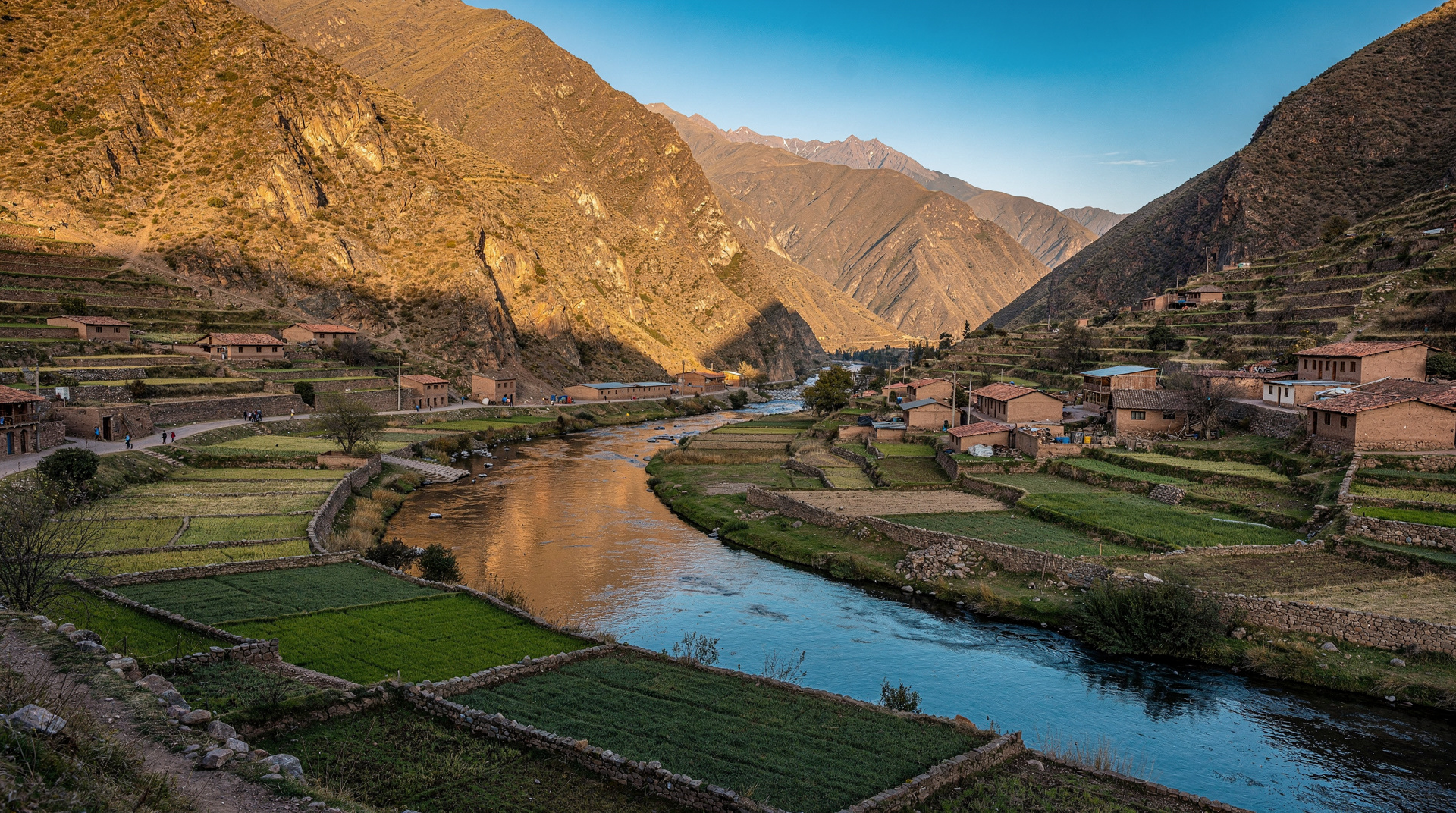
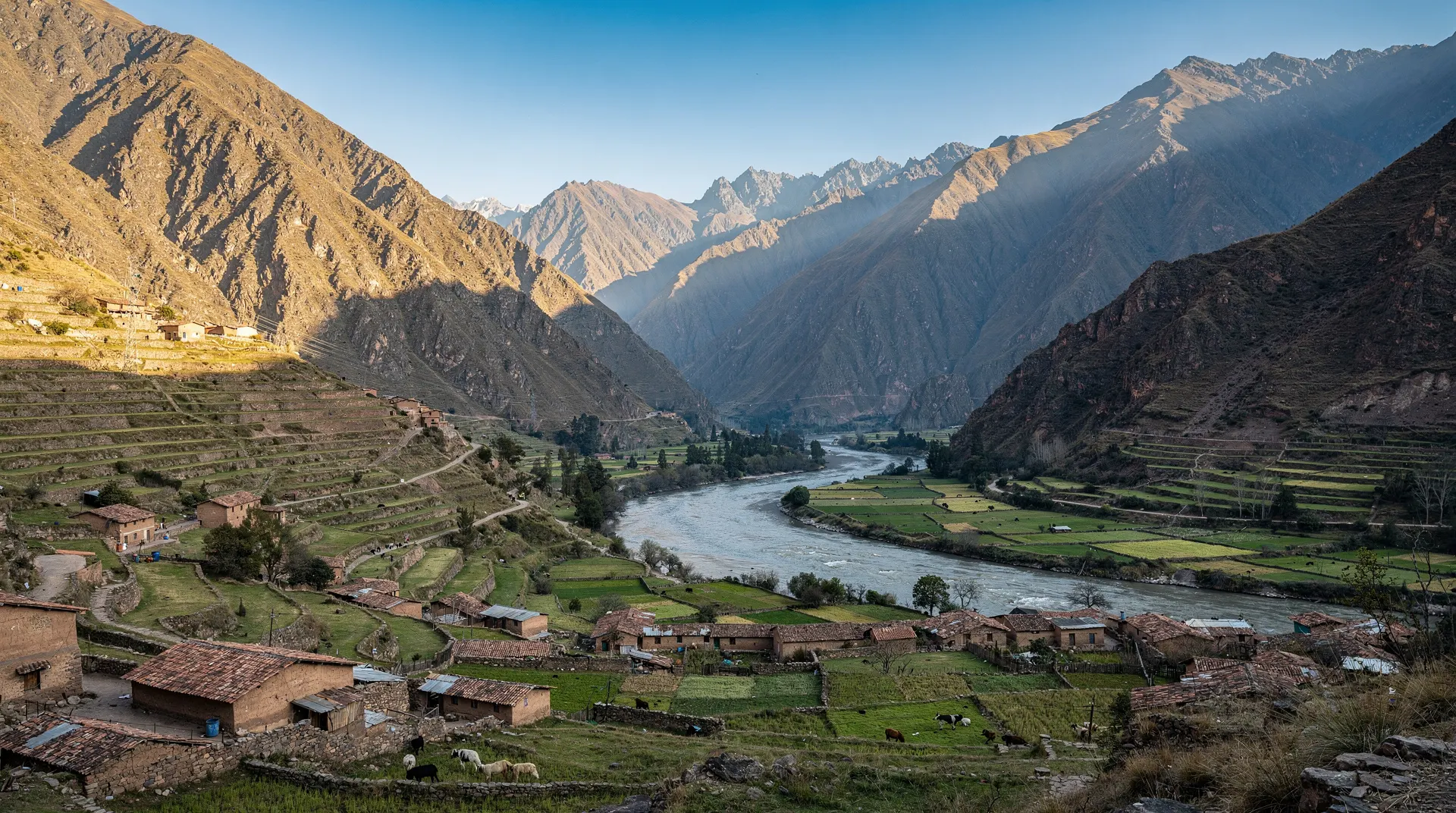
The Urubamba River flows north-west from Cusco through a broad, sun-warmed trench in the Andes before the mountains close in near Ollantaytambo and the river plunges toward the cloud forest. The Inca called this stretch Willkamayu — the Sacred River — and for good reason: this was the agricultural heartland of their empire, a place of experiment, worship, trade and royal retreat. The name Sacred Valley is a modern translation, but the reverence it implies is accurate. This is where the Inca grew their food, buried their dead, worshipped their sun god, and built some of their most ambitious engineering projects.
For contemporary travellers, the valley deserves considerably more itinerary space than the single morning that many first-time visitors allocate to it. Five major sites — Pisac, Chinchero, Maras, Moray and Ollantaytambo — each has a distinct character and a depth of history that would justify a dedicated day trip in isolation. Compressed into one well-organised loop, they offer one of the richest single-day archaeology-and-culture experiences on the continent. Two days here allows you to breathe, linger and begin to understand what you are looking at.
The practical argument for the valley is altitude. Cusco sits at 3,400 m; the valley floor runs at 2,800–3,000 m. Those 400–600 vertical metres make a genuine physiological difference on arrival. New arrivals sleeping in the valley on their first night report noticeably less broken sleep, fewer headaches and more usable energy the following morning than those who stay in Cusco from day one. This is not anecdote — it is the predictable result of sleeping at a lower elevation when your body has not yet adjusted to reduced oxygen partial pressure. The acclimatisation guide explains the physiology; the practical recommendation is simply: spend your first night in the valley, not in Cusco.
| Where | Pisac to Ollantaytambo, 33–72 km from Cusco |
| Cost | Boleto Turístico ~S/130 full circuit; tours ~S/60–100 |
| Time needed | 1 full day minimum; 2 days recommended |
| Getting there | Guided tour, collectivo, or private driver |
| Best time | May–September dry, or April/October shoulder for fewer crowds |
Pisac: market town and ridge-top citadel
Pisac sits 33 km from Cusco at the valley’s eastern entrance, at approximately 2,950 m. It operates on two distinct levels that most visitors fail to connect. The town below holds a craft market in the Plaza de Armas every day of the week, peaking on Sunday when Quechua-speaking vendors arrive from outlying communities in the surrounding hills. The atmosphere is genuine rather than manufactured: vendors here have been selling textiles, ceramics and agricultural products since well before tourism existed in this part of Peru. Prices for handwoven alpaca pieces are a fraction of what equivalent items cost in Cusco’s tourist-facing shops.
The market works best early. Arrive by 8–9 am on Sunday to browse before the organised coach tours pull into the car park at around 11 am. By noon the square is crowded and the intimate quality that makes the market interesting has largely evaporated. The textile stalls in the side streets off the plaza are better than those on the main square — look for pieces with the slight colour irregularity and weave density that characterises genuinely backstrap-loom woven alpaca rather than machine-produced acrylic.
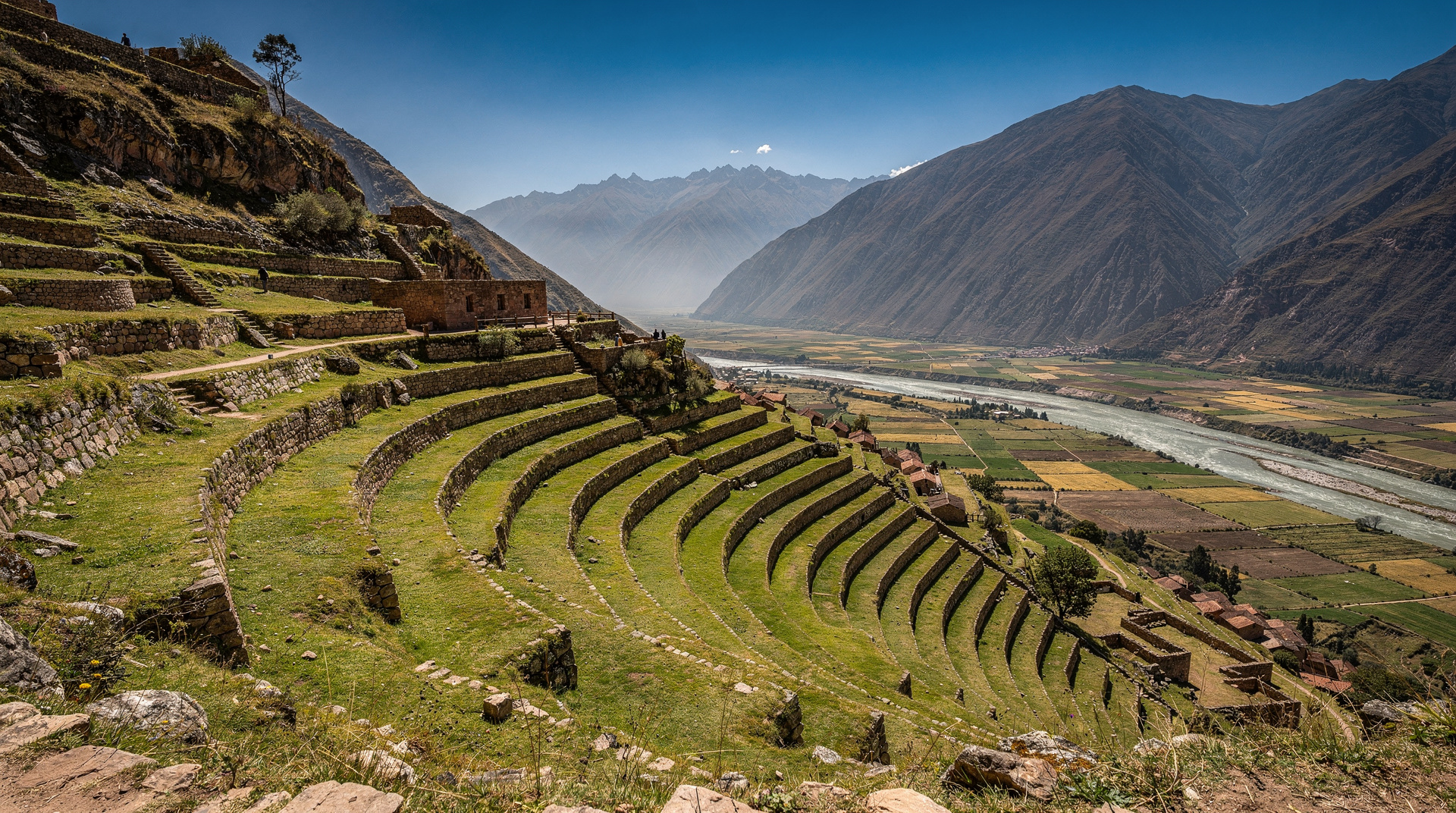
Above the town, accessible by a stiff 45-minute climb or a short taxi (~S/10 to the top entrance), the Pisac Archaeological Complex stretches for several kilometres along a mountain ridge. This is not a modest ruin — it is a full Inca city: temples, military platforms, storehouses, fountains, water channels and burial towers distributed across a series of ridge spurs above the valley.
The Intihuatana sun-temple group at the summit is the ceremonial heart, with views down the valley in both directions that are extraordinary on a clear morning. The terracing that covers the surrounding slopes is among the most extensive in the region. Admission is covered by the Boleto Turístico (~S/130 full circuit). Allow two to three hours at altitude-aware pace to walk the complete ridge.
Chinchero: textiles and a church built on Inca stone
Chinchero sits above the valley proper at approximately 3,760 m — a plateau between Cusco and the valley that is perceptibly cooler and quieter than the sites below. The colonial church here was built directly on an Inca palace foundation; the recycled Inca stonework is clearly visible in the outer walls, while vivid colonial frescoes cover the interior. The Sunday market is smaller and more local in character than Pisac’s, with a stronger agricultural-produce element.
The main draw at Chinchero, however, is the weaving cooperatives. Several women’s collectives give demonstrations of the full Andean textile process: washing raw alpaca or sheep fleece, hand-spinning thread on a drop spindle, dyeing in baths of natural pigment — cochineal for reds, indigo for blues, weld and onion skin for yellows — and weaving the coloured threads into cloth on a backstrap loom anchored to a belt around the weaver’s waist. These are working sessions rather than staged performances. The patterns being reproduced are centuries old, transmitted by memory rather than written instructions.
A small purchase is expected at the end of a demonstration, and this is fair: a piece that takes a skilled weaver several days to produce should not be viewed as a free attraction. The quality of textiles sold directly by cooperatives is substantially higher than that available at market stalls, where much of the stock is machine-made in Cusco factories.
Maras: the hillside salt cooperative
A few kilometres beyond Chinchero on a dirt road, a steep hillside has been covered in salt crystallisation pools since at least the Inca period and possibly earlier. There are more than three thousand individual pans, each roughly the size of a large dining table, terraced down the slope in a cascade of white and pale pink. A single brine spring at the top of the hillside feeds the entire network through a system of hand-cut channels. Local families own and work individual pools, harvesting the salt by hand and raking it into small mounds to dry.
The site is open daily (admission ~S/10, separate from and in addition to the Boleto Turístico). Early morning or late afternoon light is far superior to midday for photography — the salt crystals glow in low-angle light in ways that harsh overhead sun cannot produce. Allow about an hour to walk the viewing paths, which run along the upper edges of the terraced area rather than through the working pools. The spring source and primary distribution channel at the top are worth inspecting for what they reveal about the engineering simplicity of the system.
A guided Maras and Moray tour combines both plateau sites with transport from Cusco, which removes the logistical difficulty of finding taxis on roads where they are genuinely scarce. Independent visitors can hire a taxi from Urubamba (~S/60–80 for the circuit waiting included) but should confirm the driver knows the route before departure.
Moray: the agricultural laboratory
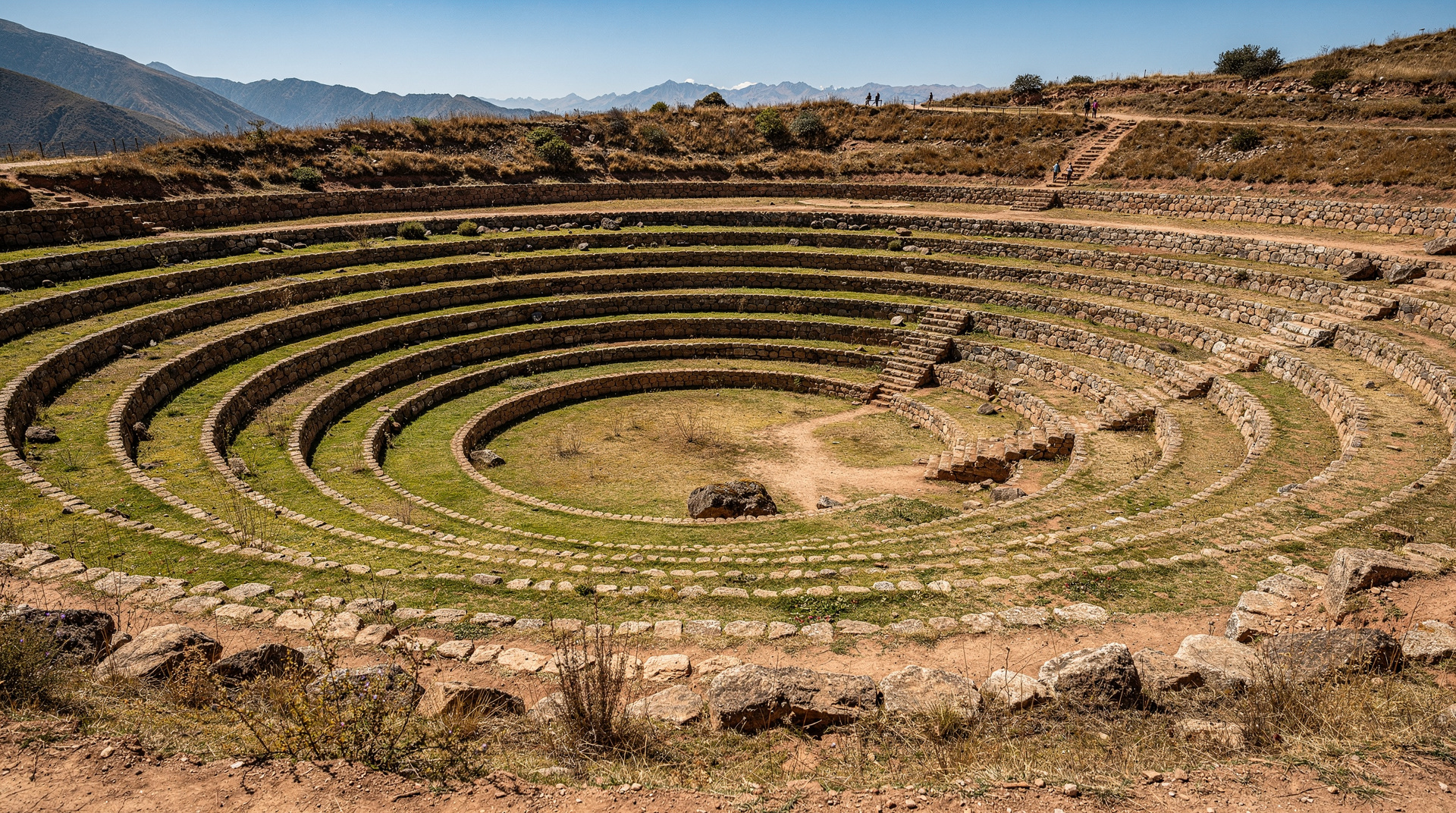
Three sets of concentric circular terraces have been cut into natural depressions on the Chinchero plateau, the largest dropping roughly 30 m from rim to centre. The depth of the rings creates distinct microclimates: research has measured temperature differentials of up to 15°C between the outermost and innermost rings of the main depression, with each ring representing a slightly different growing environment.
The most widely accepted interpretation is that Moray was an agricultural research station — a place where the Inca tested the growth conditions of different crop varieties across a compressed range of climatic zones, effectively simulating multiple altitude environments in one location. Whether or not this is the complete explanation, Moray provides a kind of intellectual engagement that differs from the military and ceremonial sites that dominate most Inca itineraries. The question it poses — what were these for? — sits with you in a way that purely aesthetic sites do not. Admission is covered by the Boleto Turístico. Allow 30–45 minutes on site.
Ollantaytambo: the fortress the Spanish could not take
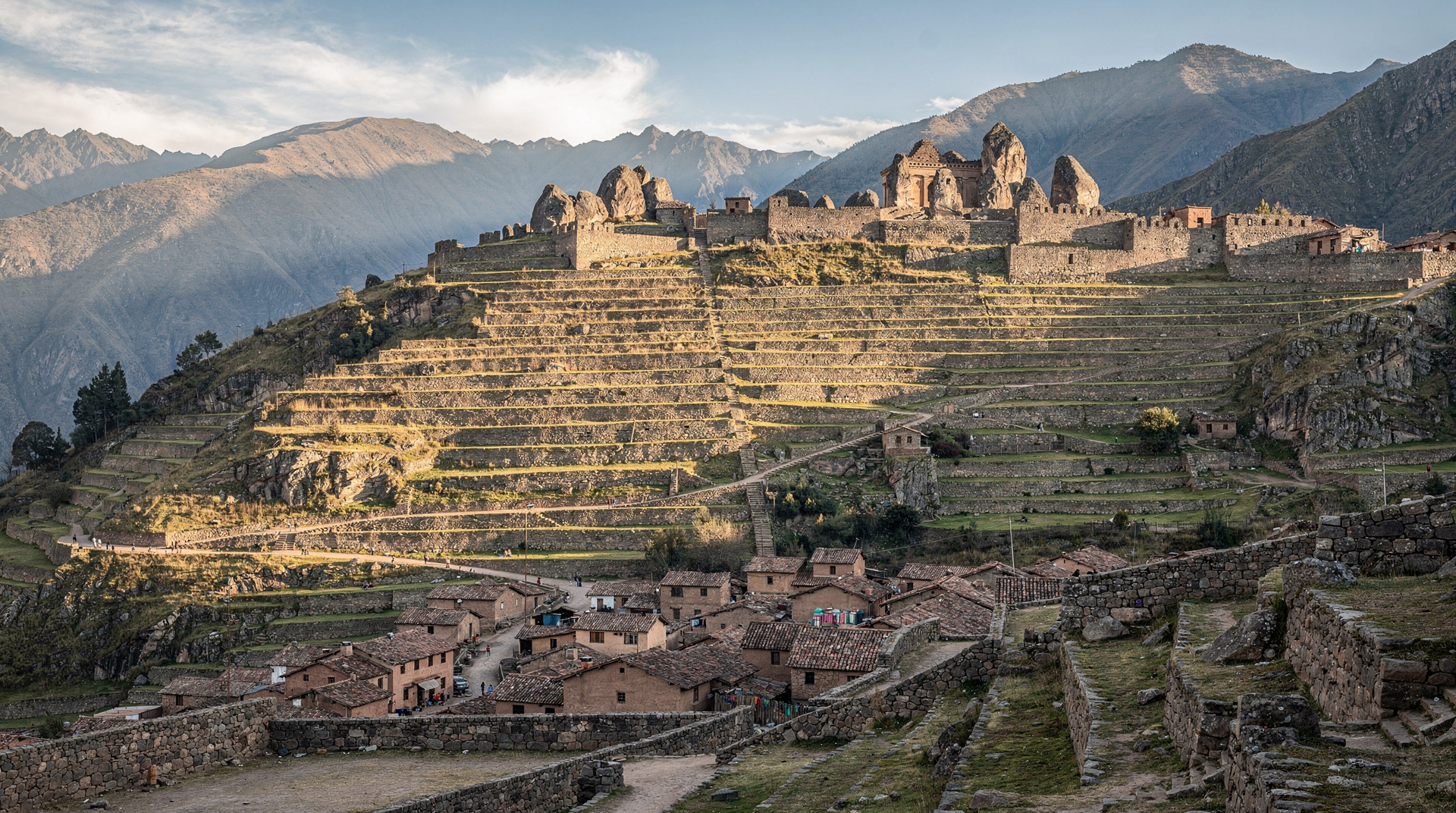
Ollantaytambo marks the valley’s western end, where the Urubamba gorge narrows and the surrounding mountains close in dramatically. The fortress above the town is significant for a specific historical reason: in 1537, Hernando Pizarro led an assault on the site and was driven back, one of the very few Spanish military defeats during the conquest of Peru. Manco Inca’s defenders used the geography of the gorge and the terraced walls of the fortress to repel a cavalry charge that had proved unstoppable almost everywhere else.
The Temple of the Sun on the upper platform contains six monolithic pink granite blocks, each estimated at around 50 tonnes, transported from a quarry visible across the gorge on the opposite hillside. The mechanics of moving 50-tonne stones across a river and up a steep hillside without wheeled vehicles or draft animals capable of bearing such loads remains an active subject of archaeological inquiry. Whatever the method, the physical fact of those six blocks assembled into a precise wall is one of the most impressive things you will see in the Inca world.
Below the fortress, the town preserves its original Inca street plan. Canchas — rectangular compounds each containing several houses sharing a central courtyard — still function as family housing arranged in a layout that has not fundamentally changed in 600 years. Walking these alleys, with an Inca water channel running along the street edge and the fortress terraces visible above the roofline, is as close as any site in Peru comes to inhabiting the Inca world rather than observing it.
For most itineraries, Ollantaytambo is also the departure point for the train to Aguas Calientes and Machu Picchu. Both PeruRail and Inca Rail run services from the station — a ten-minute walk from the town centre. Round-trip fares from Ollantaytambo to Aguas Calientes run approximately $60–130 depending on service class and season. Book several weeks ahead for June–August travel; trains sell out entirely. The Machu Picchu train tickets guide covers booking strategy, price tiers and service comparison in detail.
How to visit: guided tour versus going independently
Full-day group tour from Cusco
The most popular option is a guided loop by minibus covering Pisac market, Chinchero, Maras, Moray and Ollantaytambo in a single day. A full-day Sacred Valley tour from Cusco typically includes transport, a bilingual guide and entrance fees, making it good value for the logistical convenience alone — public transport between the plateau sites is slow and unreliable. The pace is brisk (45–90 minutes per stop), which works well for a first overview. You will leave having seen all the main sites with enough context to understand what you are looking at.
For a more in-depth experience, a private VIP Sacred Valley tour allows you to set the pace and linger at whichever sites interest you most. The premium is justified if you have a particular interest in Inca engineering, want extra time at Moray, or prefer unhurried access to the Pisac ruins rather than the market. Private tours also give you more flexibility to skip a site that interests you less and add time elsewhere.
If your specific interest is the Pisac-to-Maras-to-Moray circuit with guide expertise throughout, a Pisac, Maras and Moray combination tour covers those three sites in depth, often with a traditional lunch in a local family home included. The bilingual commentary at Moray, in particular, transforms the site from a visually interesting puzzle into a coherent explanation of Inca agricultural ambition.
Self-guided with collectivos
Collectivos (shared minibuses) run frequently between Cusco and Pisac (~S/5, 45 minutes) from Calle Puputi near the Tullumayu bridge. From Pisac onwards, a second collectivo to Urubamba (~S/3–4, 30 minutes) connects with further services to Ollantaytambo (~S/3–4, 30 minutes more). Taxis between specific sites cost S/20–50 per journey depending on distance. This is a feasible and economical approach for the Pisac–Urubamba–Ollantaytambo axis.
The complication is the plateau. Getting from the valley floor to Chinchero, Maras and Moray without a private vehicle requires either hiring a taxi from Urubamba (~S/80–120 for the Maras–Moray circuit with waiting time) or taking a collectivo to Chinchero and attempting to find further transport on the plateau — where taxis are sparse. For a one-day visit covering all five sites, a guided tour or private driver solves this problem more reliably than collectivos.
Where to sleep in the valley
Staying overnight in the valley at 2,800–3,000 m is one of the most straightforward altitude-management decisions available to travellers arriving from sea level. The physiological benefit — sleeping at a lower altitude while your body adjusts — is real, well-documented and translates directly into better sleep quality and more energy in the mornings that follow.
Urubamba has the widest accommodation range: budget guesthouses from S/60 per night, mid-range hotels from S/150, and two luxury ecolodge properties (Explora Valle Sagrado, Hacienda del Valle) at $500+ per night. Ollantaytambo’s guesthouses (S/80–200) put you five minutes’ walk from the train station — the ideal arrangement if you are catching an early train to Machu Picchu. Several properties in Ollantaytambo occupy converted Inca-period buildings with original stonework walls. Pisac has several boutique options on the edge of the town with clear valley views.
The Sacred Valley versus Cusco base comparison guide works through the decision in detail for different trip lengths. The 7-day Sacred Valley and Machu Picchu itinerary shows how to sequence valley nights within a comprehensive itinerary. The 4-day Cusco and Machu Picchu itinerary uses a single Ollantaytambo night before the Machu Picchu day — the minimum effective use of the valley-sleep advantage.
Best time to visit the Sacred Valley
May–September is dry, sunny and the busiest period. The Pisac Sunday market is at its most atmospheric in June and July, when day length is longest and the surrounding hills are golden-dry. April and October offer nearly comparable weather with meaningfully thinner crowds and lower accommodation prices. November–March brings the rainy season — typically afternoon downpours rather than all-day drizzle — and significantly lower hotel prices across the valley. The wet-season landscape is green and vivid; the salt pans are active year-round; and Moray surrounded by green grass rather than brown scrub is arguably more beautiful. Visitor numbers in January and February are low enough that you can have Ollantaytambo fortress almost to yourself.
The altitude sickness guide covers seasonal aspects of altitude management and is worth reading before any visit to the region regardless of when you are travelling.
Practical notes
Boleto Turístico: Buy it at COSITUC (Av. El Sol 103, Cusco) or at the covered sites — full circuit ~S/130, Sacred Valley partial ~S/70. Carry your passport with it; sites sometimes request photo ID.
Maras admission: S/10 cash at the gate, separate from the Boleto. Bring small notes; the cooperative entrance does not always have change.
Cash throughout: Card readers exist at some restaurants and accommodation in the valley but cannot be relied upon. Carry Peruvian soles (S/) for transport, market purchases, site fees and meals. ATMs exist in Urubamba and Pisac but run out of cash in peak season.
Altitude-appropriate clothing: Sunscreen and a sun hat are non-negotiable at 3,000 m — UV intensity at this altitude is severe regardless of cloud cover. A light waterproof layer and a fleece are useful from Chinchero upward. Comfortable shoes with grip are needed for the Pisac ruins ridge walk and the uneven surfaces at Ollantaytambo.
Drinking water: Carry at least 1.5 litres per person. There is nowhere to buy water at Moray, and dehydration at altitude accelerates headaches. Most valley restaurants provide safe filtered or bottled water.
The Sacred Valley is not a warm-up act for Machu Picchu. It is a destination with an independent cultural depth that rewards every additional hour you give it. The one-day Sacred Valley itinerary shows how to cover all five main sites in a single well-organised day if time is limited.
Food in the valley: what to actually order
The Sacred Valley’s restaurants, particularly in Urubamba and around Ollantaytambo, serve a genuinely good version of Andean cuisine that is often better and cheaper than the equivalent dishes in Cusco’s more tourist-facing restaurants. Trucha (trout, farmed in the cold Urubamba tributaries) appears on nearly every menu and is reliably fresh; a simple trucha a la plancha with a side of Andean potatoes is a safe, satisfying order almost anywhere in the valley. Cuy (guinea pig), if you want to try it, is more genuinely traditional in valley villages than in city-centre restaurants oriented toward visitors — ask your guide or hotel for a recommendation rather than the first cuy sign you see, since quality varies considerably.
Quinoa soup (sopa de quinua) is a reliable, warming lunch option that also happens to be a genuinely traditional Andean dish rather than a modern health-food invention. Chicha morada (a sweet, non-alcoholic purple corn drink) and chicha de jora (its fermented, mildly alcoholic cousin, traditionally brewed and served in rural communities) are both worth trying at least once, ideally at a smaller local restaurant rather than a large tour-bus stop where quality and authenticity both tend to decline.
Photography through the valley
Each of the five main sites offers a distinct photographic character worth planning around rather than treating identically. Pisac’s ridge-top ruins are best photographed in early morning light, when the terracing casts long shadows that emphasise its scale; the market itself photographs best candidly rather than posed, and always with permission if individuals are the subject. Maras’s salt pans are strongly directional — early morning or late afternoon low-angle light brings out the crystalline texture that flat midday sun flattens entirely.
Moray’s concentric terraces work well from the rim looking down, ideally with a person somewhere in the frame for scale, since photographs without a scale reference can make the site’s remarkable depth difficult to read. Ollantaytambo’s fortress, with its six monolithic blocks, is dramatic in the low golden light of late afternoon, when the pink granite takes on a warmer tone than it shows at midday. Across all five sites, a wide-angle lens or phone ultra-wide setting captures the landscape context better than a standard focal length, given how much of the valley’s appeal is the relationship between the ruins and the surrounding mountains.
Off-the-beaten-path options beyond the five main sites
Visitors who have already covered Pisac, Chinchero, Maras, Moray and Ollantaytambo — or who simply want to avoid the coach-tour circuit entirely — have several genuine alternatives within the valley. Huchuy Qosqo, a lesser-visited Inca site above the town of Lamay, requires a half-day hike or horseback ride but rewards the effort with a genuinely quiet ruin and sweeping valley views without another tour group in sight. The Lares valley, north of the main Sacred Valley road, offers hot springs, weaving communities that receive a fraction of Chinchero’s visitor numbers, and a multi-day trekking route as an alternative to the crowded Inca Trail corridor.
The South Valley sites — Tipón and Pikillacta — sit in the opposite direction from Cusco and combine Inca agricultural terracing with pre-Inca Wari ruins, visited by a small fraction of the Sacred Valley’s typical daily crowds. None of these require abandoning the classic circuit; they work well as a second or third day for visitors who want depth beyond the standard itinerary.
Weather and what to expect month by month
| Months | Conditions | Crowd level | Notes |
|---|---|---|---|
| May–Sep | Dry, sunny, cold nights | Highest (Jun–Aug peak) | Best photography and trail conditions |
| Apr, Oct | Largely dry, occasional showers | Moderate | Good value, thinner crowds |
| Nov–Dec | Building rains, afternoon showers | Moderate-low | Green landscape, lower hotel prices |
| Jan–Mar | Heaviest rain, some road disruption | Lowest | Cheapest, quietest, but wettest |
Combining the valley with Machu Picchu logistics
For most itineraries, the Sacred Valley is not a side trip but the logistical gateway to Machu Picchu, and planning the two together saves real time and expense. Basing yourself in Ollantaytambo for one or two nights before boarding an early train to Aguas Calientes avoids the alternative of a very early departure from Cusco itself, and lets you see Ollantaytambo’s fortress properly rather than rushing through it on the way to the station.
Booking train tickets well in advance matters more than almost any other logistics decision in a Cusco trip — the Machu Picchu train tickets guide covers the booking window and price tiers in detail, and the 4-day Cusco and Machu Picchu itinerary shows exactly how the valley night and the train departure fit together in practice.
Frequently asked questions about Sacred Valley complete guide: Pisac, Maras, Moray and Ollantaytambo
Do I need the Boleto Turístico to visit Sacred Valley sites?
Is it worth sleeping in the Sacred Valley rather than Cusco?
What is the best day to visit Pisac market?
How far is the Sacred Valley from Cusco?
Can I do the Sacred Valley and Machu Picchu in two days?
Is the Sacred Valley suitable for children?
Top experiences
Bookable activities with verified prices and instant confirmation on GetYourGuide.