Buying train tickets to Machu Picchu: the complete 2026 guide
Excursion to Machu Picchu + Huayna Picchu Mountain
How do I buy train tickets to Machu Picchu?
Book directly through PeruRail (perurail.com) or Inca Rail (incarail.com). Trains run from Ollantaytambo (most convenient from the Sacred Valley, ~1 hr 50 min to Aguas Calientes) and Poroy/Cusco (~3 hrs). Round-trip Expedition class from Ollantaytambo ~$60–70; Vistadome ~$90–120. Book 3–4 weeks ahead minimum in May–August — trains sell out. Never buy from third-party websites.
Two bookings that must be coordinated
| From | Ollantaytambo (~1h50, recommended) or Poroy/Cusco (~3–3.5h) |
| Cost | around $58–72 round trip, Expedition class, from Ollantaytambo |
| Book by | 4–6 weeks ahead June–August; 1–2 weeks Oct–March |
| Operators | PeruRail (perurail.com) and Inca Rail (incarail.com) — check both |
| Buy from | official sites only, never third-party ticket resellers |
Getting to Machu Picchu by train requires two separate bookings that must fit together: your Machu Picchu entry ticket (with a specific date and entry time slot, purchased at tuboleto.cultura.pe) and your train ticket (with a departure time that gets you to Aguas Calientes in time for that entry slot). The most common planning mistake is booking these independently without coordinating the timing — arriving at the site entrance 30 minutes after your entry slot began, or discovering your train arrives too late to reach the 9 am entry slot you booked six weeks ago.
The coordination rule is simple: book your Machu Picchu entry first, then book the train that gets you to Aguas Calientes at least 60–90 minutes before your entry time. This accounts for the 20-minute bus ride from Aguas Calientes to the site entrance, the bus queue (which can take 20–30 minutes in peak season) and a short walk from the bus drop-off to the main gate.
The two train operators
Two private companies run train services on the narrow-gauge railway between the Sacred Valley and Aguas Calientes. They use the same track and serve the same stations, but maintain entirely separate booking systems, have independent inventory, and should both be checked when availability is tight.
PeruRail
Website: perurail.com Cusco office: Av. El Sol 611 (near the COSITUC Boleto Turístico office), open daily approximately 6 am–8 pm
PeruRail is the larger and older operator, running the Cusco–Machu Picchu route since 2003. It offers four main service classes:
Expedition: Basic but entirely comfortable. Padded seats, panoramic side windows, a light snack and soft drink included. The most popular choice for independent travellers looking for the best value on the route. Round-trip from Ollantaytambo: approximately S/215–265 (~$58–72 USD) depending on season.
Vistadome: Panoramic windows extending into the roof section, better seats, a light meal and live entertainment (typically a brief fashion show of traditional Andean textiles on some services, accompanied by panpipe music). The panoramic roof is worth the price premium on this visually spectacular section of railway. Round-trip from Ollantaytambo: approximately S/330–450 (~$90–120 USD).
Vistadome Observatory: PeruRail’s premium mid-tier with full glass roof panels, wider seats and an upgraded meal service. Round-trip from Ollantaytambo: approximately S/475–590 (~$130–160 USD).
Hiram Bingham (Belmond): PeruRail’s luxury Orient Express-branded service. Full dining carriage, bar car, live music, guided Machu Picchu visit included in the fare. Departs from Poroy station (30 minutes from central Cusco) rather than Ollantaytambo. Approximately $450+ per person round trip. Reserved for travellers who want the train journey to be a significant experience in itself rather than a means of getting to the site.
Inca Rail
Website: incarail.com Cusco office: Portal de Panes 105, Plaza de Armas (ground floor, next to Hotel Ruinas), open daily approximately 7 am–9 pm
Inca Rail is the independent competitor, launched in 2010. Service quality is comparable to PeruRail equivalents, and the company has a strong reputation. Services from Ollantaytambo:
Explorer: Entry-level, comparable in price and comfort to PeruRail Expedition.
Voyager: Mid-tier with panoramic windows and a meal service, comparable to Vistadome.
The 360°: Inca Rail’s premium open-roof panoramic carriage. Similar price to PeruRail Vistadome Observatory.
The Private (First Class): Small-group or exclusive carriages for premium pricing.
The two operators’ fares are broadly similar for equivalent service levels. The practical recommendation: check both when booking. If PeruRail shows a sold-out departure, Inca Rail may have availability for the same time, and vice versa. Checking both websites is the fastest way to find remaining inventory.
Departure points
Ollantaytambo (recommended for most travellers)
Ollantaytambo station is a flat 10-minute walk from the Plaza de Armas through the town. Trains depart from approximately 5:45 am through 5:30 pm in both directions. The journey to Aguas Calientes takes approximately 1 hour 45 minutes to 2 hours 10 minutes depending on service.
The case for departing from Ollantaytambo is compelling. Spending the previous night in Ollantaytambo puts you five minutes from the station and lets you catch the early trains without a 3 am alarm. Ollantaytambo sits at 2,792 m — lower than Cusco — and the night there helps with acclimatisation (see the Ollantaytambo village guide for accommodation). The morning trains from Ollantaytambo are the ones that give you the most time at Machu Picchu before early afternoon crowds build.
Poroy station / Cusco
Poroy station is 15 km from central Cusco, requiring a taxi (~S/30–40, 30 minutes) or a shared shuttle. Some PeruRail services run directly from Cusco’s San Pedro station or Cusco’s Wanchaq station on certain itineraries — check the PeruRail website for current routing. Journey time from Poroy to Aguas Calientes is approximately 3–3.5 hours, passing through Ollantaytambo en route.
Poroy departures are most practical when you are firmly based in Cusco city and cannot or do not want to travel to Ollantaytambo the night before. For early morning trains (before 7 am from Poroy) you need to leave central Cusco at 5:30–6 am — not impossible, but requiring a pre-booked taxi and an early wake-up. The Sacred Valley versus Cusco base guide explains why Ollantaytambo is usually the better overnight choice.
Prices in 2026
Approximate fares in USD (mid-2026, before peak-season increases):
| Service | Round trip from Ollantaytambo | One way |
|---|---|---|
| PeruRail Expedition | $58–72 | $30–38 |
| PeruRail Vistadome | $90–120 | $48–62 |
| PeruRail Vistadome Observatory | $130–160 | $68–85 |
| Inca Rail Explorer | $60–75 | $32–40 |
| Inca Rail Voyager | $90–110 | $48–58 |
In Peruvian soles (S/), at approximately S/3.75 per USD in mid-2026: the Expedition round trip runs approximately S/215–270. Prices are quoted in USD on both operators’ websites; you can pay in either currency.
Prices in June–August are typically 10–25% higher than the figures above due to peak demand. Check current fares directly on the operators’ websites when booking — prices are dynamic and change seasonally.
When to book: the realistic timeline
June–August (peak season): Book 4–6 weeks ahead for standard services. Huayna Picchu entry holders need a 6–7 am Ollantaytambo departure; these sell out first and fastest. Book immediately when travel dates are confirmed.
April–May and September: 2–4 weeks ahead is typically sufficient for most departure times, though early mornings on popular dates can sell out earlier.
October–March (including Inca Trail closure in February): 1–2 weeks ahead is usually adequate. Some February dates near Carnival have unusual demand — check earlier in this period.
Both operators release cancelled tickets back into inventory periodically. If your target date shows sold out, check both websites again over the following days — new availability appears regularly up to about 72 hours before departure.
Choosing between PeruRail and Inca Rail when both have availability
When both operators show open seats for your target time, the decision usually comes down to small differences rather than a clear winner. PeruRail has the larger network and slightly more frequent departures; Inca Rail’s 360° carriage is a close equivalent to Vistadome at a comparable price and sometimes has better availability in shoulder season.
Neither operator has a meaningfully different safety or reliability record — both run the same narrow-gauge track and are subject to the same occasional weather delays. If price and time are equal, check which platform’s confirmation email and app you find easier to navigate; some travellers simply prefer one operator’s booking interface over the other’s, and that is a perfectly reasonable tiebreaker for what is otherwise a near-identical product.
The booking process
Go to perurail.com or incarail.com. Select route (Ollantaytambo to Aguas Calientes or Cusco to Aguas Calientes), travel date, service class and number of passengers. Enter passenger names as they appear in passports. Pay by Visa or Mastercard. Confirmation arrives by email with a PDF ticket containing a QR code.
No printing required — the QR code on your phone or printed PDF is scanned at the station gate. Both operators have mobile apps that store tickets. Keep the email confirmation accessible without relying on connectivity, since the Aguas Calientes station area can have unreliable mobile signal.
Do not book through third-party train ticket websites, regardless of how professional they appear. PeruRail and Inca Rail do not sell through authorised third-party agents for individual tickets. Any website offering train tickets is either accessing the same inventory at a markup (meaning you overpay) or selling fake confirmations. Book directly. See the train ticket scams guide for specific patterns to avoid.
What to expect on the journey
The Ollantaytambo-to-Aguas Calientes journey descends from 2,792 m to approximately 2,040 m as the Urubamba gorge narrows and the cloud forest closes in. Vegetation changes noticeably over the 90-minute journey: from the dry-scrub Andean hillsides visible from Ollantaytambo station, through transitional vegetation, to dense cloud forest arriving at Aguas Calientes. On the Vistadome and Observatory services, the roof and extended windows make the landscape transformation the highlight of the journey.
The light snack service on the Expedition (soft drink and biscuits) and the full meal on the Vistadome run approximately halfway through the journey. Coca tea is standard on all services — both a traditional Andean remedy for altitude discomfort and a genuinely pleasant hot drink. The cabin temperature is managed; the main variation is on exposed platform sections when boarding or alighting.
Luggage: PeruRail allows one backpack up to 8 kg (100 cm, height + length + width) or one carry-on up to 12 kg (115 cm); Inca Rail allows one piece up to 8 kg (118 cm). Oversized luggage imposes on other passengers in the narrow carriages. Leave your main bag at your hotel in Ollantaytambo or Cusco; take only what you need for the day.
The return journey and booking it
Return trains from Aguas Calientes to Ollantaytambo run through the afternoon and evening, with the final service typically around 9–9:30 pm. Book your return at the same time as your outward journey — both operators allow round-trip booking in a single transaction and the return slot is part of the same inventory pressure as the outward leg.
A confirmed round-trip train booking is the foundation of a smooth Machu Picchu day. If you change your plans and want to take a different return train, changes are possible at the station in Aguas Calientes subject to availability and a fee.
A full Machu Picchu day trip by train from Cusco, with return transport and site admission combined into one booking, is the right format for travellers who want everything coordinated in advance without managing the three-step process (Machu Picchu ticket + train outward + train return) separately.
If trains are genuinely sold out
Check both operators. PeruRail selling out on a date does not mean Inca Rail is full; their inventories are separate.
Try different times. The 7 am Ollantaytambo departure is the most popular slot. The 9 am or 10 am departure may have availability while early departures are full.
Wait for cancellations. Check daily from 60 days ahead. Both operators process cancellations regularly; the most common release time is when group booking holds expire, typically 60–90 days before departure.
Consider the Hidroeléctrica route. A bus from Cusco or Santa Teresa to the Hidroeléctrica trailhead, followed by a 10 km walk along the former railway line to Aguas Calientes, takes 5–6 hours total and costs approximately S/60–80 per person in transport. It requires no train booking and is the backup option for peak-season sold-out situations. It is not comfortable compared to the train, but it reaches Aguas Calientes.
The 4-day Cusco and Machu Picchu itinerary and the 7-day comprehensive itinerary both use Ollantaytambo as the train departure point and budget the correct coordination time between train arrival in Aguas Calientes and Machu Picchu site entry.
Aguas Calientes: what to expect between train and site
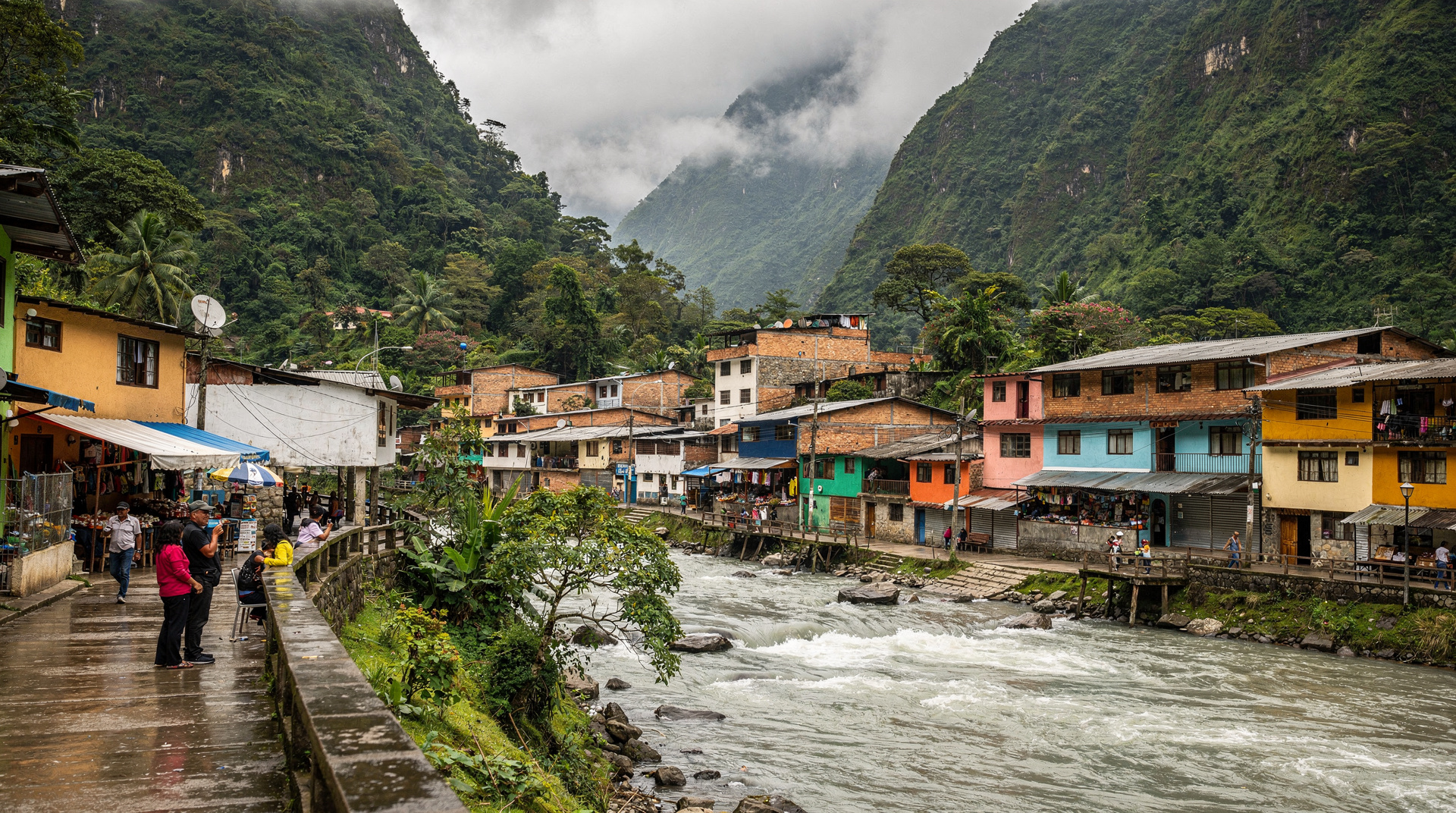
Aguas Calientes (officially Machu Picchu Pueblo) is the sole access town for the Machu Picchu site and the only place to spend a night near the citadel. It sits at approximately 2,040 m in a narrow valley where the train track ends and the switchback bus road begins. The town has hot springs (the name means “hot waters”), a lively restaurant scene concentrated on the main pedestrian street (Av. Imperio de los Incas), a local craft market, and accommodation ranging from S/80 budget guesthouses to the Sumaq Machu Picchu Hotel ($400+).
Arriving from Ollantaytambo, you exit the train at the station in the centre of town. The Consettur bus departure area is approximately 200 m away along the main road. The bus ride up the switchback road takes 20 minutes and costs approximately S/57 ($15–16 USD) one way. The first buses leave from 5:30 am; queues at peak season form from 4:30–5 am. Buy your bus ticket at the Consettur kiosk — no advance online purchase exists.
If you are making a single-day visit without overnight stay in Aguas Calientes, you typically: arrive by train in the morning, take the bus directly to the site, spend 4–6 hours at Machu Picchu, take the bus back down, have lunch in Aguas Calientes, and board your return train in the afternoon or evening. The one-day Machu Picchu day trip guide covers this sequence in full.
Luggage, pets and special assistance
Both operators limit hand luggage — PeruRail to one backpack up to 8 kg or one carry-on up to 12 kg, Inca Rail to one piece up to 8 kg — and the narrow aisle and limited space in each carriage mean oversized suitcases genuinely inconvenience other passengers. Leave large bags at your Cusco or Ollantaytambo hotel and travel with a daypack for the Machu Picchu day itself. Neither operator carries pets in the passenger cabin. Wheelchair users and travellers with reduced mobility should contact PeruRail or Inca Rail directly ahead of booking — assistance at Ollantaytambo and Aguas Calientes stations exists but needs advance notice, since platform-to-carriage transitions are not step-free on every service.
Booking mistakes that cost people their trip
The most expensive mistake in the whole Machu Picchu logistics chain is booking the train and the citadel entry independently without checking that the timings actually connect — a 10 am Ollantaytambo departure does nothing for a 7 am entry slot booked six weeks earlier on tuboleto.cultura.pe. The second most common mistake is assuming a same-day return is always comfortable: for visitors prone to early starts, the option of an overnight in Aguas Calientes (see below) removes far more stress than the marginal cost of a night’s accommodation. The Machu Picchu tickets explained guide should be read alongside this one before you book either component.
Staying overnight in Aguas Calientes
An overnight stay allows you to take the first bus (5:30 am) for sunrise conditions at the site before the main visitor surge. It also removes the time pressure of catching a specific return train the same evening. Many serious visitors to Machu Picchu prefer two days — the first afternoon and all of day two — over a single rushed visit.
The train schedule from Aguas Calientes to Ollantaytambo runs until approximately 9–9:30 pm, so returning to Ollantaytambo or Cusco on the evening of day two is practical. Book your return train for the evening of day two when making your original outward booking.
The train journey as an experience
The railway between Ollantaytambo and Aguas Calientes is one of the most scenic short train journeys in South America. The track descends steadily through the narrowing Urubamba gorge, losing nearly 800 m in altitude over approximately 50 km of rail. The vegetation changes continuously: from the dry-scrub Andean environment around Ollantaytambo station, through transitional polylepis woodland, to dense cloud forest with hanging moss and bromeliads at the lower altitudes near Aguas Calientes.
On the Vistadome services, extended roof windows make this change visible without craning. The sound changes too — the dry mountain air at Ollantaytambo gives way to the muffled, humid acoustic of cloud forest by the final 15 minutes. Arriving in Aguas Calientes after this descent feels like entering a different world from the high-Andean plateau you left that morning.
Frequently asked questions about Buying train tickets to Machu Picchu: the complete 2026
What is the cheapest train to Machu Picchu?
How long does the train from Ollantaytambo to Aguas Calientes take?
Is it better to take the train from Ollantaytambo or Poroy/Cusco?
What happens if trains are sold out?
Do I need to print my train ticket?
Is the Hiram Bingham luxury train worth it?
Top experiences
Bookable activities with verified prices and instant confirmation on GetYourGuide.