Is Cusco safe? Peru travel safety guide 2026
Cusco: Half-Day City Tour with Sacsayhuaman and Q’enco
Is Cusco safe for tourists?
Yes — Cusco is one of the safer major tourist cities in South America. The main risks are petty theft (pickpocketing, bag-snatching in crowded areas), scams targeting tourists at travel agencies and transport hubs, and altitude sickness. Violent crime against tourists is rare. The city centre and main tourist areas are well-traversed, relatively well-lit, and policed by both regular police and tourist police (POLTUR).
The honest safety picture
Every travel writer who has spent meaningful time in Cusco reports the same gap between perception and reality: many visitors arrive expecting a difficult, high-crime environment and find an active, well-managed city where the main risks are petty theft and altitude. The perception comes partly from generalised South America caution and partly from outdated travel information. The reality in 2026 is a city that handles several million tourists per year with a mature tourism infrastructure, dedicated tourist police (POLTUR), and a local population that has a significant economic interest in visitors having safe, positive experiences.
This guide does not minimise genuine risks. Petty theft is real. Scams targeting tourists are real. Altitude sickness is a genuine health consideration. What it does is put those risks in accurate proportion, describe where they concentrate, and give specific advice on avoiding them — rather than offering vague caution that leaves visitors more anxious and no better prepared.
| Where the risks concentrate | San Pedro Market approaches, bus terminal, Gringo Alley after midnight |
| Main risk types | Petty theft, tourist-targeted scams, altitude, not violent crime |
| Emergency numbers | Police 105, ambulance 116, POLTUR +51 84 249 654 |
| Best safeguard | Money belt, small daily cash, clearly marked or app-based taxis |
| Overall verdict | One of the safer major tourist cities in South America |
Petty theft: where it happens and how to avoid it
The San Pedro Market area: The market entrance on Calle Santa Clara and the immediately surrounding streets are the highest-density pickpocketing environment in Cusco. The market interior itself is usually fine; the crowded street approaches are where incidents concentrate. Keep bags in front, use a money belt for passport and excess cash, and do not hold your phone out when walking through the crowd.
The bus terminal (Terminal Terrestre): The area around the terminal has more bag-snatching activity than the tourist centre. If arriving by overnight bus, take a taxi from the terminal exit rather than walking to your accommodation with luggage. The taxi queue inside the terminal uses fixed rates; the unofficial touts outside do not.
Busy streets and tourist sites: Phone snatching — the device taken from your hand as you stand on a street — is increasingly reported on Avenida del Sol and around Plaza de Armas. Keep the phone pocketed when not actively using it. Phones have been snatched from café tables immediately adjacent to the street.
The effective countermeasures are mundane: A money belt worn under clothing for passport and primary cash. Small amounts (S/50–100) in a pocket for daily use. A bag that closes properly and sits in front of the body in crowded areas. An awareness of your surroundings in market areas that takes 20 minutes to develop and then becomes automatic. None of these interferes with enjoying Cusco; all of them significantly reduce exposure.
Scams: the main patterns
Fake Machu Picchu tickets. Street sellers, unofficial kiosks near Plaza de Armas, and some informal “travel agencies” sell counterfeit Machu Picchu tickets that look authentic and fail at the gate scanner. The loss is the face value of the ticket with no recourse. Book only through tuboleto.cultura.pe (the official Ministry of Culture portal) or a licensed agency with a physical address. The Machu Picchu tickets guide covers the legitimate booking process in detail.
Below-cost tour agencies. Agencies offering Inca Trail places at $400 when the legitimate market rate is $650–800 are not offering a discount — they are selling a substandard experience at best, or taking a deposit and disappearing at worst. The Inca Trail permit system makes outright fraud harder than it used to be (permits are registered to passports), but there are documented cases of agencies substituting cheaper, alternative routes after taking Inca Trail deposits. Check the Ministry of Culture’s licensed operator list and the South American Explorers Club recommendations.
“Helpful” strangers at the airport. People in the arrivals hall who offer to help with luggage or call a taxi are not working for a service — they will carry your bag a short distance and demand payment. Official taxi desks inside the terminal are the safe alternative; their rates are fixed and displayed.
The photo-with-llama or photo-with-dressed-local situation. People posing with llamas or in traditional dress near Plaza de Armas allow photographs and then demand significant payment (S/20–50) aggressively. The interaction is legal — you photographed someone who was present for that purpose — but unexpected for visitors who did not initiate it. The simple avoidance: do not photograph anyone posing for commercial purposes unless you have agreed a price in advance.
Currency exchange short-changing. Always count your change. Always. The technique of giving you a note back to “check it” and palming one is simple and still in use at informal exchange points. Use ATMs or established casas de cambio with a transaction receipt.
The tourist police (POLTUR)
Cusco has a dedicated tourism police force (POLTUR) with officers at Plaza de Armas, the main sites, and tourist-facing transport hubs. They are there specifically to assist tourists, speak varying levels of English, and can help with reporting incidents, directing to official services, and dealing with immediate safety concerns. Their presence in the historic centre is genuine and effective. Do not hesitate to approach them.
For reporting theft: the report (denuncia) is required for insurance claims. POLTUR can direct you to the relevant police station for a formal report; the process takes 1–2 hours and the document is the basis for any insurance claim.
Transport safety
Official vs unofficial taxis: Always use clearly marked, authorised taxis with company name, phone number, and registration number visible. App-based services (InDriver is the most widely used in Cusco) are a reliable alternative for bookings where you have data access. Unmarked private cars posing as taxis — “taxi pirata” — are the primary vehicle-related safety risk; they are most active outside bars late at night and near the bus terminal.
Colectivos to the Sacred Valley: The shared minibus services from Avenida Grau to Pisac, Ollantaytambo and the valley are used by tourists and locals alike and are generally safe. They can be crowded and luggage space is limited; keep bags with you rather than in the luggage hold on short journeys.
Night buses: Overnight buses from Cusco to Puno, Arequipa, and Lima are used by the majority of budget travellers in the region. The main safety consideration is luggage security in the hold — use a padlock on checked bags and keep valuables with you in the cabin. The Cruz del Sur and Ormeno premium services have better safety records and security procedures than the budget lines.
Altitude as a safety consideration
Altitude sickness is covered in depth in the altitude sickness guide. From a safety perspective, the key points:
Mild soroche is normal and not a safety issue. Headache, fatigue, and breathlessness in the first 24–48 hours in Cusco affects the majority of visitors. Rest, hydration, and over-the-counter pain relief handles it.
High-altitude pulmonary oedema (HAPE) and cerebral oedema (HACE) are serious. These rare conditions require immediate descent and medical attention. Warning signs: severe breathlessness at rest (not just on exertion), coughing up pink or frothy fluid, inability to walk in a straight line, confusion, or severe headache that does not respond to medication.
Rainbow Mountain at 5,200 m. The altitude of Rainbow Mountain Vinicunca is genuinely high — above the altitude at which altitude illness becomes more serious. Do not attempt this before day five in Cusco and only when genuinely acclimatised. A guided city tour on days two and three, staying at 3,400 m and building acclimatisation before any higher excursion, is the sensible approach.
Food and water safety
Water: Tap water in Cusco is not safe to drink for visitors not acclimated to the local bacteria. Use bottled or filtered water throughout — for drinking, cleaning teeth, and anything consumed raw (salads, fruit that has been washed). The altitude compounds the effects of traveller’s stomach; it is much easier to prevent than to manage.
Food safety: Restaurants in the tourist-facing areas of Cusco with good recent reviews are generally safe. The main risk is from street food and very cheap restaurants with no evident food hygiene practices — the price point is not a reliable safety indicator (the San Pedro Market set lunches are cheap and safe), but visibility of food preparation and recency of reviews are. Avoid raw shellfish and ceviche from very cheap street stalls.
Coca tea and coca products: Safe, legal in Peru, genuinely helpful for mild altitude symptoms. Coca leaves are not cocaine; the alkaloid content in tea or leaves is minimal and the effect is a mild stimulant similar to strong tea. Note that coca tea consumption can produce a positive result on a cocaine drug test — relevant if you are subject to workplace testing.
Night safety and the bar area
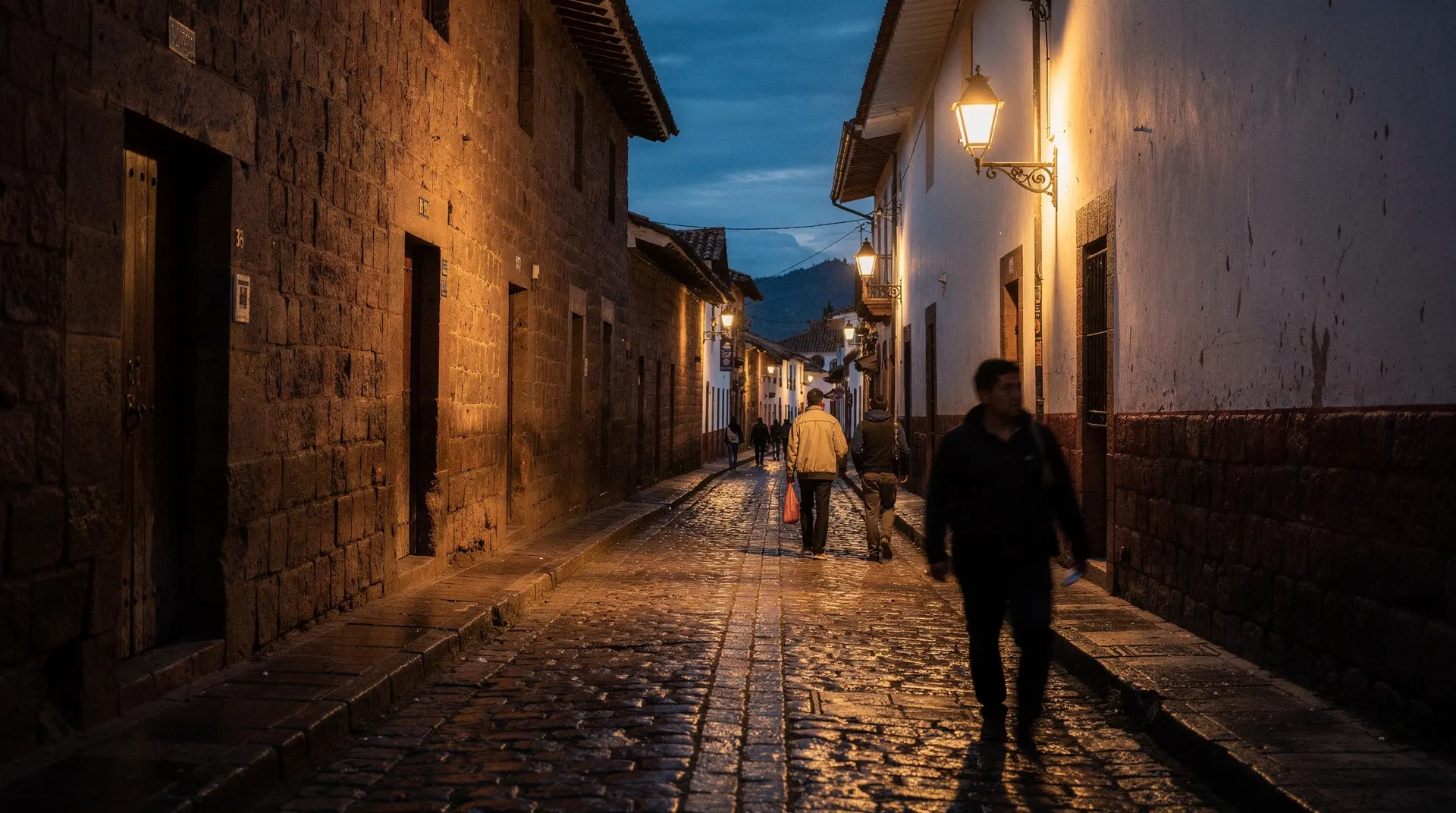
Cusco has a concentrated nightlife area along Calle Procuradores (known as Gringo Alley) and the surrounding streets, with bars, clubs, and live music venues catering primarily to tourists. For solo travellers in particular, this area carries specific risks after midnight: drink spiking, fake taxis waiting outside venues, and opportunistic bag theft.
The practical precautions that reduce risk significantly: go out with a group from your hostel rather than alone; drink from bottles or cans you open yourself; leave before midnight if your group has dispersed; use only clearly-marked taxis or pre-booked app rides to return. None of these require avoiding Cusco nightlife — they just require basic situational awareness. The bar area is generally safe until around 11 pm with moderate crowds; the risk profile increases as the night progresses and the crowd thins.
For anyone finding nightlife genuinely unappealing at altitude — which many visitors do, since alcohol hits harder above 3,000 m — the evenings in Cusco are excellent without bars. Evening concerts of traditional Andean music occur regularly at venues in the historic centre, often free or at S/20–30 admission. Restaurant evenings in San Blas or around Plaza Regocijo are pleasant, well-attended, and entirely without the nightlife crowd dynamics.
Solo travellers and specific traveller groups
Solo female travellers find Cusco generally comfortable with the same precautions recommended in any city: avoid unlit streets alone late at night, prefer app-based or clearly marked taxis after dark, and respond to unwanted attention from street vendors firmly rather than engaging at length. The solo travel guide covers accommodation choices, meeting other travellers, and specific neighbourhood advice in more depth than fits here.
Families with children face essentially the same risk profile as any visitors, with altitude the added consideration — children can develop symptoms faster and communicate them less clearly than adults. Keep a closer eye on energy levels and appetite in the first 48 hours than you might at home.
Older travellers or those with existing health conditions should discuss the trip with a doctor before departure specifically regarding altitude — cardiovascular and respiratory conditions interact with reduced oxygen availability in ways worth planning for rather than discovering in Cusco. Acetazolamide, if prescribed, should be started before arrival per your doctor’s guidance.
Travel insurance: what actually matters here
Standard travel insurance is not automatically sufficient for a Cusco trip. Confirm two things specifically before you travel: that your policy covers medical evacuation from altitude (a rapid descent by vehicle or helicopter for severe altitude illness is expensive without cover), and that any trek you plan — Inca Trail, Salkantay, Ausangate — is explicitly covered, since some standard policies exclude high-altitude trekking above a stated metre threshold by default. Read the policy wording rather than assuming “travel insurance” covers everything; this is the single most commonly overlooked safety preparation for the region.
Emergency contacts and practical resources
POLTUR (Tourist Police): Station at Portal de Harinas 180, Plaza de Armas, Cusco. Phone: +51 84 249 654. Open 24 hours for tourist assistance and crime reporting.
Clínica Pardo: Avenida de la Cultura 710, Cusco. The most frequently recommended private clinic for tourist medical needs including altitude illness. English spoken.
Emergency (police, ambulance, fire): 105 (police), 116 (ambulance) — Spanish-language services.
Your hotel or hostel: In the first instance for any medical concern or safety issue, contact accommodation staff. They have experience with the most common tourist problems and can facilitate faster assistance than navigating emergency services independently.
The South American Explorers Club maintains a Cusco office with up-to-date safety information, vetted tour operator recommendations, and support for members in emergencies.
The bottom line
Cusco is safe for the vast majority of visitors who apply straightforward urban travel common sense. The risks are real but concentrated, well-documented, and largely avoidable with preparation. The solo travel guide covers specific considerations for solo travellers. The Cusco trip planning guide covers all the logistics that sit alongside safety preparation. Arrive informed rather than anxious and the safety picture will look as it is: manageable.