Palccoyo — the quiet rainbow mountain most people walk straight past
Why I chose the one nobody was talking about
When I told people in my guesthouse that I was going to Palccoyo instead of Vinicunca, two of the three had never heard of it. The third had heard of it vaguely — “isn’t that the easier one?” — with the slight dismissiveness that the word “easier” sometimes carries in trekking conversations.
Yes, it’s easier. It’s also, in my view, better — or at least comparably beautiful with significant practical advantages. Let me make the case honestly.
| Where | 120 km southeast of Cusco, Andean altiplano |
| Cost | Around S/60–70 for a guided full-day tour |
| Time needed | Full day (about 3hrs drive each way + 2–3hr walk) |
| Getting there | Guided tour from Cusco (independent transport is impractical) |
| Best time | Dry season, May to September, for clear skies and firm trails |
Palccoyo is approximately 120 km south-east of Cusco, about 20 km further from the city than Vinicunca. The drive takes about three hours. The trailhead sits at around 4,900 m — already higher than any point on the Inca Trail — and the walk to the three coloured ridges that give it its character is a 3–4 km round trip with around 200 m of elevation gain. The summit at the end of the Palccoyo walk tops out at roughly 5,100 m.
Vinicunca’s trailhead, by comparison, is at around 4,700 m and the summit is at 5,200 m — a 450 m climb over about 7 km round trip. Both mountains are high. Palccoyo is not a gentle stroll. But the difference in elevation gain and walk length is genuinely significant, particularly for visitors who are still acclimatising.
What Palccoyo actually looks like
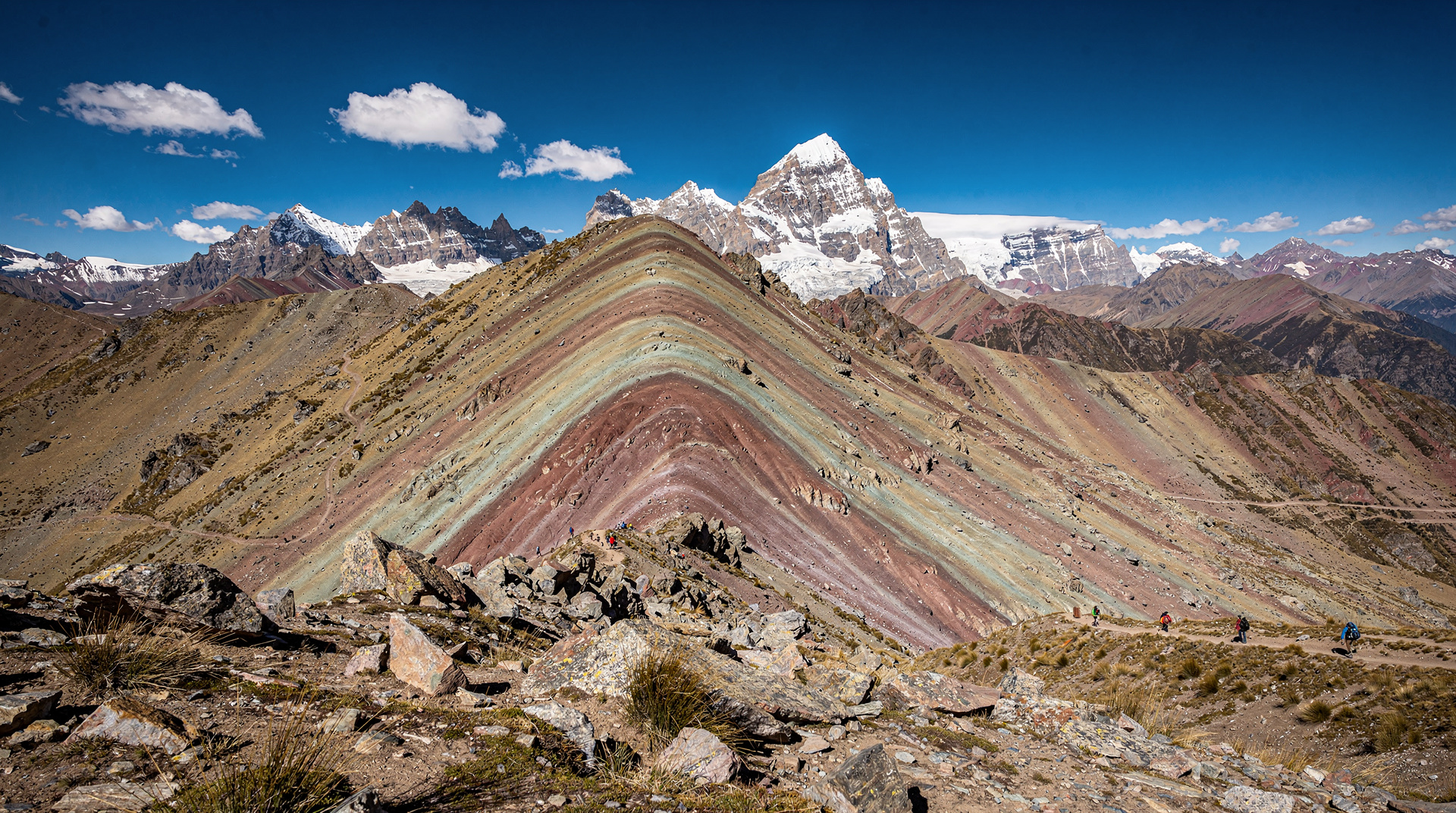
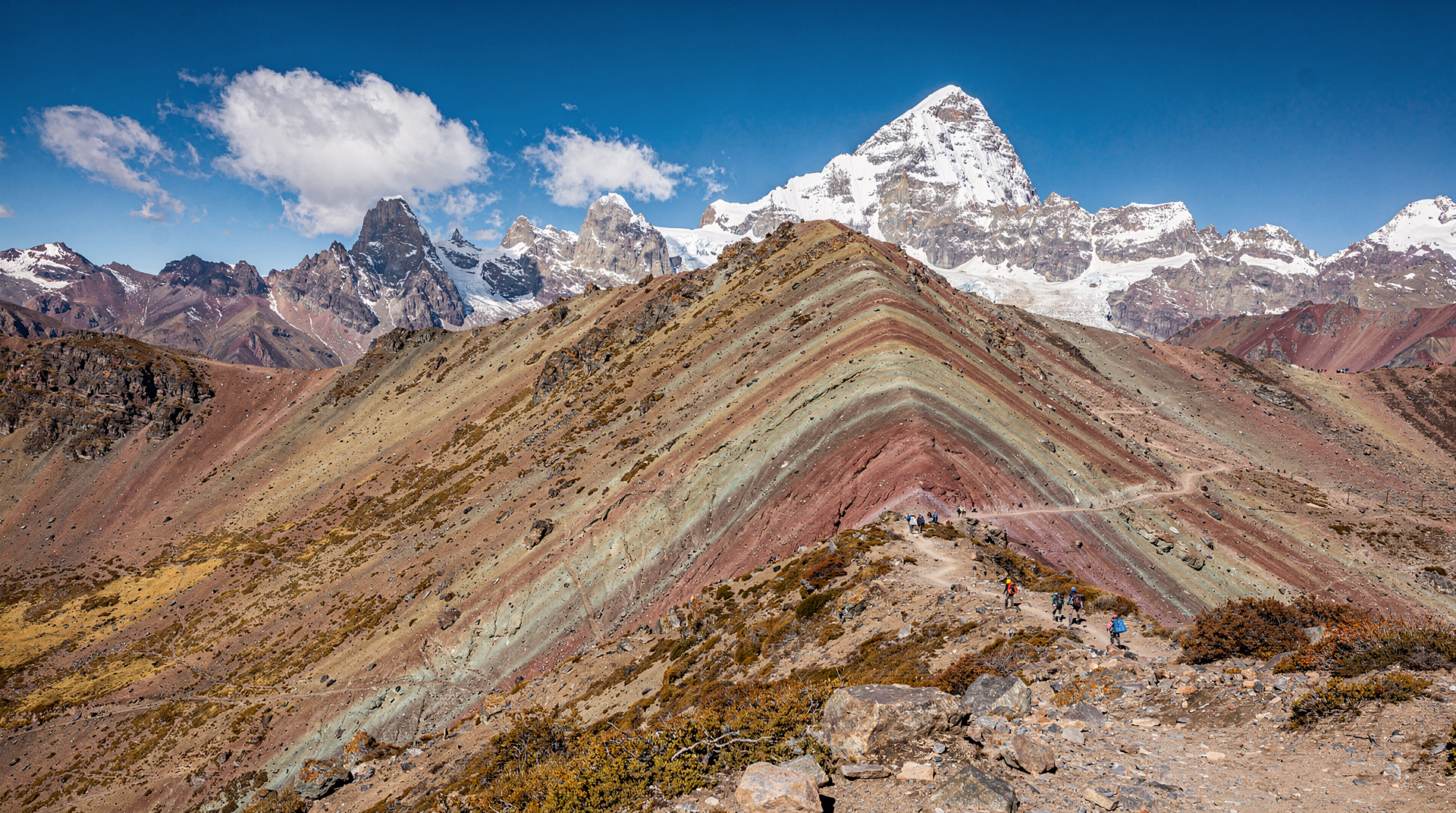
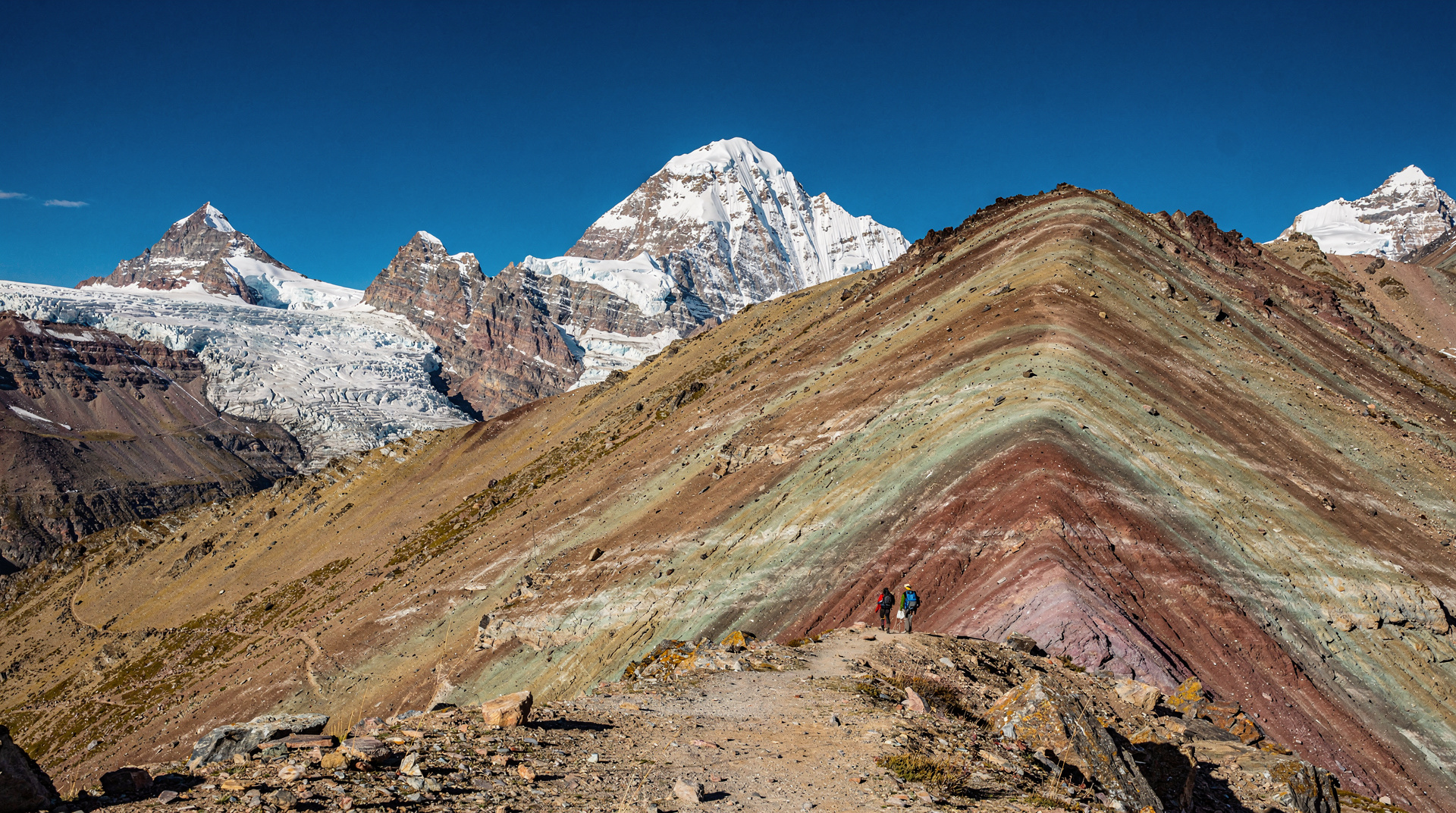
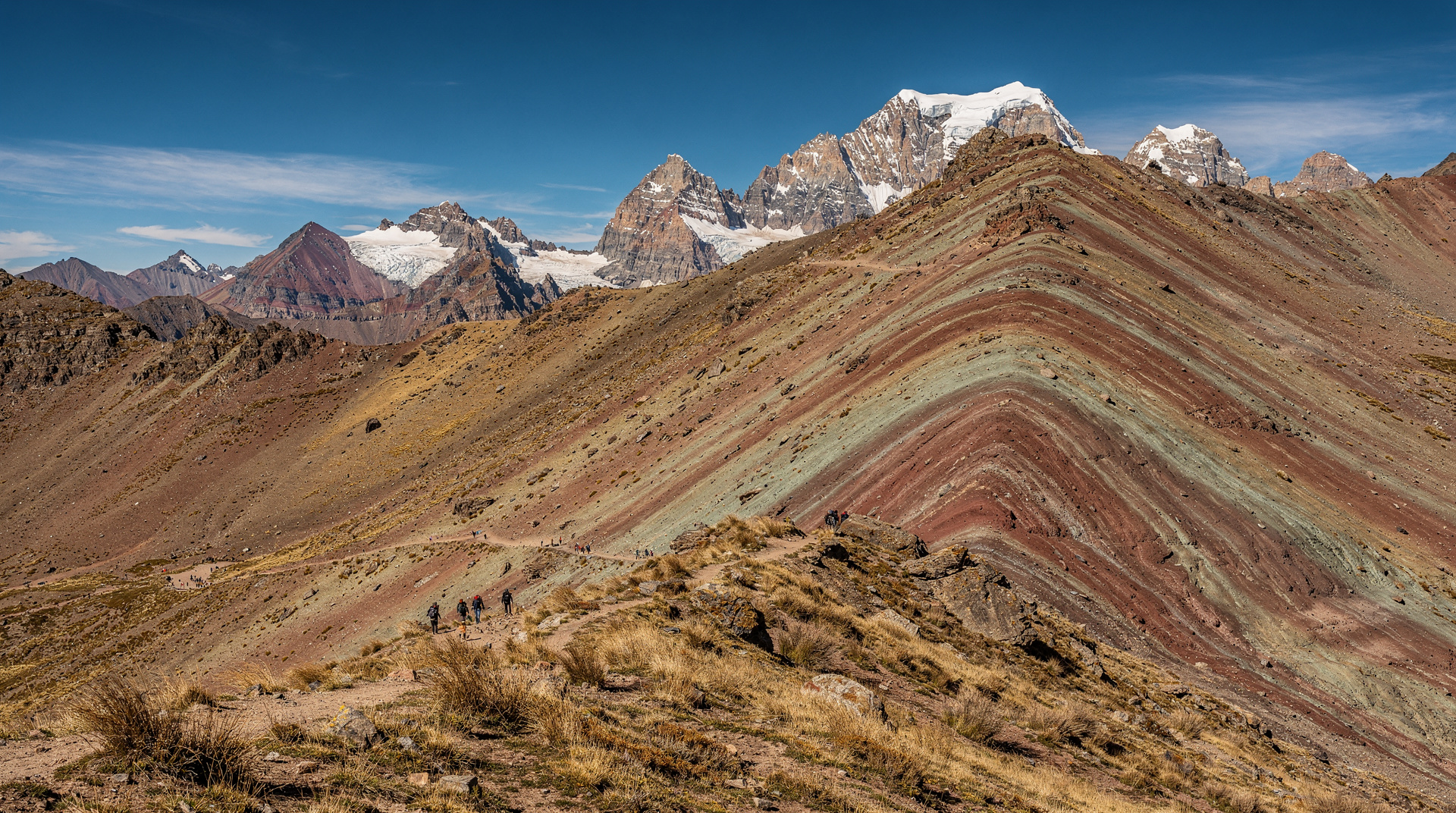
The colours at Palccoyo are different from what the Instagram images of Vinicunca suggest. Vinicunca is famous for its striped cone — a single dramatic peak with horizontal bands of red, yellow, green, purple and orange that look almost too vivid to be natural geology. It photographs like a geological illustration.
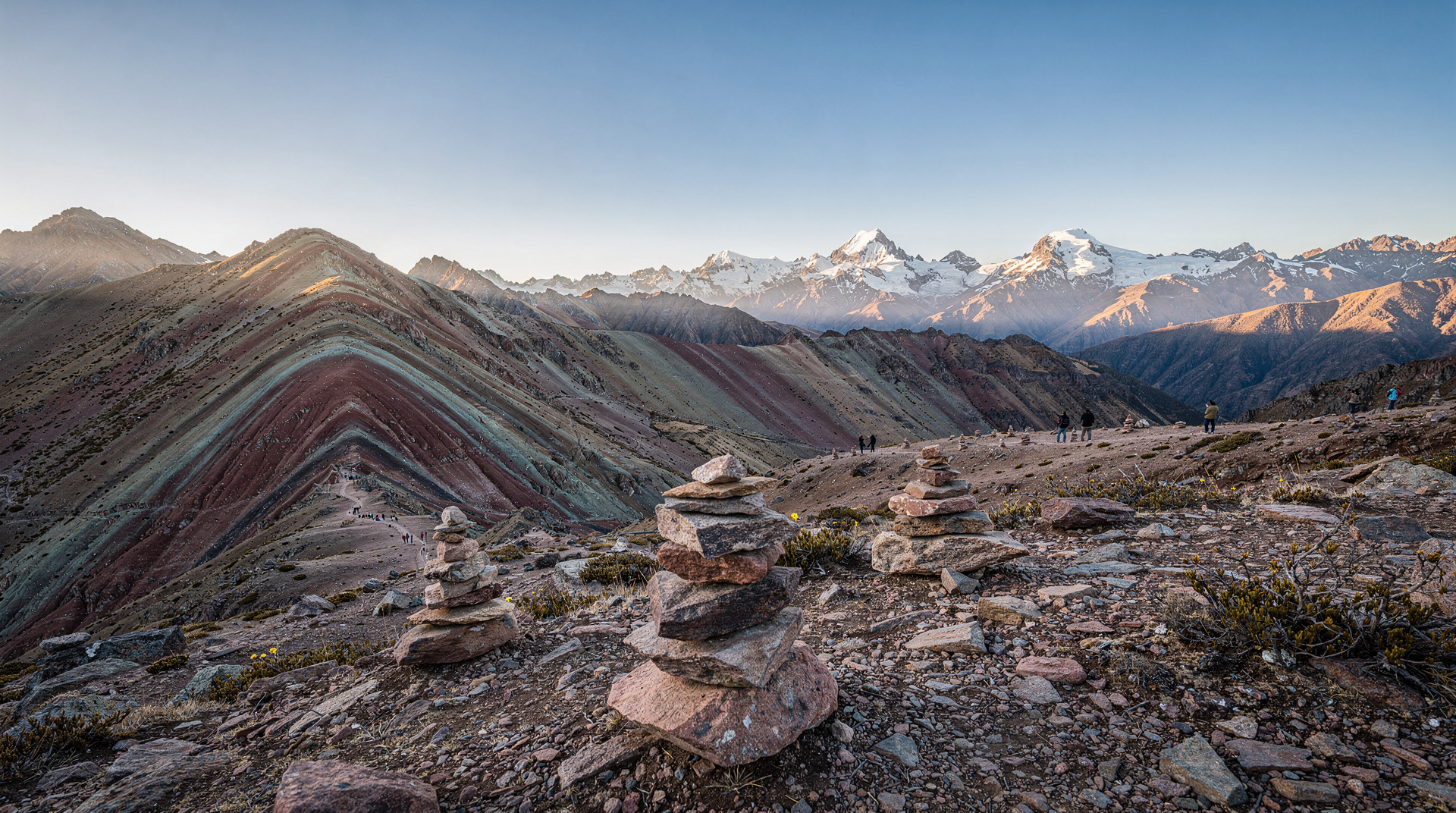
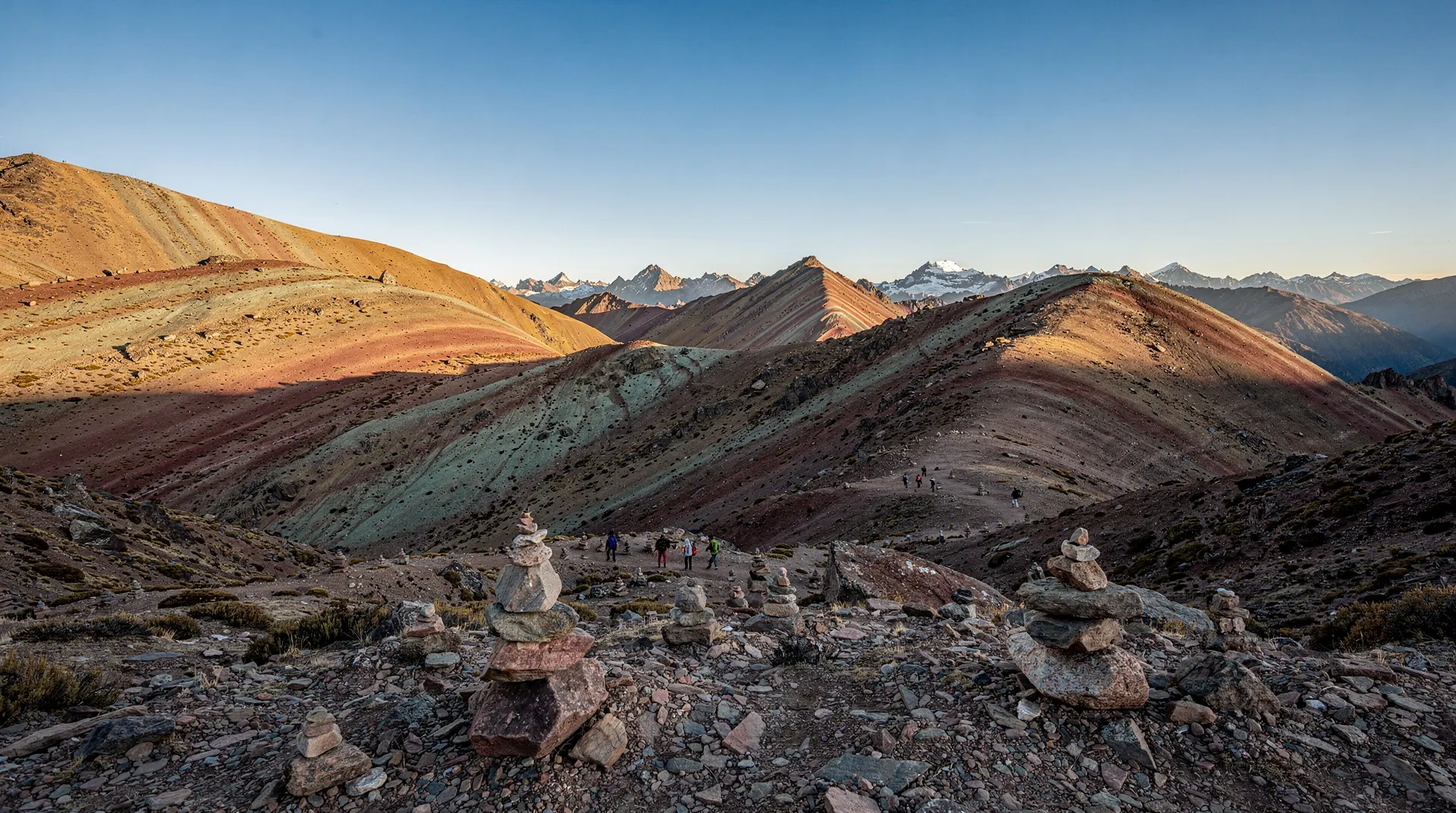
Palccoyo has three ridges — three separate crests, each coloured differently — spread across a wider landscape. The effect is more panoramic and less concentrated than Vinicunca. The colours are subtler in some areas (more muted ochres and earthy purples) and equally vivid in others (a section of pure vermillion that I photographed from every possible angle). The landscape around the ridges includes wetlands (bofedales) with ichu grass, vicuñas grazing at close range, and a stone forest — a field of weathered outcrops that breaks the ridge walk into something more interesting than a single linear climb.
I saw approximately 30 people during my three-hour visit. A tour operator I spoke to at the trailhead said that Vinicunca on the same day had probably 800–1,000 visitors. This was December, which is shoulder season — in July, the comparison would be even starker.
The altitude reality
Both Palccoyo and Vinicunca sit above 5,000 m. There is no version of this experience that is casual at altitude, and anyone telling you otherwise is either very fit, very acclimatised, or not being straight with you.
At 5,000 m, with normal acclimatisation (three days in Cusco beforehand), I was moving slowly and stopping every 15–20 minutes to breathe. Not struggling — not headache, not nausea — but aware of every step in a way I’m not at sea level. My heart rate was elevated from the moment I got out of the vehicle. The air is thin, the UV is intense even in December cloud, and the cold at the ridgeline came in sharp and sudden.
The altitude tips guide for Rainbow Mountain is worth reading before either visit. The key points: don’t go on your first or second day in Cusco, stay hydrated, go slowly and mean it (not “I’ll go slowly” but actually stopping, breathing, waiting), and don’t let the fit-looking people around you set your pace.
The advantage Palccoyo offers at altitude is that the shorter walk with less elevation gain means you spend less total time at maximum altitude. If altitude has been affecting you during your Cusco stay, Palccoyo is the more conservative choice. If you’ve been fine and want the Vinicunca experience specifically, that’s a reasonable calculation.
Book a full-day Palccoyo tour from Cusco — the transport and guide are included, which matters here because the site requires local knowledge to navigate properly, and the guide-to-trekker ratio at Palccoyo is much better than at the packed Vinicunca tours.
The vicuñas at close range
The vicuñas were one of the best parts of Palccoyo and they deserve a mention. Vinicunca also has vicuñas, but the density of visitors tends to push the animals back from the trail. At Palccoyo, with 30 people spread across a large landscape, the vicuñas were grazing 10–15 metres from the path without particular concern.
Vicuñas are the wild ancestors of the alpaca — small, cinnamon-coloured, with white underparts and enormous amber eyes. They’re protected under Peruvian law (their fibre, vicuña wool, is among the most expensive natural fibres in the world, and populations were severely depleted in the 20th century before protection and recovery programs). Seeing them at 5,000 m, grazing on ichu grass in the wind, is an encounter that belongs to this specific landscape and nowhere else.
The stone forest
The stone forest (bosque de piedras) is a field of eroded rock outcrops between the second and third coloured ridges — weathered into shapes that are genuinely strange, about 2 metres high on average, forming a natural labyrinth. It’s not something that appears in most Palccoyo write-ups, possibly because it requires walking a small loop off the main ridge trail.
The combination of the coloured ridges, the stone forest, and the wetland bofedales means that Palccoyo’s landscape is more varied than a single-peak destination. For a comparable time investment to Vinicunca, you see three different types of terrain rather than one.
The honest comparison
The Vinicunca vs Palccoyo guide makes the full argument with more precision. My simplified version: if you want the iconic single-peak photograph and crowds don’t bother you, Vinicunca is the correct choice. If you want a better-quality, quieter, more varied experience with some physical advantage at altitude, Palccoyo is better.
| Palccoyo | Vinicunca | |
|---|---|---|
| Trailhead altitude | ~4,900 m | ~4,700 m |
| Summit altitude | ~5,100 m | ~5,200 m |
| Walk distance | 3–4 km round trip | ~7 km round trip |
| Elevation gain | ~200 m | ~450 m |
| Typical crowd | A few dozen visitors | 800–1,000+ visitors |
| Tour cost | Around S/60–70 | Around S/90–100 |
The fact that Palccoyo costs less, requires less total exertion, and shows you more landscape variety makes it, in my honest opinion, the better default choice for most visitors. The Palccoyo complete guide has everything you need to plan the visit, and the Rainbow Mountain complete guide covers both sides plus Ausangate for a fuller comparison.
What I’d suggest: if you have time for only one coloured mountain and you’re normally fit and have spent three days properly acclimatising in Cusco, go to Vinicunca for the classic experience. If you have any altitude concerns, are short on time, or simply want fewer humans around you, go to Palccoyo and do not feel that you’ve chosen the consolation prize. You haven’t.
What to bring and how to prepare
Layers matter more than anything else on this trip. The vehicle picks you up in Cusco in cool morning air, the trailhead itself is cold and windy even in full sun, and by early afternoon the altiplano light can feel surprisingly strong. I wore a base layer, a fleece, a windproof shell, and was still cold at the ridge for the ten minutes I stood taking photographs. The what to pack for Cusco guide covers this properly — the short version is: warm layers, sun protection, and proper footwear, because the terrain switches between dry dust, loose scree and boggy bofedales within the same short walk.
Bring cash in small denominations — soles, not dollars — for the entrance fee some communities charge and for anything you might want to buy from the handful of stalls near the trailhead. The Cusco taxi and money tips guide has the practical detail on carrying and changing money in the region, which matters more out here than it does in the city, where card payment is increasingly normal.
Fitting Palccoyo into a longer Cusco stay
Palccoyo works best when it sits a few days into the trip, after your body has had time to adjust. If you are still deciding how to order things, the Cusco acclimatization plan and the Cusco altitude vs Sacred Valley guide explain why sleeping lower first makes the high days far more pleasant. The Sacred Valley is a natural place to spend those early nights, and a slow day at the ruins in Ollantaytambo is a gentler warm-up than any big walk.
For a ready-made sequence, the Cusco and Rainbow Mountain 3-day itinerary shows how the coloured-mountain day can be slotted between city time and easier outings. If you would rather read a broader trip account first, my week in Cusco trip report and the Rainbow Mountain reality check cover the same landscape from different angles.
Reading the honest side of the trip
Because Palccoyo is quiet, it is easy to assume nothing can go wrong there. The usual Cusco cautions still apply: choose a licensed operator and be wary of anyone offering suspiciously cheap departures. The unlicensed tour agencies guide and the Cusco tourist traps guide are worth a few minutes before you hand over any money. If a headache or nausea does show up on the day, the altitude sickness story I wrote and the guide to coca tea and altitude remedies explain what helped and what to be cautious about.
Afterwards, a plain meal in town is the best reward. The best restaurants in Cusco is a good place to start, and the San Pedro market food guide suits anyone who wants something simple and warm after a cold day on the altiplano.
If you still want Vinicunca
Nothing in this account is meant to talk you out of Vinicunca. If the classic striped cone is the picture you came for, a guided day trip to Vinicunca from Cusco is the straightforward way to do it, and the Rainbow Mountain Vinicunca destination page explains what the site is like. The Is Rainbow Mountain worth it guide and the Rainbow Mountain day trip from Cusco guide help you decide with a clear head, and the three-way comparison with Ausangate is useful if you are still weighing the options.
Travellers who like a more active day sometimes prefer a version that adds a different kind of activity. a Rainbow Mountain and Red Valley outing with an ATV section is one example, and the Red Valley guide describes the landscape beyond the mountain itself. Whichever you pick, read the Palccoyo day trip guide first so you know how the day is likely to unfold.
Is it worth doing both?
A few people I’ve met tried to squeeze both Palccoyo and Vinicunca into the same trip, usually on consecutive days. I’d advise against it unless you have time to spare and genuinely love the terrain — the two experiences rhyme closely enough that the second visit inevitably feels like a slightly diminished repeat of the first, and your legs and lungs will be doing more or less the same work twice at altitude. If you can only pick one, pick based on your priorities from the comparison table above, not on trying to see everything.
Frequently asked questions about Palccoyo — the quiet rainbow mountain most people walk straight past
Is Palccoyo as good as Vinicunca for photos? Different, not lesser. Vinicunca gives one concentrated, highly photogenic cone; Palccoyo gives three ridges spread across a wider landscape plus a stone forest and grazing vicuñas, which makes for a more varied set of photographs even if no single shot is quite as iconic as Vinicunca’s classic image.
Do I need a guide to visit Palccoyo? Practically, yes. There’s no reliable public transport to the trailhead, and the guided full-day tours include the transport, a guide who knows the terrain, and usually breakfast or lunch — all for a modest price given the distance involved.