Palccoyo Rainbow Mountain
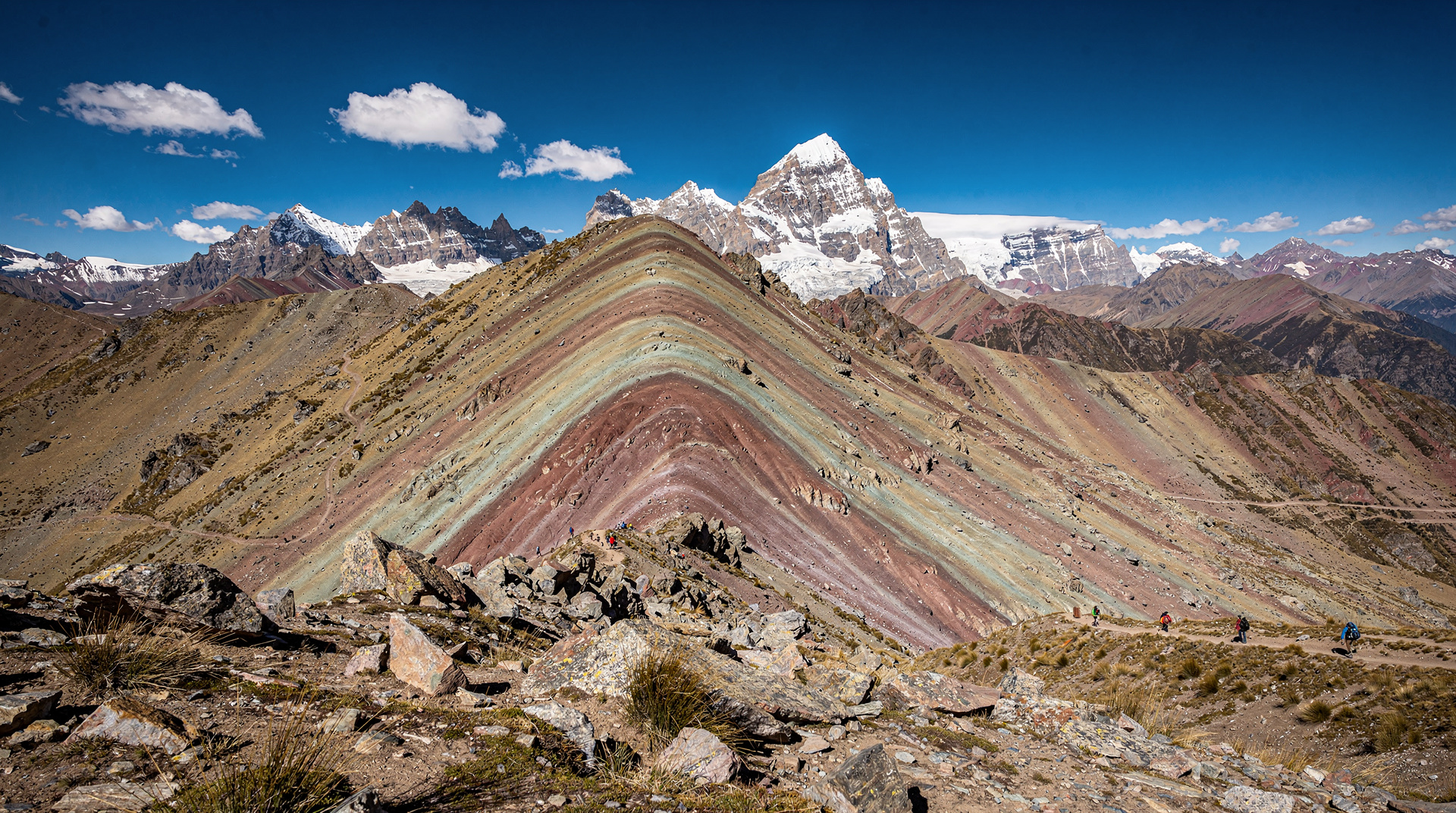
Palccoyo offers three coloured ridges, a stone forest, and a fraction of Vinicunca's crowds at 4,900 m — the honest case for choosing the alternative.
Cusco: Full-Day Palccoyo Rainbow Mountain All-Inclusive Tour
Quick facts
- Country
- Peru
- Altitude
- 4,900 m / 16,076 ft
- Currency
- Peruvian sol (S/) — USD widely used
- Best for
- Quieter high-altitude trekking, mineral colour ridges, stone forest, low-crowd photography
The rainbow ridge most visitors never find
There are two places near Cusco where the Andean geology expresses itself in bands of mineral colour so vivid they look artificial. Vinicunca, the famous Rainbow Mountain, gets the crowds, the Instagram posts, and the early morning jeep convoys. Palccoyo, roughly three hours from Cusco in a different direction and at a more forgiving 4,900 m, gets the quiet.
That gap in visitor numbers is not because Palccoyo is second-rate. It is because Vinicunca arrived on the tourist map first, and once a site achieves that kind of momentum the alternative struggles to be heard. Palccoyo has three separate coloured ridges rather than one, a stone forest tucked into the approach valley, and a typical daily visitor count that ranges from a few dozen to perhaps 150 on a busy Saturday — compared to Vinicunca’s 1,500–2,000. The minerals are the same. The colours are the same. The peak season chaos is not.
This guide makes the honest case for when Palccoyo is the better choice, and when Vinicunca still wins.
| Where | South-east of Cusco, ~3 hrs by 4WD — trailhead at 4,700 m |
| Cost | Community entrance fee ~S/10–15; full-day tour includes transport & guide |
| Time needed | Half-day to full day (2–3 hrs walking, plus ~6 hrs round-trip driving) |
| Getting there | Guided tour from Cusco recommended; unpaved final approach roads |
| Best time | May–September (dry season); depart Cusco by 6am for best light |
What makes Palccoyo different
Most destinations billed as alternatives to famous sites feel like consolation prizes. Palccoyo is a genuine exception because it has structural advantages that Vinicunca does not.
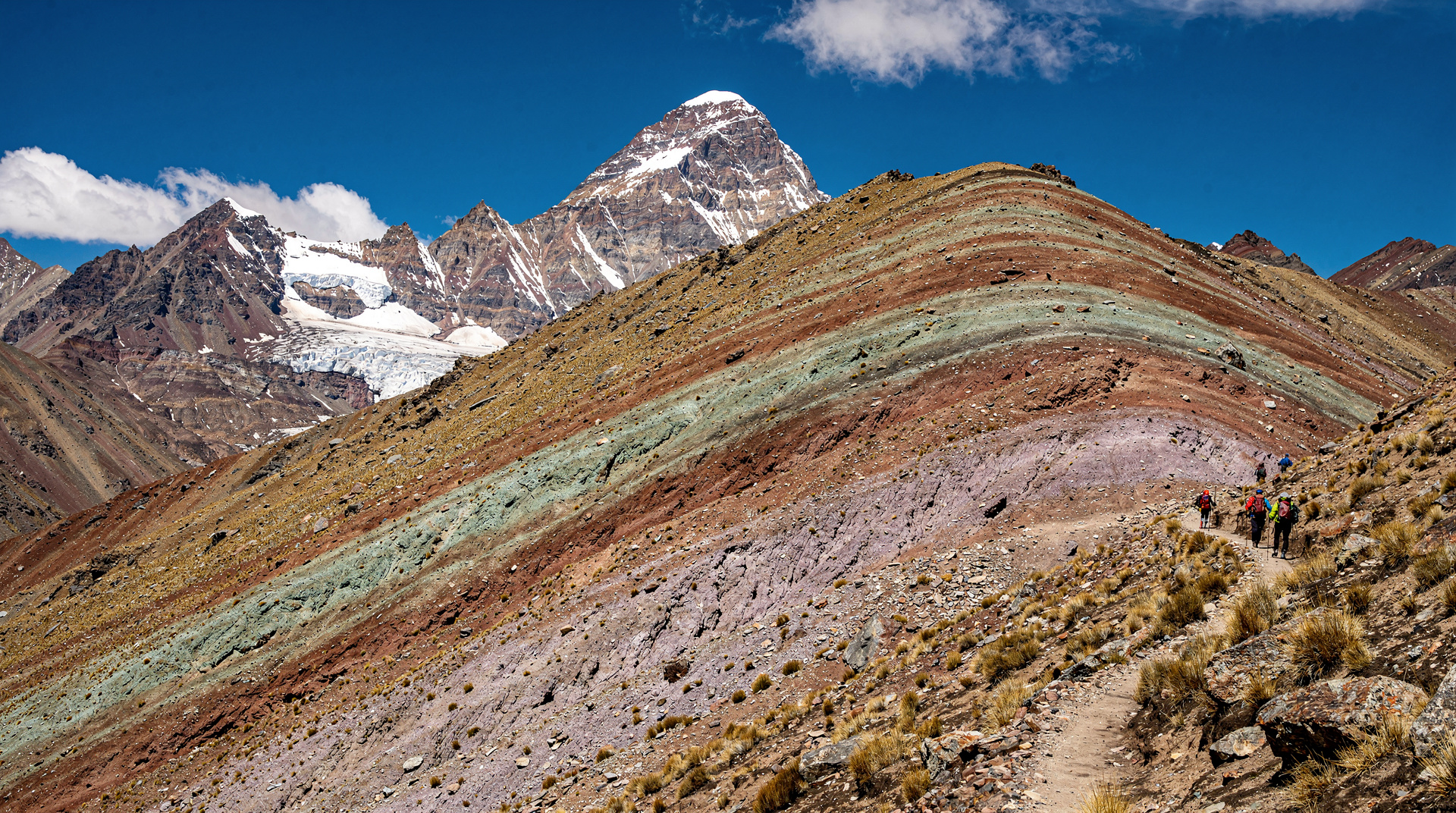
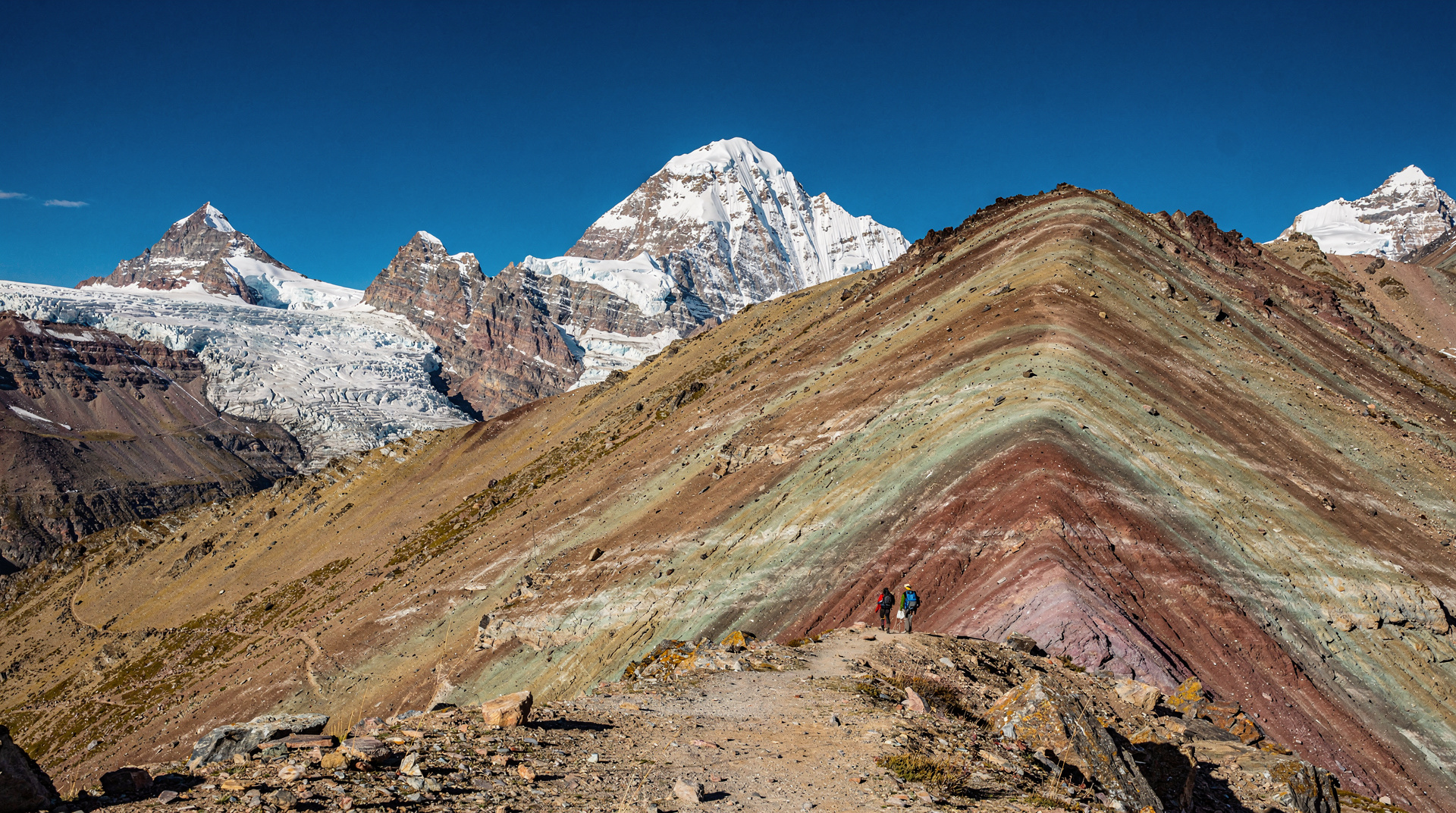
The first is the three-ridge layout. Where Vinicunca concentrates all its mineral colour onto a single dramatic peak, Palccoyo spreads it across a sequence of ridges that you traverse in order. The approach from the trailhead (around 4,700 m) brings you into view of the first ridge within about 30 minutes of starting. From there, the walking route connects to the second and third ridges over a gentle traverse, with the colour bands varying in intensity and character at each point. The total walking time from trailhead back to trailhead is around two to three hours — shorter than Vinicunca’s approach by 30–60 minutes.
The second structural advantage is the stone forest. Set in a narrow valley below the main coloured ridges, it is a field of tall, wind-eroded rock pillars in ochre and rust-brown, rising from the highland grass at odd angles. It is not large — you can walk through it in 15 minutes — but it is genuinely unusual and almost always empty of other visitors. The combination of stone forest and coloured ridges in one half-day circuit gives Palccoyo a variety that Vinicunca, for all its drama, cannot match.
The third advantage is the altitude. At 4,900 m, Palccoyo is still very high — do not treat it as an easy stroll — but it is 300 m lower than Vinicunca, and that difference is physiologically meaningful. The final stretch to Vinicunca’s summit at 5,200 m is where many visitors hit a wall. At Palccoyo’s elevation, that specific ceiling does not exist. It matters most for visitors who are on day two or three of acclimatisation rather than day four or five.
The altitude: still serious, still needs respect
Palccoyo’s lower profile can create a false sense of ease. At 4,900 m, this is still among the highest places most people will walk on foot anywhere on Earth. It is higher than the highest point in the European Alps, higher than most Himalayan trekking routes, and high enough to trigger acute mountain sickness in unacclimatised visitors.
The honest minimum is still two full nights in Cusco or the Sacred Valley before attempting the trek. The Cusco acclimatisation plan lays out how to structure those first days — slow mornings, light meals, no alcohol, and ideally a gentle walk to 3,700–3,900 m on day two before pushing higher on day three. The altitude sickness guide covers the symptoms to recognise and what to do if you start to feel them on the ridge.
What Palccoyo gives you that Vinicunca does not is a slightly larger margin. If you feel breathless at 4,900 m you can slow down, sit on a rock, and let your body catch up — and you will almost certainly be able to continue. At 5,200 m, the equivalent moment more often means turning back. For travellers with limited time in the Andes, that extra margin is worth something real.
The trailhead is at approximately 4,700 m, reached by a three-hour drive from Cusco through some of the most remote highland landscape in the southern Andes. The road is unpaved for the final sections and requires a 4WD vehicle. Altitude is already significant when you step out of the vehicle.
The walk: what to expect on the ground
From the trailhead, the path heads uphill on a clear but uneven trail through highland puna grassland. Llamas and alpacas graze freely across the slopes, largely unbothered by walkers. The first coloured ridge comes into view after approximately 20–30 minutes of ascent — this is the moment that consistently surprises visitors, because the colours are fully visible from some distance and the contrast with the green-brown grassland around them is immediate.
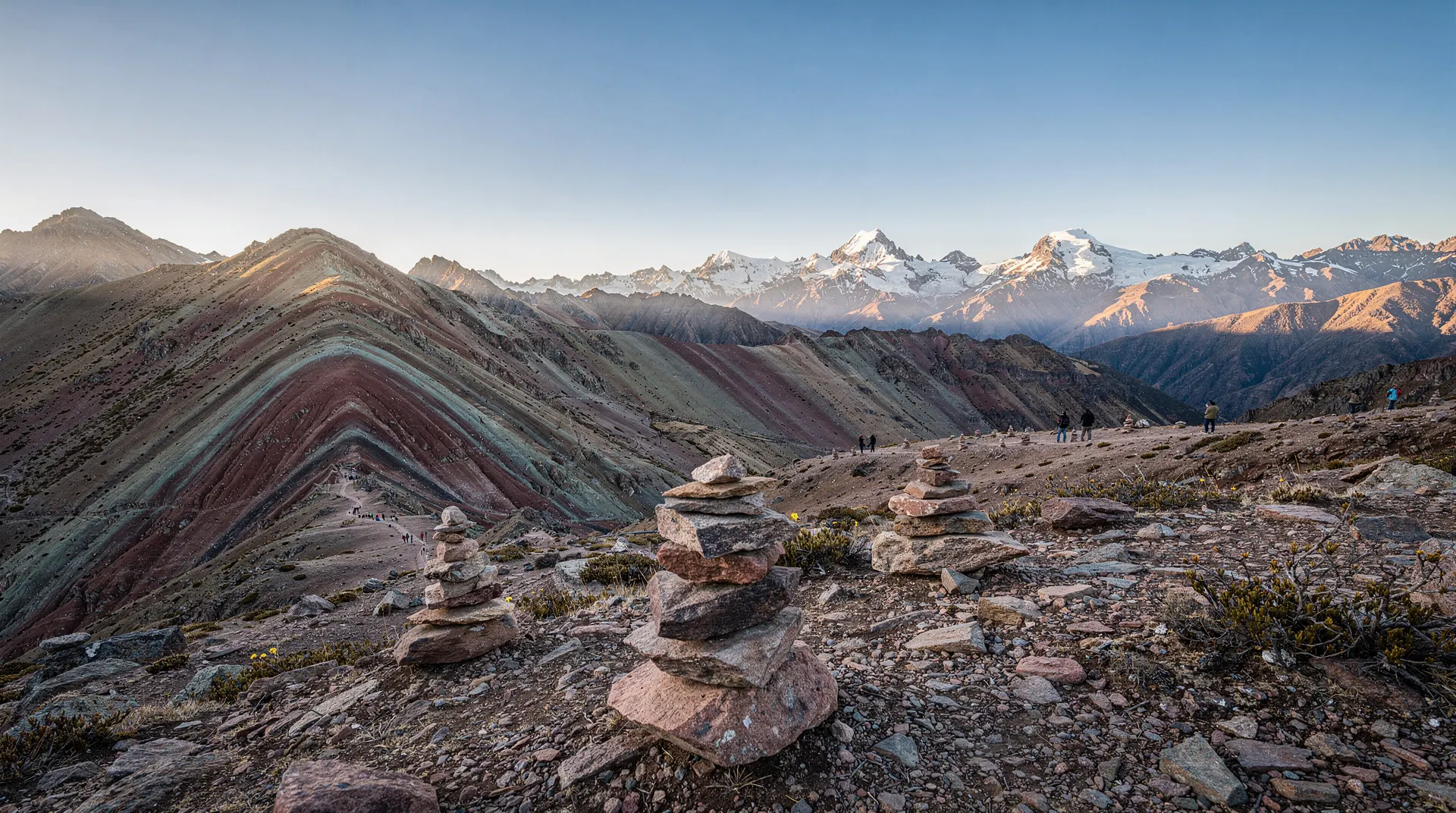
The three ridges form a rough loop at the upper end of the circuit. The mineral colours shift between ridges — the first tends to show the strongest reds and purples; the second adds yellows and whites; the third is slightly lower and broader, with a wider panoramic view across the Palccoyo valley and the snow peaks beyond. On a clear day in dry season, the entire Vilcanota mountain range is visible from the high points, with Ausangate (6,384 m) prominent to the south-east.
The stone forest is best visited on the way back down, tucking off the main ridge trail into the valley floor. It takes about 15 minutes to walk through and makes for good photography in afternoon light when the sun angles into the pillars from the west.
Total elevation gain from trailhead to the highest ridge is approximately 200 m. There are no technical sections. Trekking poles are useful but not essential. Horses are sometimes available at the trailhead but are needed far less often than at Vinicunca given the gentler gradients.
A full-day Palccoyo tour from Cusco is the most practical way to visit, covering transport, a local guide, and the circuit of all three ridges and the stone forest. Independent visits are possible but require a reliable 4WD hire and familiarity with the unmarked approach roads.
Palccoyo versus Vinicunca: making the call
The Vinicunca versus Palccoyo guide does the full comparison, but the practical decision usually comes down to three questions.
How many nights have you spent at altitude? If the answer is one or two, Palccoyo is the safer choice. If the answer is four or more and your body has been responding well, Vinicunca is accessible.
What time can you leave Cusco? Vinicunca’s crowds peak between 9 am and 1 pm. To beat them requires a 3:30 am departure. Palccoyo’s crowd curve is so much flatter that any departure before 7 am puts you well ahead of whatever groups are coming.
Is the single dramatic peak image important to you? Vinicunca has an iconic summit profile that Palccoyo does not replicate. If that specific photograph matters to your trip, Vinicunca is the right choice. If you want coloured ridges, a stone forest, and an actual mountain experience rather than a managed viewpoint queue, Palccoyo is worth prioritising.
Most people who visit both sites — and a reasonable number of visitors do, since the two half-days are entirely compatible with a week-long Cusco itinerary — rate Palccoyo as the more enjoyable day out. That verdict does not appear in the algorithm because Palccoyo cannot produce the same viral photograph. It should appear in your planning.
Palccoyo vs Vinicunca at a glance
| Palccoyo | Vinicunca (Rainbow Mountain) | |
|---|---|---|
| Altitude | 4,900 m | 5,200 m |
| Walking time | 2–3 hrs round trip | 3–4 hrs round trip |
| Daily visitors | A few dozen to ~150 | 1,500–2,000 |
| Number of ridges | Three, plus a stone forest | One dramatic summit |
| Departure time | Any time before 7am is comfortably ahead of crowds | 3:30am needed to beat the crush |
Both routes are covered in full in the rainbow mountain complete guide, which also details the geology behind the mineral colour bands common to both sites.
Combining Palccoyo with other highlights
Palccoyo pairs well with a morning in the Ausangate area, since the two sites are in the same general corridor south-east of Cusco. Several operators offer combined itineraries covering the Palccoyo circuit in the morning and a section of the Ausangate lakes trail in the afternoon, which makes for a long but rewarding full day in the high Andes.
It also makes sense as a first high-altitude day hike in a sequence — go to Palccoyo on day three of your acclimatisation, assess how your body handled 4,900 m, and then decide on day four whether Vinicunca (5,200 m) is a realistic follow-up. Many travellers find this staged approach both safer and more satisfying than attempting Vinicunca cold.
If rainbow-mountain landscapes are the core interest of your Cusco trip, the rainbow mountain complete guide covers both sites in depth, including the geological background behind the mineral colours, photography timing advice, and how to fit either or both into a typical 7-day Cusco itinerary.
Practical details
When to go: May–September is the dry season and the reliable window for clear colours. October and April are shoulder months — possible but with unpredictable cloud. November–March brings regular afternoon rain and frequent snow cover at ridge level, which can obscure the mineral bands entirely.
What to bring: Warm layers (4,900 m means temperatures of 4–8°C at midday in dry season, significantly colder before 9 am), waterproof outer layer, sunscreen, sunglasses, at least 2 litres of water, snacks, and any personal medication. Acetazolamide (Diamox) is available at Cusco pharmacies and is worth considering if you are time-constrained on acclimatisation — the altitude sickness guide covers dosage and when to start.
Trailhead facilities: More limited than Vinicunca — a few stalls with hot drinks and basic snacks, limited toilet facilities. Bring your own food if you want anything beyond the basics.
Entry fee: A community entrance fee of approximately S/10–15 (around $3–4) is collected at the trailhead. Organised tours include this in their pricing. Independent visitors pay at the barrier.
Photography: The first ridge is best photographed in the 90 minutes after arrival — typically between 9 and 11 am if you depart Cusco by 6 am. Afternoon light angles into the stone forest more dramatically, but the ride colours can wash out slightly in direct afternoon sun.
Palccoyo does not have Vinicunca’s fame, its marketing budget, or its place in the travel algorithm. What it has is the same Andean geology, a quieter path, and a view of the high plateau that feels more like discovery than tourism. Book a Palccoyo full-day tour and set your alarm for a reasonable hour rather than 3 am — the mountain will still be extraordinary.
A third option: Ausangate’s lakes
Vinicunca and Palccoyo are not the only high-altitude colour-and-scenery day trips near Cusco. The Ausangate lakes circuit, at similarly demanding altitudes, offers turquoise glacial lakes rather than mineral ridges, with its own quieter crowd profile. Travellers who have already done one rainbow-coloured mountain and want a genuinely different high-Andes landscape — rather than a repeat of the same geological phenomenon — often find the Ausangate lakes the more satisfying second outing. The Vinicunca vs Palccoyo vs Ausangate comparison lays out all three side by side for travellers trying to choose just one or sequence two across a longer trip.
Frequently asked questions about Palccoyo Rainbow Mountain
Is Palccoyo suitable if I haven’t fully acclimatised? It is more forgiving than Vinicunca thanks to the 300 m lower altitude and gentler gradient, but 4,900 m is still a serious elevation. At least two full nights in Cusco or the Sacred Valley beforehand is the honest minimum, and you should still expect to feel breathless on the ascent.
Do I need a guide, or can I drive myself? A guide or organised tour is strongly recommended. The final approach roads are unpaved, unmarked in places, and require a 4WD vehicle; a guided tour also includes a local guide who can explain the geology and point out details in the stone forest that are easy to miss unaided.
Top experiences
Bookable activities with verified prices and instant confirmation on GetYourGuide.