Rainbow Mountain (Vinicunca): the complete guide
Vinicunca Rainbow Mountain Day Trip from Cusco
Visiting Rainbow Mountain
Rainbow Mountain (Vinicunca) is a 5,200 m peak about 90 km from Cusco, famous for its striped mineral colours. Day trips cost $30–50 (S/110–180) including transport and guide. The hike at altitude is genuinely demanding — 2+ hours uphill from the trailhead at 4,300 m. Acclimatise in Cusco for at least 2 nights before attempting it. If altitude or fitness is a concern, Palccoyo (4,900 m, far shorter hike) is the honest alternative.
The mountain that looks like nothing else
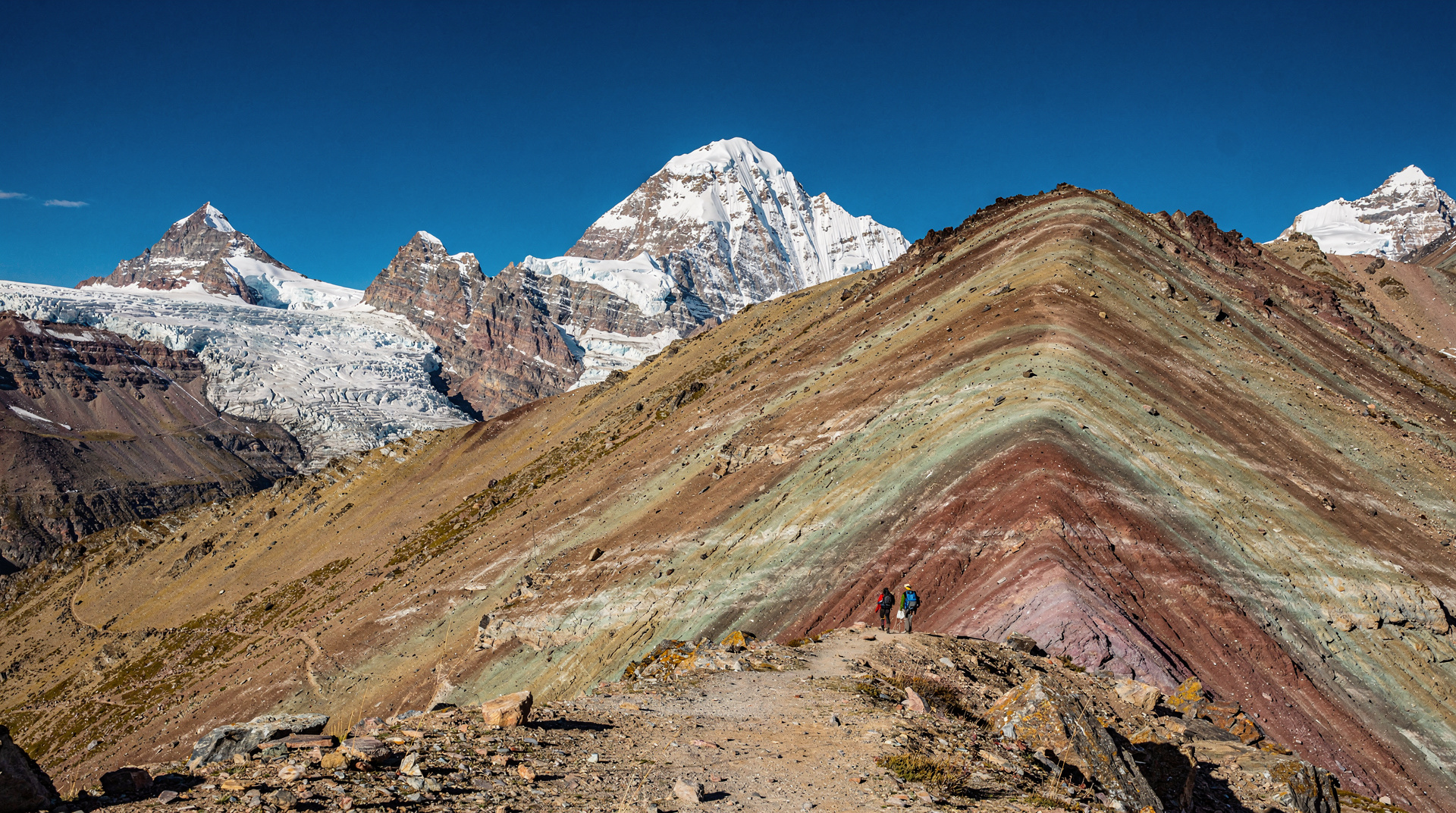
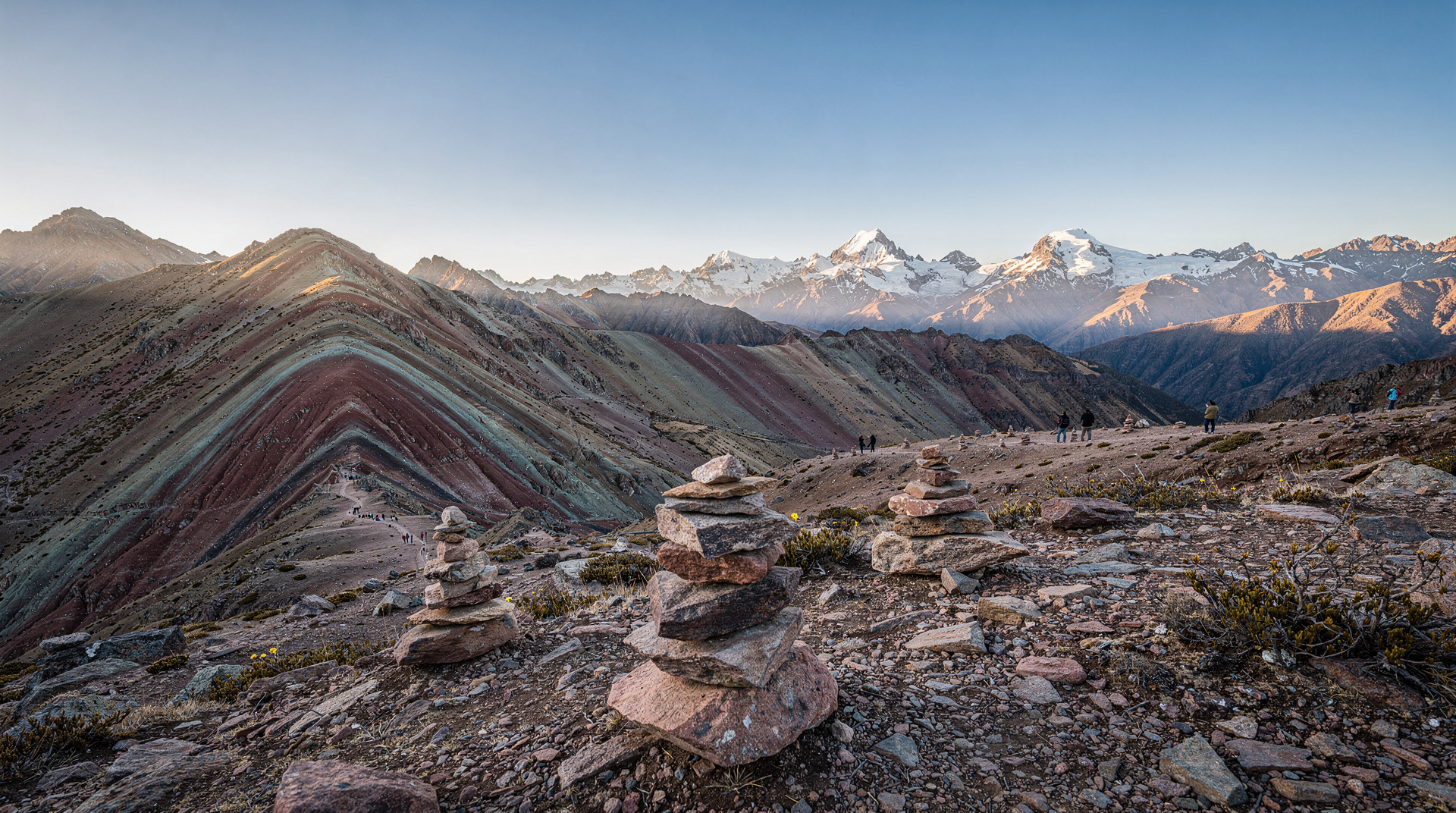
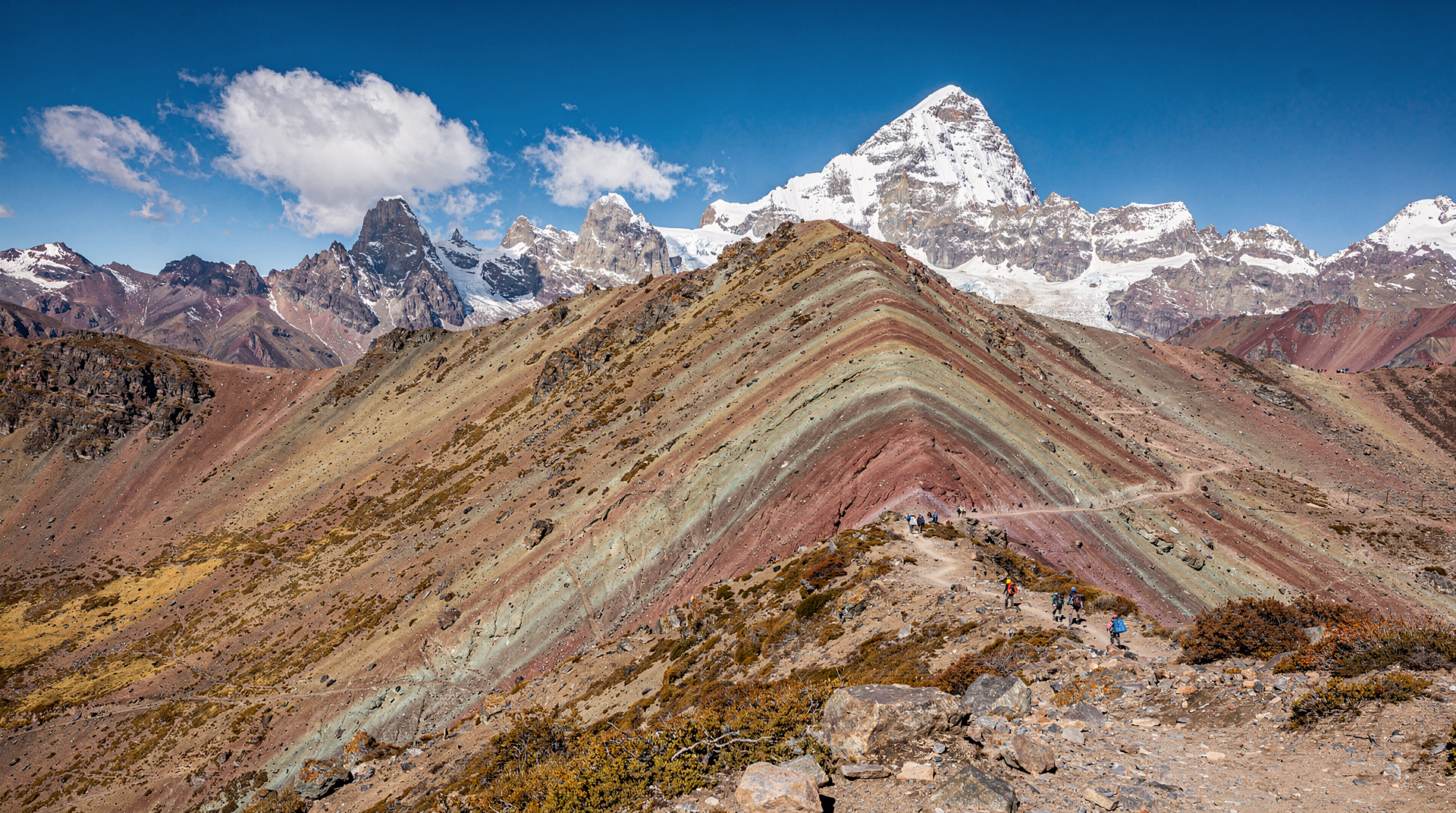
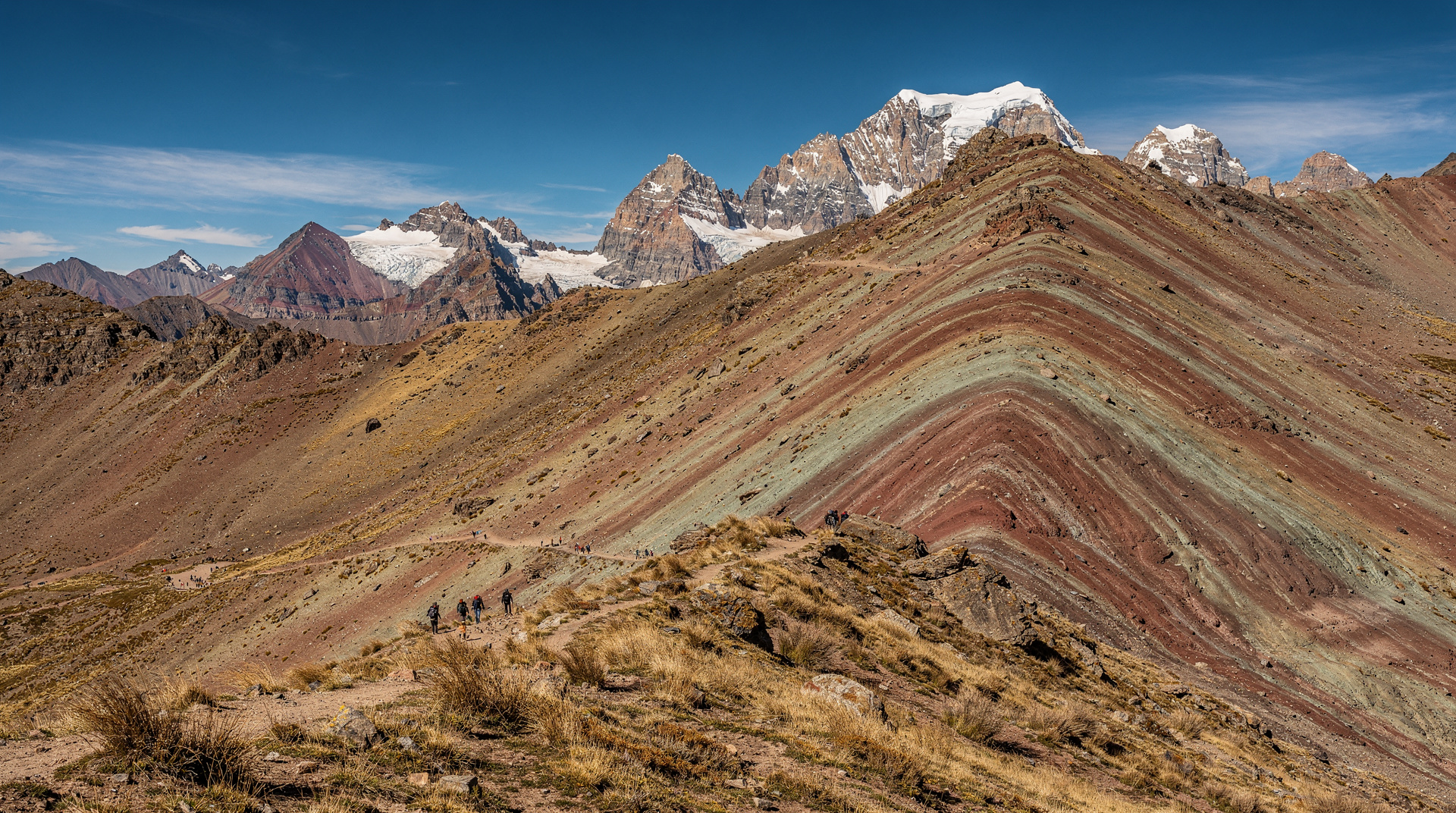
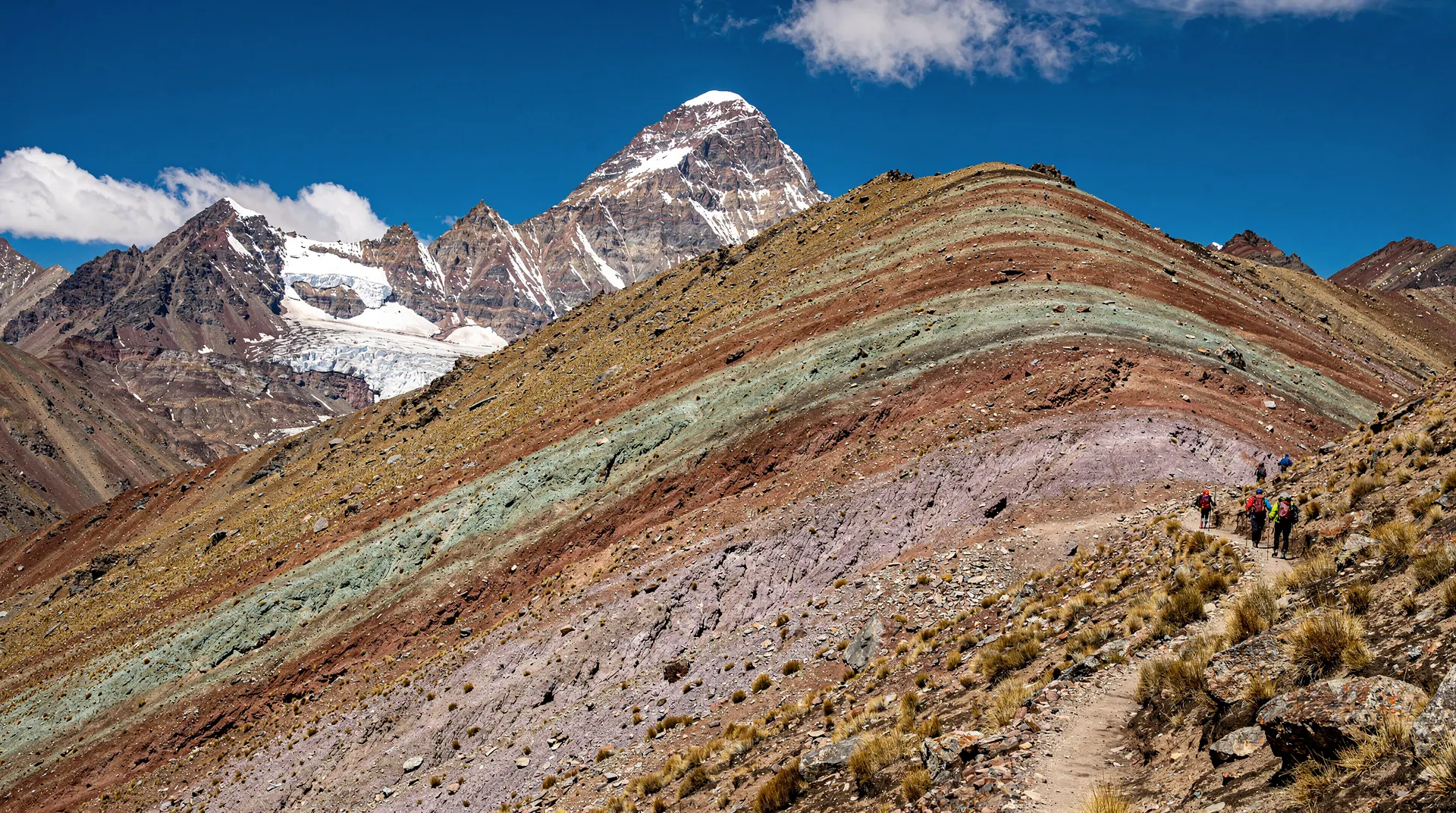
Rainbow Mountain — officially Vinicunca, or Montaña de Siete Colores (Mountain of Seven Colours) — is a 5,200 m peak in the Vilcanota mountain range, roughly 90 km southeast of Cusco. Its mineral-striped flanks combine reds, purples, yellows, greens, and turquoise in bands that are entirely natural — the result of iron sulphide, iron oxide, and clay minerals of different compositions deposited in the Andean geological uplift and exposed by erosion. Until about 2015, the mountain was covered by a permanent glacier and almost entirely unknown to tourism. The glacier has retreated significantly, the colours have been exposed, and the site has become one of the most visited attractions in Peru within a single decade.
The honest version of this story includes two things that most tour descriptions omit. First: the hike to the summit viewpoint at 5,200 m from the trailhead at 4,300 m is genuinely hard at altitude — much harder than the “moderate” label suggests for visitors who have not spent time above 3,000 m. Second: the photographs that made Rainbow Mountain famous online are almost universally heavily edited, with saturation boosted well beyond what you will see with your eyes. The mountain in person is striking and beautiful; it is not the neon-saturated image from Instagram. Go with honest expectations and the experience is well worth making.
| Where | Vilcanota range, ~90 km southeast of Cusco |
| Cost | $30–50 (S/110–180) per person, group tour |
| Time needed | Full day, 10–12 hours door to door |
| Getting there | Tour minibus, 3–4 hrs each way from Cusco |
| Best time | May–September, morning arrival before cloud builds |
The altitude reality
The single most important fact about a Rainbow Mountain trip: you will be hiking at 4,300–5,200 m. This is not a technicality. At 5,200 m the air contains roughly 50% of the oxygen at sea level. Even fit, healthy people in normal low-altitude condition feel significantly impaired at this elevation. Symptoms range from mild (headache, breathlessness on exertion, slow pace) to severe (nausea, dizziness, loss of coordination). The climb from the trailhead to the summit takes most visitors 2 to 2.5 hours uphill regardless of fitness.
The minimum acclimatisation requirement is 2 nights in Cusco (3,400 m) before attempting Rainbow Mountain. Many guides recommend 3 nights. Attempting the hike on your first or second day at altitude in the Cusco region is the single most reliable way to have a miserable experience — you will either fail to reach the summit or arrive in such physical distress that you cannot enjoy what you came to see.
The full guide to altitude sickness in Cusco covers the acclimatisation process in detail. The Rainbow Mountain altitude tips guide applies this directly to the Vinicunca hike.
What a day trip involves
Most visitors join an organised day trip from Cusco. Here is the realistic timeline:
3:30–4:30 am: Pickup from Cusco hotel. Tours leave this early to beat the crowd buildup at the trailhead and to maximise chances of clear skies before afternoon cloud develops.
7:00–7:30 am: Arrival at the trailhead (Cusco Punku checkpoint) at approximately 4,300 m. Toilet facilities here. Many tours include breakfast on arrival.
7:30–10:00 am: The hike upward. The trail is 3.5 km one way, gaining roughly 900 m of altitude. Most visitors walk; horse hire is available at the trailhead (approximately S/30–50 one way or return) and is worth considering if you are uncertain about your altitude fitness.
10:00–11:30 am: Time at the summit viewpoint. Clear skies most likely in the morning; cloud typically builds from around 11 am. Photography time, rest, guided explanation.
11:30 am–2:00 pm: Descent and return journey to the vehicles.
4:00–6:00 pm: Return to Cusco.
A small-group Rainbow Mountain tour typically includes transport (3–4 hours each way from Cusco), a local guide on the trail, entry fees, and often breakfast or lunch. Quality varies significantly: the best operators provide guides who speak about altitude safety, maintain a slow pace appropriate for acclimatisation, and carry supplemental oxygen. The price range is $30–50 per person; operators at the very low end of this range tend to pack large groups into vehicles and rush the schedule.
A standard Rainbow Mountain day trip covers the same route and typically includes the basics. Compare what is included before booking: entry fees, guide quality, group size, and whether breakfast is provided all affect the experience.
The trail and summit
The trail from Cusco Punku trailhead follows a broad, well-marked path that was engineered for the tourism surge rather than being a traditional route. In the dry season it is stable and straightforward; in the wet season (November–March) it becomes muddy and can be slippery. The gradient is consistent throughout rather than dramatic — there is no single scrambling section, but the sustained uphill at altitude is what challenges people.
The final section before the summit viewpoint is the steepest and most demanding. Most guides recommend stopping here to drink water and rest for 5–10 minutes before the final push. Taking this advice is worth more than it sounds — the combination of altitude and sustained effort means your body genuinely benefits from even a short rest before the hardest part.
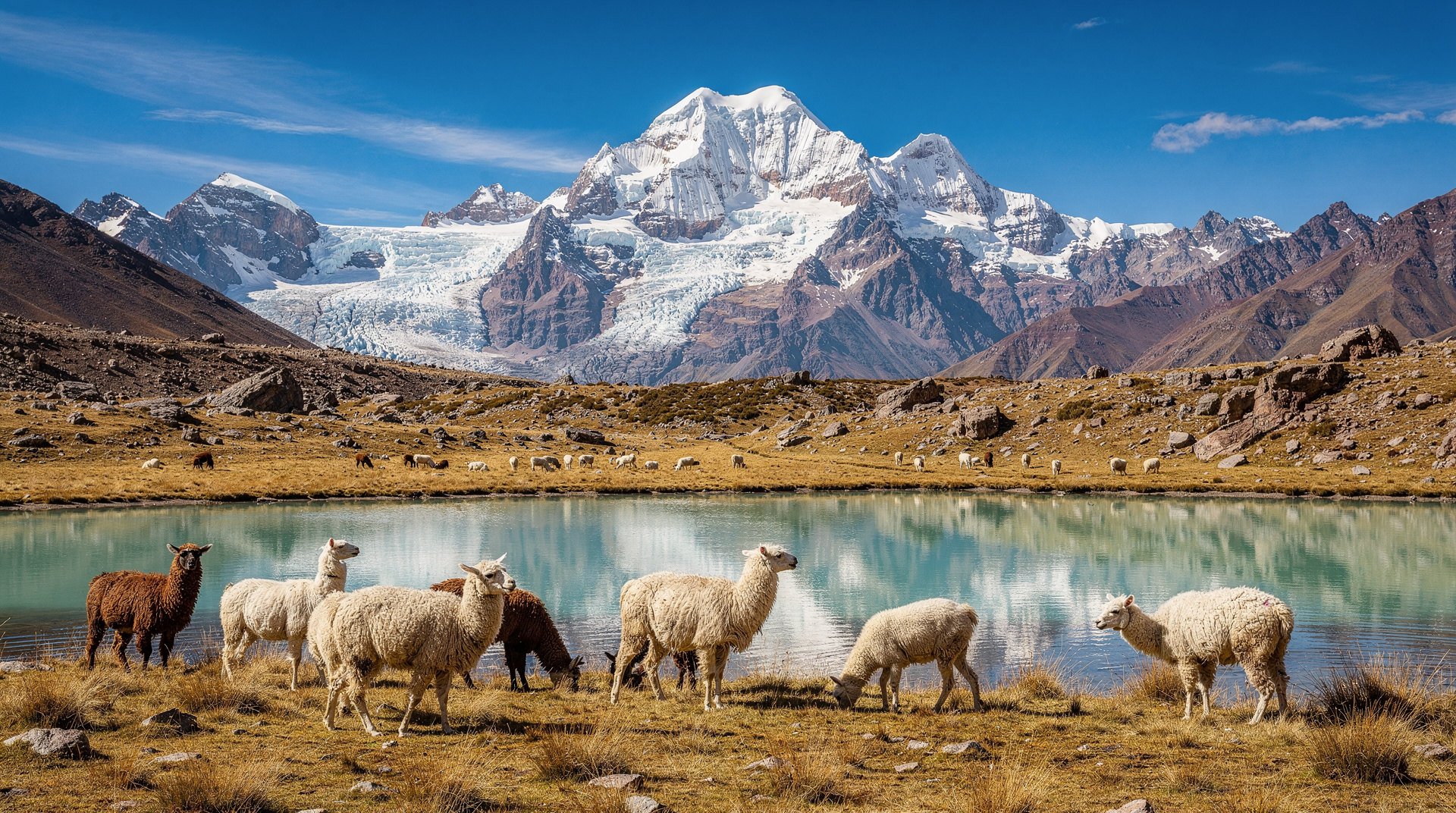
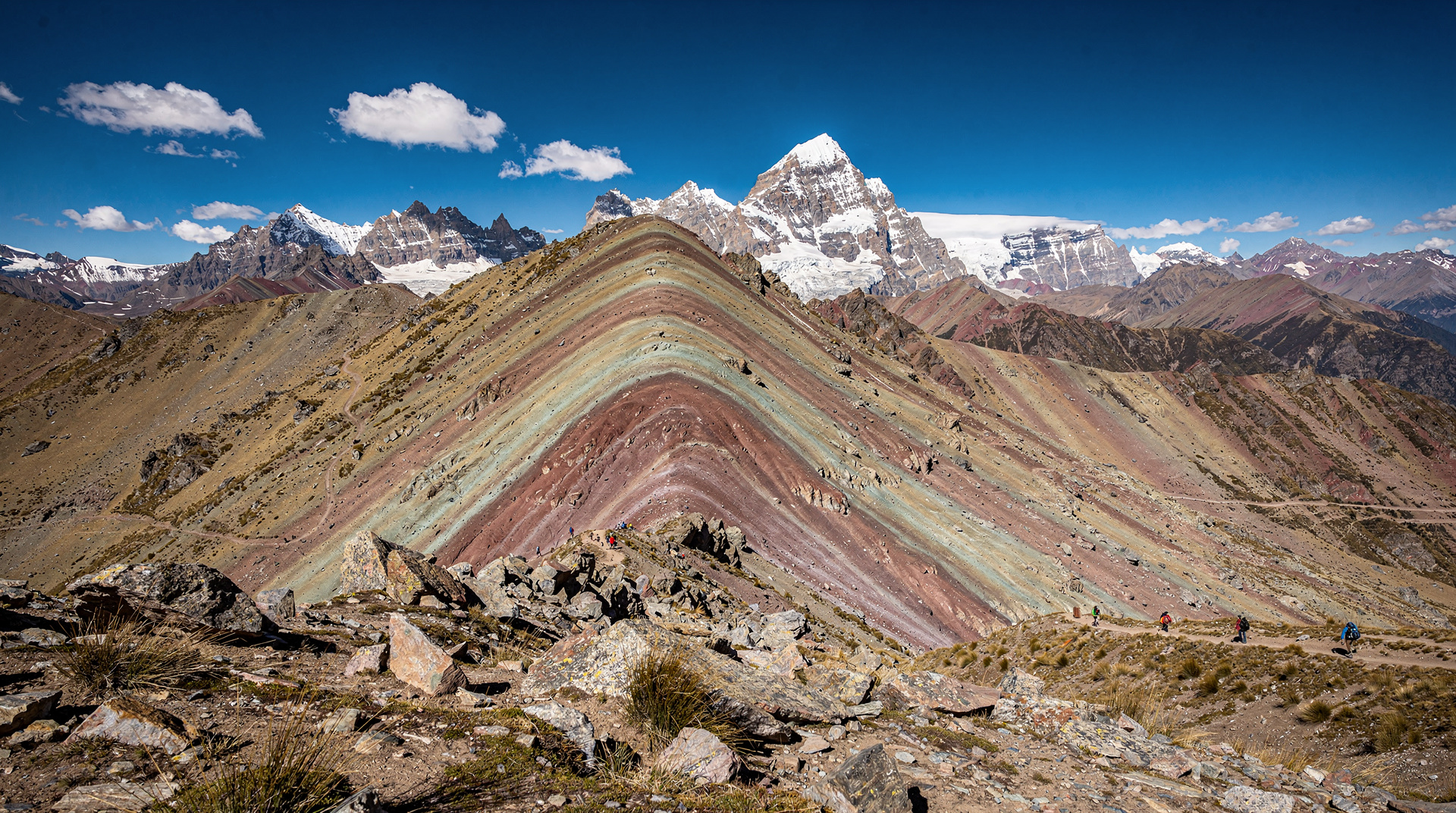
At the summit (5,200 m) the viewpoint is a wide ridge with the coloured flanks of Vinicunca visible to one side and, in clear conditions, views of the Ausangate massif — the highest peak in the Cusco region at 6,384 m — to the other. The colour bands of the mountain are best photographed in direct morning light from the eastern side of the ridge. The most famous image angle looks directly at the striped face with Ausangate in the background.
Be honest with yourself about what you will see. In perfect conditions (dry season, morning, clear sky) the mineral colours are vivid and extraordinary. In typical conditions (mixed cloud, midday) they are still distinctive but more muted. In cloud, the face is barely visible. Plan for the first, prepare for the second, and accept that weather at 5,200 m is unpredictable.
The horse hire question
Horses are available for hire at the Cusco Punku trailhead, offered by local community members. The cost is approximately S/30–50 one way and S/50–80 return depending on negotiation. The horses carry riders up the main trail — they do not go to the very summit but cover most of the ascent.
Horse hire is not “cheating” and is not only for unfit visitors. At 4,300–5,200 m, many otherwise fit people find that respiratory limitations rather than muscular fitness are the binding constraint. Using a horse allows you to arrive at the summit with enough energy to enjoy it rather than simply surviving it. Local community families rely on the income. If you are unsure about your altitude readiness, the horse is a sensible investment.
Honest photography expectations
The rainbow mountain photographs that circulate online — the ones that prompted the tourism surge — are almost all edited with heavy saturation. In the best natural conditions, the mountain is genuinely beautiful: deep reds and burnt oranges, patches of sulphur yellow, mineral greens and greys, with a purple-tinted ridge. In typical conditions, the colours are more muted.
What you will not see with the naked eye: the neon-turquoise, vivid green, and electric red of the most widely shared images. Photography editing software (Lightroom, Instagram filters) routinely adds 40–60% more saturation than the natural scene. This is not a reason not to go — the real mountain is still remarkable — but calibrating your expectations saves significant disappointment.
Palccoyo: the honest alternative
For roughly 20% of visitors, Palccoyo (4,900 m) is the right choice rather than Vinicunca. The reasons:
- 300 m lower elevation (meaningful difference in oxygen availability)
- 3 km round-trip walk from vehicle drop-off (versus 7 km for Vinicunca)
- Three separate rainbow mountains visible in one panoramic view
- A fraction of the crowd
- Lower cost (approximately S/80–120 for the day trip)
Palccoyo lacks the single dramatic face and “summit achieved” feeling of Vinicunca, and its photography impact is less concentrated. But for visitors who are unsure about their altitude fitness, travelling with older family members, or simply prefer fewer crowds and a shorter hike, it is an entirely honest and worthwhile alternative.
The Vinicunca vs Palccoyo comparison and the Palccoyo guide cover the decision in detail. The Ausangate guide is for those considering the multi-day version.
Fitting Rainbow Mountain into a wider trip
Because the hike asks so much of your body at altitude, the day you choose matters as much as the operator you book with. Place it after your first days in the region rather than at the start. The Cusco acclimatisation plan shows how to sequence easier days first, and the comparison of Cusco and the Sacred Valley as a base helps if you are weighing where to sleep while your body adjusts.
If you would rather see the route laid out day by day, the Cusco Rainbow Mountain 3-day itinerary builds the trip around the mountain. For a closer look at the standard departure from the city, the Rainbow Mountain day trip from Cusco guide goes through the practical details, and is Rainbow Mountain worth it tackles the question head on.
Dress for the cold and the sun together, since conditions change quickly on the ridge. The what to pack for Cusco list covers layers and sun protection that suit this kind of outing. If you want a first-hand account before deciding, the Rainbow Mountain reality check tells the story from a visitor’s point of view.
Is it worth it?
Most visitors who go with accurate expectations and adequate acclimatisation answer yes. The combination of extreme altitude, extraordinary landscape, the scale of the Andes, and the genuine geological oddity of a striped mountain makes for an experience that most people do not encounter anywhere else on Earth.
The visitors who answer no tend to fall into two groups: those who went on insufficient acclimatisation and spent the hike in physical distress; and those who expected the neon saturation of the edited photographs and felt the real mountain disappointed by comparison.
Both disappointments are preventable. Acclimatise properly. Adjust your visual expectations. The mountain will take care of the rest.
The geology behind the colours
The colours of Vinicunca are not paint or dye or any process requiring human intervention. They are the exposed mineral history of a mountain range that has been rising out of the Earth for tens of millions of years.
The Andean geological uplift — the process driven by the subduction of the Nazca tectonic plate beneath the South American plate — has been pushing the Andes upward at a geologically rapid rate. As the mountains rise, erosion removes the surface layers and exposes the mineral strata below. At Vinicunca, the specific combination of minerals in the exposed rock produces the colour bands: iron oxide (rust red and orange), iron sulphide weathering to goethite (yellows), chlorite and serpentine minerals (greens), feldspar and limestone (whites), and manganese oxides (purples).
Until roughly 2015, this geological spectacle was hidden under a permanent glacier. As the glacier retreated — a direct consequence of climate change in the Peruvian Andes — the mineral face was exposed. The mountain that has been rising for forty million years became a tourist attraction in less than a decade. This context does not diminish the experience of seeing it, but it adds a layer to what you are looking at: a geological archive being opened in real time by a changing climate.
The Ausangate massif, visible in the background from the summit viewpoint, is at 6,384 m the highest peak in the Cusco region and one of the most sacred mountains (apus) in Andean cosmology. The combination of Vinicunca’s mineralogical colours and Ausangate’s glacier-capped bulk in a single frame is the canonical Rainbow Mountain image — and it is entirely natural.
Practical summary:
- Distance from Cusco: ~90 km, 3–4 hours by road
- Trailhead altitude: ~4,300 m
- Summit altitude: ~5,200 m
- Hike distance: 7 km return
- Typical hike time: 2–2.5 hours up, 1.5 hours down
- Day trip cost: $30–50 (S/110–180)
- Best time: May–September dry season, morning departure
- Minimum acclimatisation: 2 nights in Cusco (3+ recommended)
Rainbow Mountain in each season
| Period | Conditions | Crowds | Verdict |
|---|---|---|---|
| May–Sep (dry) | Clear skies, stable trail, cold mornings | Peak (Jul–Aug busiest) | Best photography and reliability |
| Apr / Oct (shoulder) | Mostly clear, occasional cloud | Moderate | Good compromise, fewer people |
| Nov–Mar (wet) | Frequent cloud, muddy trail | Lowest | Real risk of a clouded-out summit |
Group tours versus private tours
The standard group tour — 10 to 20 people in a shared minibus with a shared guide — is the cheapest and most widely available way to visit Rainbow Mountain, and for most visitors it is entirely adequate: the hike itself is done at individual pace regardless of group size, and the summit experience is the same view for everyone. A private tour, arranged with your own vehicle and guide, costs roughly two to three times more per person for a small group but buys genuine flexibility: a departure time you choose (useful for beating the crowds even earlier than the standard 3:30 am pickup), a pace set entirely by your own group rather than a bus schedule, and a guide whose full attention is on your party.
For families travelling with children, visitors with mobility considerations, or anyone who specifically wants extra time for photography at the summit without a fixed return schedule, the private tour premium is often worth paying. For most solo travellers and couples on a standard schedule, the group tour delivers the same mountain for meaningfully less money.
What locals wish visitors knew
Guides who work the Rainbow Mountain route daily consistently raise a few points that visitors rarely hear from marketing copy. The community that maintains the trail and collects the entrance fee relies on that income directly — treating the S/10 entrance fee and any horse-hire payment as a fair transaction with the local Andean community, not an annoying add-on, changes the tone of the visit for the better.
The mountain’s fame is genuinely recent — many guides remember when Rainbow Mountain was known only to a handful of local shepherds before roughly 2015 — and the surge in visitor numbers has real environmental and social consequences for a small high-altitude community that was not previously oriented around tourism at this scale. Being a considerate visitor — packing out your own rubbish, not straying off the marked trail onto fragile alpine vegetation, and tipping guides and horse handlers fairly — matters more here than at more established, larger-capacity attractions.
Frequently asked questions about Rainbow Mountain (Vinicunca): the complete
How hard is Rainbow Mountain?
What is the best time of year for Rainbow Mountain?
Is Rainbow Mountain overrated?
What does a Rainbow Mountain day trip cost?
Should I choose Vinicunca or Palccoyo?
How early do tours depart for Rainbow Mountain?
Top experiences
Bookable activities with verified prices and instant confirmation on GetYourGuide.