Cusco & Rainbow Mountain: 3-day itinerary
From Cusco: Vinicunca Rainbow Mountain Day Trip
Three days with one goal: getting to Rainbow Mountain properly
Rainbow Mountain — Vinicunca — sits at 5,200 m above sea level. That altitude is the single most important fact in planning any itinerary that includes it. Visitors who fly into Cusco (3,400 m) and attempt the hike within 24 hours frequently turn back halfway, spend the morning vomiting at the trailhead, or arrive at the summit too impaired to enjoy what is, on a clear day, one of the most extraordinary landscapes in South America.
This three-day itinerary is built around that physiological reality. Day one is a deliberate descent to the Sacred Valley at 2,800 m to give your body a lower-altitude first night. Day two brings you back up through Cusco, allowing the ascent to 5,200 m to happen from a body that has spent two nights acclimatising rather than zero. Day three is Cusco’s highlights.
It is a tight three days. You will not reach Machu Picchu on this schedule — that requires either the 4-day itinerary or a trip extension. What you will have at the end of three days is a proper encounter with Rainbow Mountain, a decent introduction to Cusco, and a body that has been given a fighting chance at altitude.
Before you go: Dry season (May–September) is strongly preferred for Rainbow Mountain. In the wet season (November–March), the striped mineral layers on Vinicunca are frequently obscured by cloud and mist. January and February can make the approach trail muddy and treacherous. The hike is viable year-round, but the odds of seeing the colours clearly are dramatically better in dry season. See best time to visit Rainbow Mountain for the monthly breakdown.
Altitude medication: Diamox (acetazolamide, 125 mg twice daily) starting 24 hours before arrival is particularly advisable on this itinerary given the extreme altitude on day two. Consult a doctor before taking it. It is available at Cusco pharmacies. Read the complete altitude acclimatisation guide before deciding.
| Where | Sacred Valley (1 night) + Cusco (1 night) + Rainbow Mountain day trip |
| Cost | around S/1,100–2,000 mid-range per person, excl. flights |
| Time needed | 3 days minimum, no Machu Picchu on this schedule |
| Getting there | Fly into Cusco Airport (CUZ), day trip to Vinicunca trailhead |
| Best time | May–September (dry season) for the clearest mineral colours |
One goal only: why this itinerary skips Machu Picchu
This is a single-purpose itinerary, and it is honest about the trade-off. Rainbow Mountain at 5,200 m needs proper acclimatisation more than almost any other Cusco activity, which means the two days before it — Sacred Valley, then Cusco — are dedicated entirely to altitude preparation rather than sightseeing at Machu Picchu. Trying to add the citadel into these same three days would mean either skipping the acclimatisation nights or cutting Rainbow Mountain’s preparation short, both of which increase your odds of a bad outcome at altitude. If Machu Picchu matters as much as Rainbow Mountain to you, the 5-day itinerary is built to include both properly.
Day 1: Arrive in Cusco — Sacred Valley overnight
Altitude range: 3,400 m (Cusco) to 2,800 m (Sacred Valley)
Land at Cusco Airport (CUZ) and transfer immediately to the Sacred Valley. Take an authorised airport taxi to the centre (S/20–30), then a shared shuttle towards Ollantaytambo or Urubamba (S/25–35 per person). The drive takes 45–60 minutes. A private taxi from the airport directly to Ollantaytambo costs S/100–140 and saves the double-transfer.
The goal of today is simple: arrive in the valley, eat a light lunch, walk gently, and sleep at 2,800 m. Your body will not process altitude dramatically in 24 hours, but the lower elevation compared to Cusco will meaningfully improve your sleep quality and morning energy levels.
In Ollantaytambo, wander the living Inca street grid in the afternoon — the water channels in the cobblestones are functioning, the grid dates from the 15th century. Do not attempt the fortress ruins today. Drink two to three litres of water, eat a substantial lunch (soup, lomo saltado), avoid alcohol entirely, and sleep early.
Where to stay: El Albergue (next to the train station, S/300–500 double), KB Tambo (S/200–350), or smaller guesthouses around the plaza (S/80–150). Ollantaytambo is the best base — it is quieter than Urubamba and has more character.
Day 2: Rainbow Mountain hike
Altitude range: 2,800 m (Sacred Valley) to 5,200 m (Vinicunca summit)
This is the core of the three days. Wake at 3:30–4 a.m. — the day-trip tour from Cusco picks up from Cusco hotels from around 3–4 a.m., but if you are sleeping in Ollantaytambo you will need to arrange your own transport to Cusco or directly to the trailhead at Chillca. Confirm pickup logistics when booking.
The drive to the Rainbow Mountain trailhead (Chillca, approximately 4,300 m) takes around 3 hours from Cusco. If departing from Ollantaytambo, allow an extra 45–60 minutes. Most operators pass through Cusco to collect the full group — coordinate this when booking.
The hike from the Chillca trailhead to the Vinicunca summit covers approximately 5 km one way with around 900 m of elevation gain over the trek. The path is well-marked and heavily trafficked. Horse hire is available at the trailhead (around S/40–60 each way) if the altitude is affecting you harder than expected — there is no shame in using it; what matters is reaching the summit. The final ridge approach, the last 30 minutes of the climb, is the steepest and most breathless section.
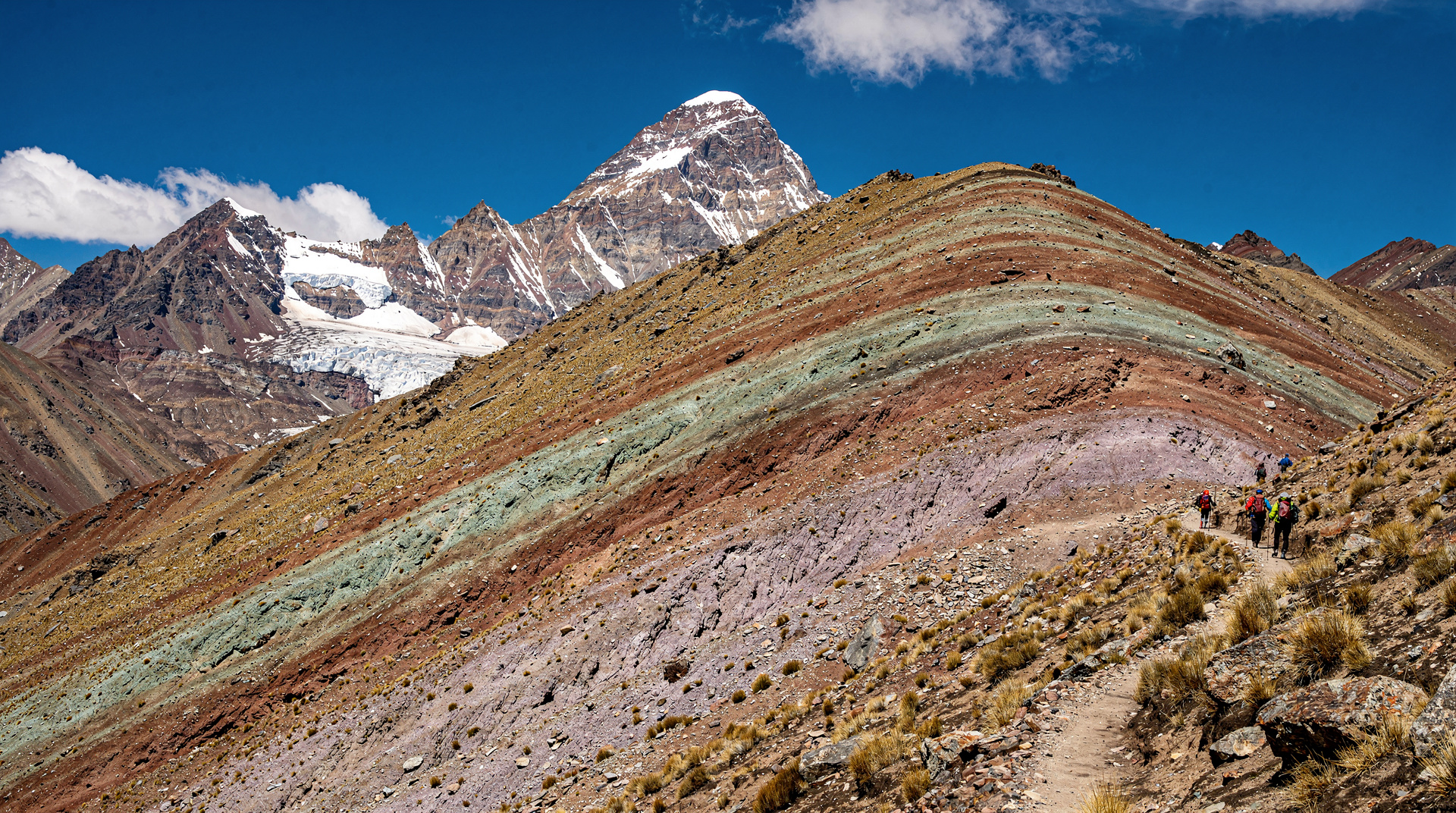
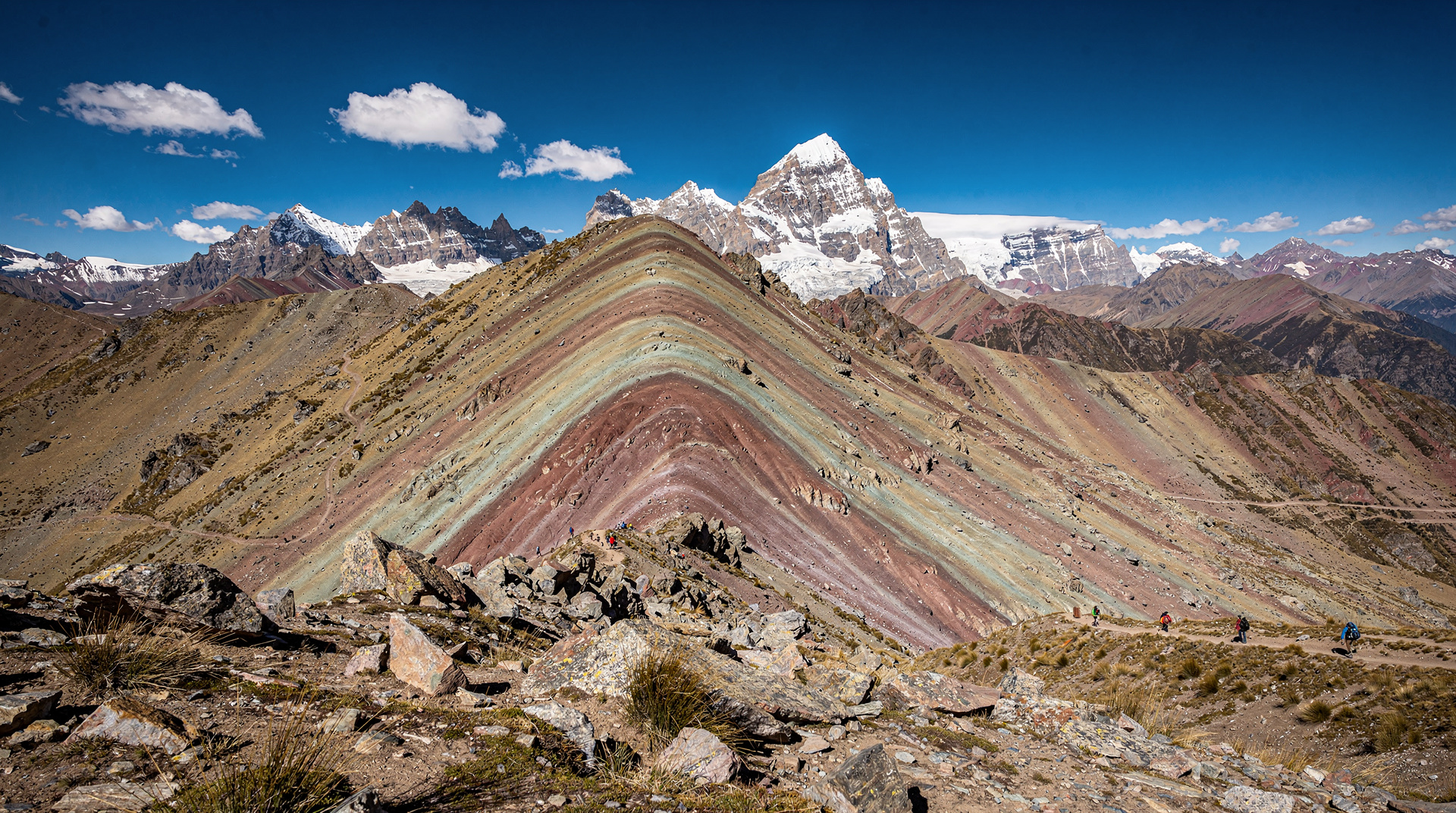
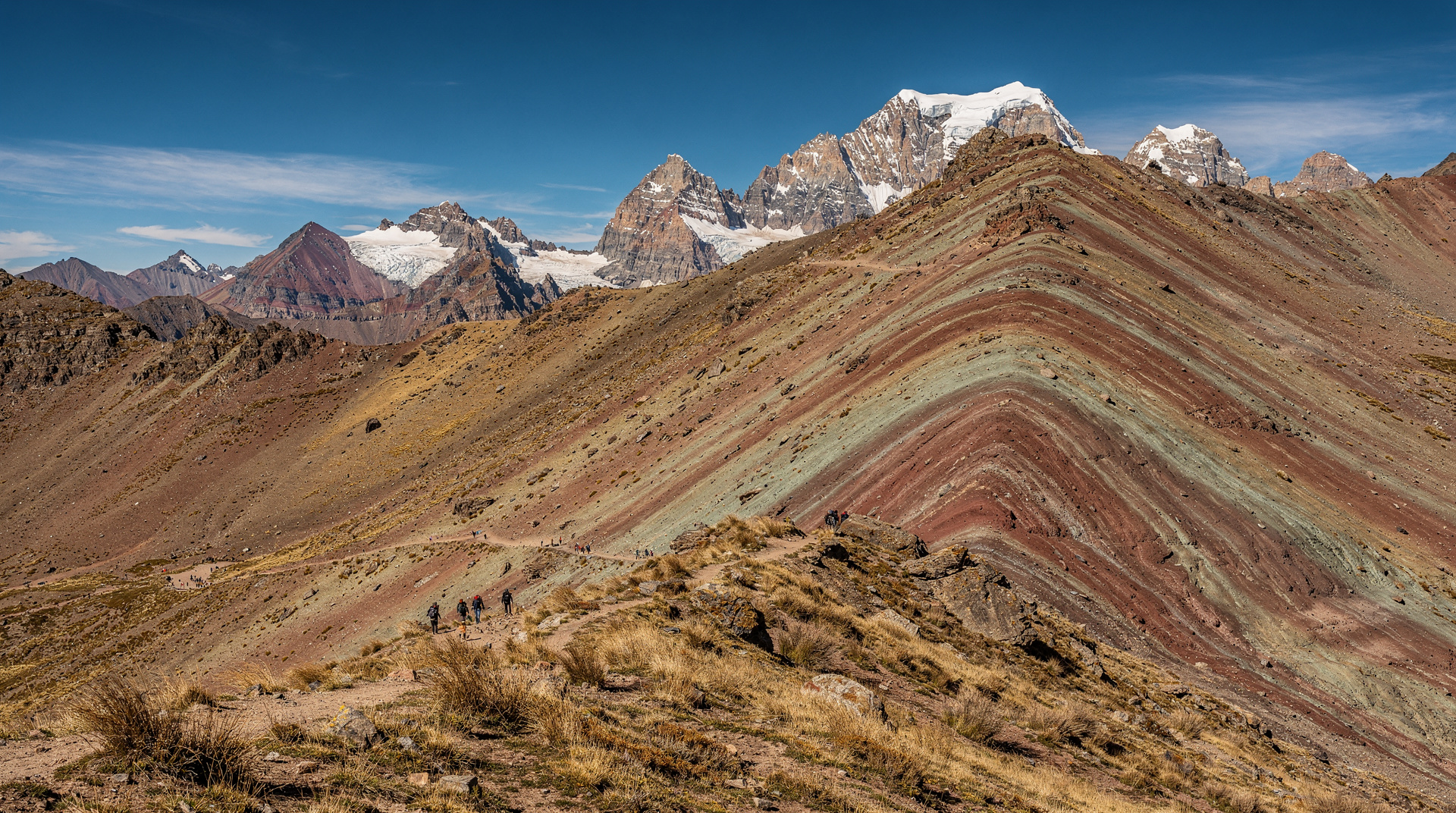
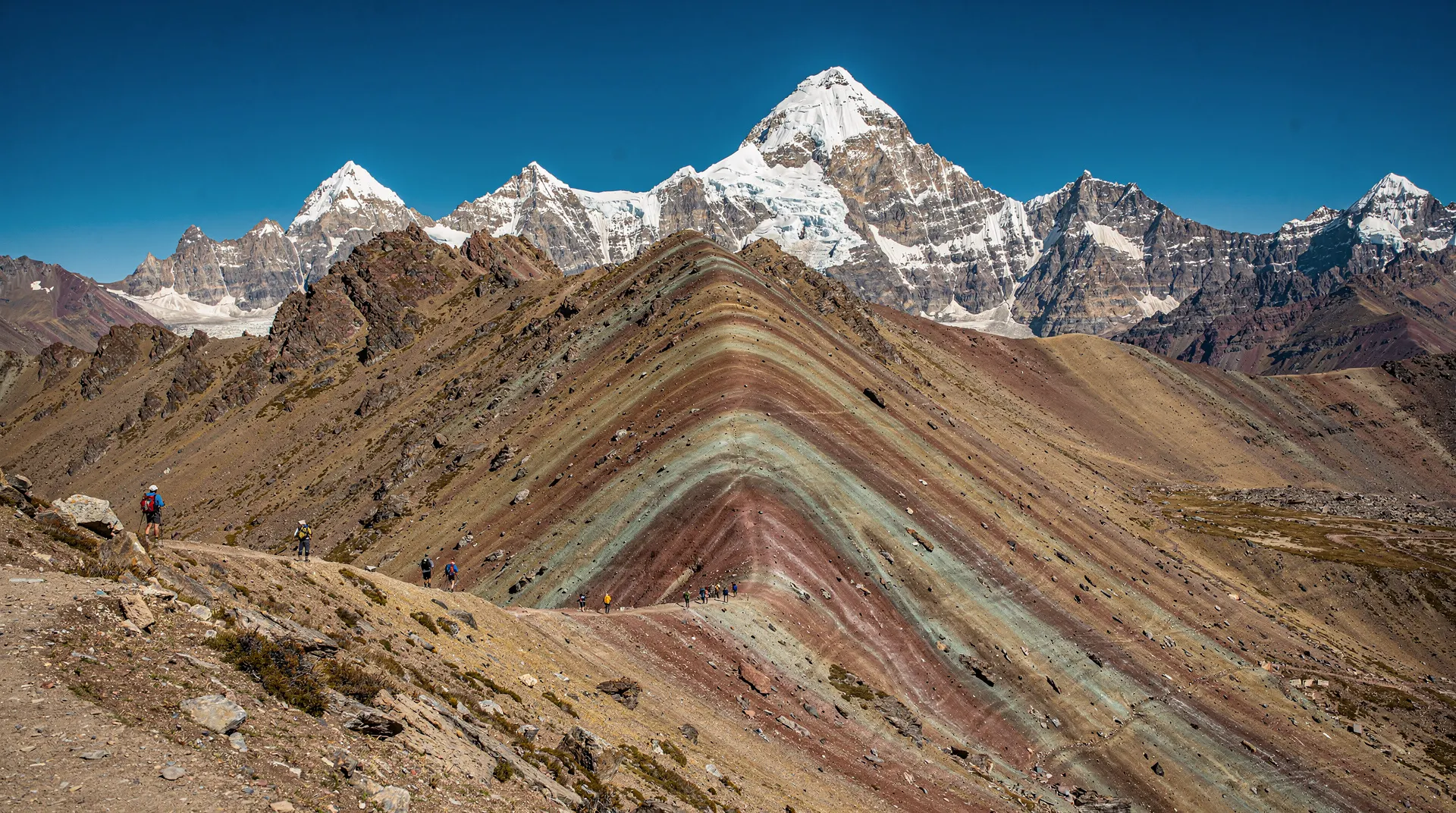
At the summit (5,200 m), on a clear dry-season morning, the view is extraordinary — the striped flanks of Vinicunca in red, ochre, yellow, green and purple, set against the snowy bulk of the Ausangate massif behind. Give it at least 30 minutes at the top. Descend by the same path.
Back at the trailhead by midday, the group typically stops for lunch (included in most tour packages, or order at the small comedores near the trailhead for S/20–30). Return drive to Cusco takes 2.5–3 hours; you will arrive late afternoon, tired and high-altitude depleted.
Should you consider Palccoyo instead? If altitude is a genuine concern — you have previously suffered severe altitude sickness, you are travelling with elderly companions, or the timing does not allow for the Sacred Valley night — Palccoyo is the honest alternative. At 4,900 m versus 5,200 m at Vinicunca, with a shorter, flatter 3-km walk, the Palccoyo full-day tour offers a real rainbow-mineral-mountain experience with significantly less physiological demand. See Vinicunca vs Palccoyo for a full comparison.
Check into your Cusco hotel in the late afternoon. Eat dinner — something substantial; the altitude burn has used your reserves — and sleep early. You have earned it.
Where to stay in Cusco: Historic centre or San Blas gives the easiest morning access to Cusco sights on day three. Mid-range options: Casa Andina Standard (S/280–380), Niños Hotel (fair-trade, S/260–340), or smaller guesthouses in the San Blas lanes (S/180–280).
Day 3: Cusco city — Qorikancha, San Blas, ruins
Altitude: 3,400 m
By day three, after two nights of progressive acclimatisation, your body can handle a proper Cusco day. Start at Qorikancha (Temple of the Sun, check current prices and opening hours on the official Qorikancha website). The perfectly fitted Inca stonework — no mortar, no gaps, laid with precision that modern engineers still debate — and the Spanish colonial convent built directly on top of it tells the story of the conquest more powerfully than any museum. Allow 45 minutes.
Walk up through the historic centre to the Plaza de Armas. The Cathedral (S/25) is worth an hour; the gilded chapels and the Cusqueño school paintings inside are extraordinary. Continue uphill to San Blas: the artisan quarter of narrow stone lanes and workshops. The carved pulpit in the tiny San Blas church — said to have been made from a single cedar trunk — is one of the technical marvels of colonial Peru.
In the afternoon, the half-day city ruins tour covers Sacsayhuamán, Q’enqo, Puca Pucara and Tambomachay with transport and a guide. Sacsayhuamán’s three zigzagging limestone walls — built with stones up to 125 tonnes, some transported from quarries kilometres away — are the defining Inca construction near Cusco. A guide makes the scale and the engineering legible. All four sites are on the Boleto Turístico (S/70 for the Cusco-area circuit). The tour typically finishes around 6 p.m., leaving time for a final dinner and pisco sour in the plaza.
Budget summary
| Category | Budget (S/) | Mid-range (S/) |
|---|---|---|
| Accommodation (2 nights) | 160–300 | 400–800 |
| Rainbow Mountain tour | 80–120 | 120–180 |
| Cusco ruins tour | 0 | 180–280 |
| Boleto Turístico (partial) | 70 | 70 |
| Meals (3 days) | 150–200 | 350–600 |
| Airport transport | 20–30 | 30–50 |
| Total per person | 480–920 | 1,070–1,980 |
At mid-range, expect S/1,100–2,000 per person for three days (roughly $295–540 USD), excluding international flights.
Honest tips
Cloud cover: On Rainbow Mountain, cloud and mist can obscure the colours even in dry season. Early departure (before 7 a.m. arrival at the citadel) is the most reliable strategy — clouds typically build from mid-morning. This is not something any operator can guarantee, and any agency that promises “guaranteed clear skies” is misleading you. See is Rainbow Mountain worth it for an honest assessment.
Altitude sickness: If you develop severe headache, vomiting, or disorientation before or during the Rainbow Mountain hike, descend immediately. The horses at the trailhead exist precisely for this. Altitude sickness at 5,200 m is not something to push through. See the altitude sickness in Cusco guide for emergency steps.
Combining with Machu Picchu: Three days cannot comfortably include both Vinicunca and Machu Picchu. If you want both, use the 5-day Cusco and Machu Picchu itinerary or the 7-day comprehensive plan.
Footwear and gear: Sturdy hiking boots or trail shoes with good ankle support make a real difference on the loose scree near the summit ridge. A trekking pole is genuinely useful for the steepest final section. Pack a down jacket regardless of the forecast — temperatures at 5,200 m can be 5–10°C colder than the trailhead, and wind on the exposed ridge is often sharp even under a clear sky.
What Rainbow Mountain actually looks like
There is a version of Rainbow Mountain that circulates endlessly on social media: a striped hillside in vivid bands of turquoise, rose, amber, and green under a cloudless sky, with a lone alpaca artfully positioned in the foreground. That photograph is real — it exists, that moment happens — but the conditions required to produce it are specific, and worth understanding before you plan around the image.
The colours of Vinicunca come from mineral deposits in the exposed sedimentary layers: red from iron sulphide, yellow from limonite, green from chlorite, white from calcium. These layers are always there. What changes is whether cloud, mist, or flat light obscures or flattens them. In the dry season (May–September), the combination of low humidity, clear skies, and direct high-altitude sunlight produces the saturated colours of the famous photographs. In the wet season, the same hill in diffuse mist looks considerably less dramatic.
Morning is always better than afternoon. By midday, even in dry season, cumulus cloud builds over the Vilcanota range and can cover the summit entirely by 11 a.m. The standard early departure (3–4 a.m. from Cusco, arriving at the trailhead around 6–7 a.m.) puts you at the summit before the cloud build, typically between 8 and 10 a.m. Groups that depart later — the cheaper, “relaxed departure” operators who leave at 6 a.m. — frequently arrive at the summit in full cloud. This is the most important factor in the quality of your experience, and it is why the 3 a.m. alarm is not optional.
The walk itself is 5 km each way with 900 m of elevation gain on well-maintained paths. You are walking from approximately 4,300 m to 5,200 m — a gain at altitude that takes a fit, acclimatised person 2–2.5 hours uphill. Horses are genuinely available and legitimately useful; this is not a sign of weakness. The path gets very crowded between 8 and 11 a.m. in high season — upwards of 1,000 people per day in peak months. Going in the shoulder season (May, September, October) gives noticeably thinner crowds and often better morning light.
At 5,200 m, the UV index is extreme even when the air feels cool. Sunscreen, lip balm, and sunglasses are not optional accessories — exposed skin burns in under an hour at this elevation. Bring a down layer regardless of the day’s forecast; the summit is frequently 5–10°C colder than the trailhead and wind can be sharp.
The Palccoyo question — honest answer
Every article about Rainbow Mountain mentions Palccoyo as the quieter, easier alternative. Both parts of that description are true, and the Vinicunca vs Palccoyo guide covers the comparison in full. The honest answer to “which should I choose” depends on two variables.
First, fitness and altitude tolerance. If the 5,200 m of Vinicunca is a genuine concern — you are travelling with elderly parents, have a history of altitude sickness, or simply have no trekking baseline — Palccoyo at 4,900 m with its flatter, shorter walk is the right call. You see rainbow-striped mountains (plural — three separate coloured ridges at Palccoyo), far fewer tourists, and with significantly less physiological demand.
Second, which photograph matters to you. The classic Vinicunca summit image is iconic. Palccoyo produces different images — wider panoramas, less dramatic peaks, more lateral spread. Neither is objectively “better,” but they are different.
On this three-day itinerary, the altitude preparation (Sacred Valley first night) makes Vinicunca a reasonable attempt for most normally fit adults under 60. If any doubt exists, the Palccoyo full-day is the conservative choice that still delivers a memorable high-altitude landscape experience.
Frequently asked questions about Cusco & Rainbow Mountain
Can I combine Rainbow Mountain and Machu Picchu in three days? Not comfortably. This itinerary dedicates two full days purely to altitude preparation before the Rainbow Mountain hike; adding Machu Picchu would mean cutting that preparation short. If you want both, use the 5-day itinerary or the 7-day comprehensive plan instead.
What if the weather looks bad on Rainbow Mountain day? Reputable operators rarely cancel outright, but cloud can obscure the summit colours, especially after mid-morning. Departing early (3–4 a.m.) gives you the best chance of clear views before the cloud builds. See what Rainbow Mountain actually looks like for realistic expectations by season.
Top experiences
Bookable activities with verified prices and instant confirmation on GetYourGuide.