A quick Inca history primer for travellers
Cusco: Half-Day City Tour with Sacsayhuaman and Q’enco
A quick Inca history primer
The Inca Empire (Tawantinsuyu) was the largest empire in pre-Columbian America, stretching 4,000 km along the Andes from modern Colombia to Chile. It lasted less than 100 years from Pachacuti's expansion (c.1438) to the Spanish conquest (1532–1572). The Inca were a small ethnic group who built a vast multi-ethnic state through military conquest, strategic alliance, and sophisticated labour and redistribution systems. Reading a short history primer before you visit Cusco transforms what you see.
Why you need this before you arrive
Every site you will visit in and around Cusco — every wall, terrace, carved stone, and drainage channel — was built within a specific historical, religious, and administrative context. Without that context, the sites are impressive but opaque. With it, the engineering decisions at Sacsayhuamán, the spatial organisation of Qorikancha, and the unfinished monoliths of Ollantaytambo all become legible — parts of a coherent story about a society that built an empire in a century and lost it in two years.
| Extent | Around 4,000 km along the Andes, Colombia to Chile |
| Duration | Under 100 years (c.1438–1533 as a unified empire) |
| Population | Estimated 10–12 million people |
| Key sites near Cusco | Sacsayhuamán, Qorikancha, Ollantaytambo, Pisac |
| Best primer time | Read before, not during, your first site visit |
This guide is not a comprehensive history of the Inca. It is a practical primer oriented towards what you will actually see on the ground. It covers the people, the mechanisms of empire, the architecture, and the end of Tawantinsuyu — in a sequence designed to help you interpret what you find when you get there.
Who the Inca were
The people commonly called the Inca were originally a small ethnic group — the Inca, or Inka — inhabiting the Cusco valley in the southern Peruvian Andes. The term “Inca” in strict usage refers to the ruling class and specifically to the Sapa Inca (the emperor himself). The broader empire and its population are more properly called Tawantinsuyu, which translates approximately as “the four parts joined together,” referring to the four suyu (regions) that radiated from Cusco as the imperial centre.
Before the expansion of the empire in the fifteenth century, the Inca of the Cusco valley were one of many competing ethnic groups in the fragmented political landscape of the central Andes. They were not obviously destined for regional dominance. The transformation from regional competitor to continental empire happened primarily during the reign of a single ruler.
Pachacuti and the century of expansion
The Inca emperor Pachacuti — his name means “world transformer” or “earth shaker” — came to power around 1438 following a military crisis in which the neighbouring Chanka confederation attacked the Cusco valley. His father, the reigning Inca Viracocha, reportedly fled. Pachacuti stayed, defeated the Chanka, and used the victory as the foundation for a programme of expansion that within his reign extended Tawantinsuyu from its Cusco valley core to cover most of the central Andes.
His son Tupac Yupanqui continued the expansion north into Ecuador and south into Chile and Argentina. His grandson Huayna Capac pushed the northern frontier into modern Colombia. By approximately 1530, Tawantinsuyu extended roughly 4,000 km along the Andes and coastal strip, from the Ancasmayu river in the north to the Maule river in the south — the largest empire in the pre-Columbian Americas and one of the largest in the world at that time.
The buildings you see in Cusco and the Sacred Valley were largely constructed in this century of expansion. Qorikancha in its final form dates to Pachacuti’s reign. Sacsayhuamán was begun under Pachacuti and completed under his successors. Ollantaytambo was constructed under Pachacuti. The terraces of Moray were refined under Pachacuti or his immediate successors. In historical terms, everything you see is very recent — a burst of construction in the third quarter of the fifteenth century, interrupted by conquest.
How the empire actually worked
The Inca state operated through two mechanisms that explain virtually every architectural and archaeological feature you encounter.
The mit’a system: Every adult male in Tawantinsuyu owed a fixed period of labour to the state each year. This was not slavery — workers were fed, clothed, and housed by the state during their service, and the period of obligation was finite. But it was comprehensive: mit’a labour built the roads, terraces, storehouses, and monumental architecture of the empire. The estimated 40,000–50,000 workers engaged on Sacsayhuamán at peak construction were mit’a workers, mobilised, organised, and supplied by the state. The Inca had no money economy in the conventional sense; the road system, the storehouses (qollqa), and the redistribution infrastructure were the economy.
The ceque system and state religion: Tawantinsuyu was not simply an administrative empire but a religious one. The Inca emperor was the son of Inti, the sun god, and the legitimacy of the imperial project was explicitly theological. The ceque system — 41 imaginary lines radiating from Qorikancha through the Cusco valley, linking 328 sacred sites (huacas) — integrated cosmology, calendrical astronomy, water management, and social organisation into a single structure. The maintenance of each ceque line and its huacas was assigned to specific social groups, making the religious landscape simultaneously a civic one.
Reciprocity and redistribution: The state extracted labour and goods through the mit’a and reciprocated through massive redistribution. Storehouses throughout the empire held food, textiles, and weapons. In times of crop failure or military campaign, the state drew on these reserves. The system was sophisticated enough to support multi-year campaigns at the imperial frontiers without the tax-and-payment mechanisms that other ancient empires used.
Reading Inca architecture
Inca architecture is instantly recognisable, but several of its most important features require explanation to be understood:
Trapezoidal forms: Doorways, windows, and niches in Inca buildings are almost universally trapezoidal — wider at the base than at the top. This form has both structural and aesthetic functions. Structurally, the tapering reduces the weight carried by the lintel. Aesthetically, it creates the characteristic Inca silhouette that distinguishes their buildings from all other architectural traditions of the Americas.
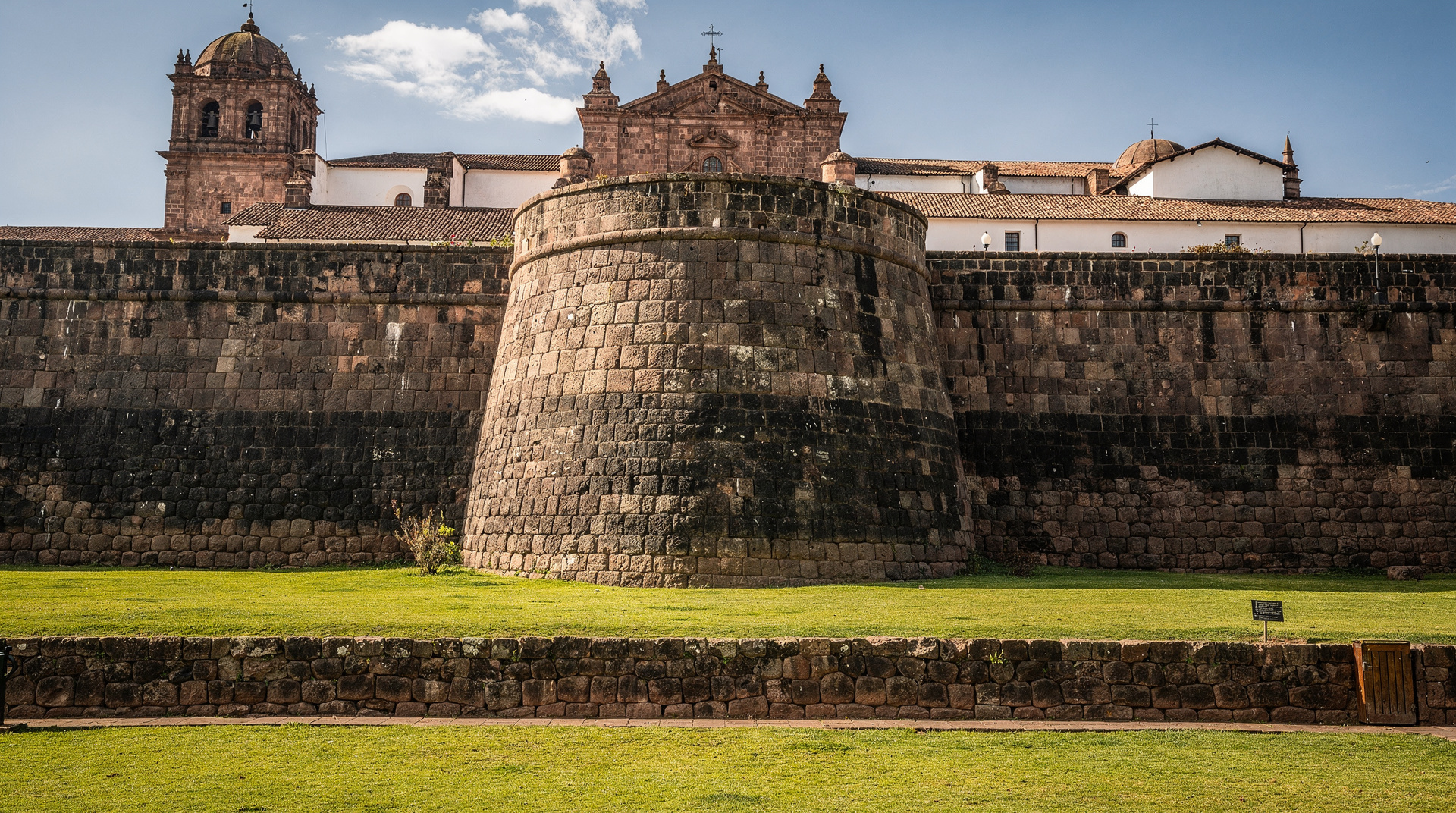
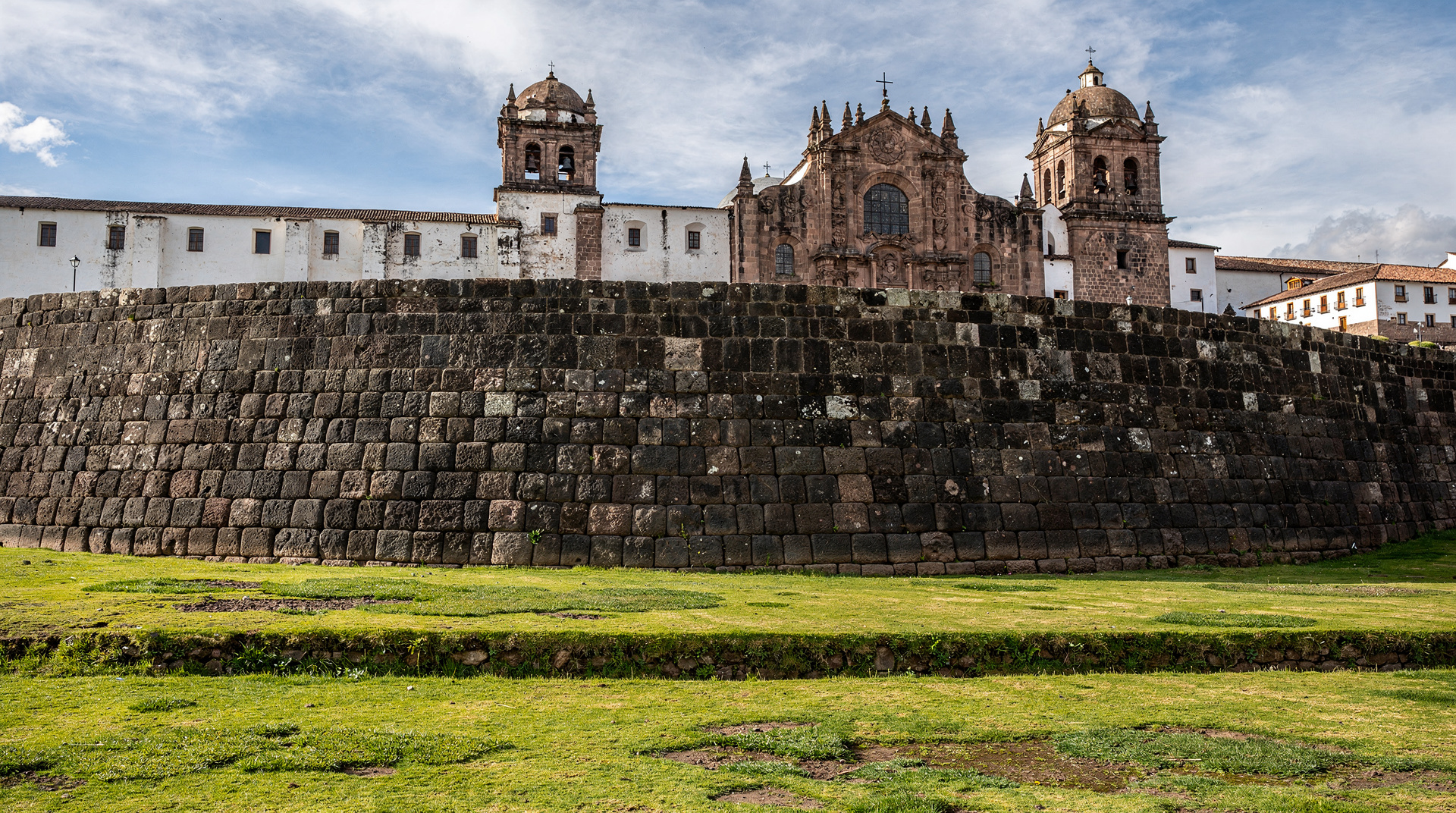
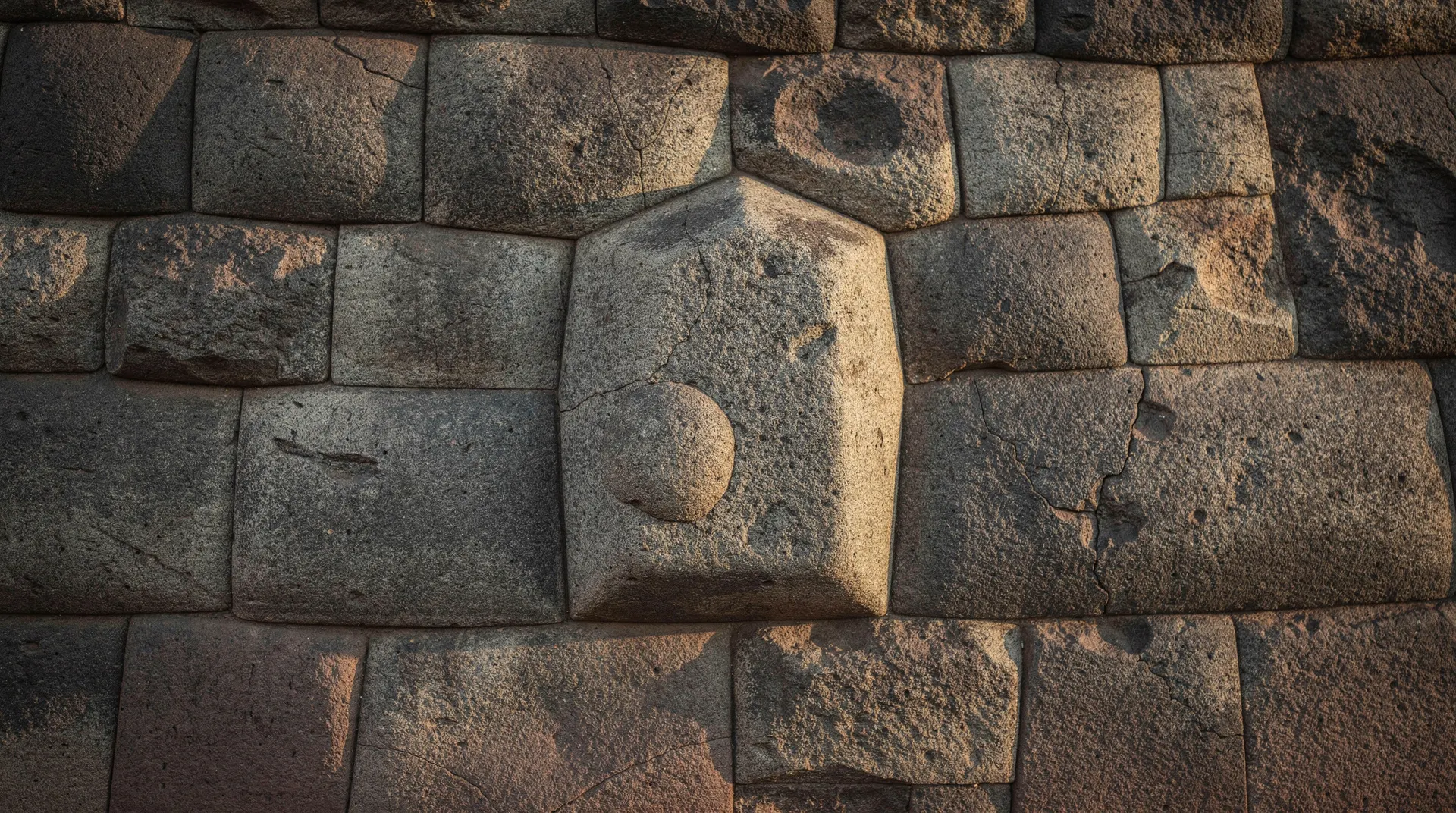
No mortar: High-status Inca masonry is famously mortar-free. The stones are fitted with extraordinary precision through a process of incremental adjustment — each stone is shaped to fit its neighbours, with surfaces ground against each other until the joint closes. The precision serves a practical purpose in a seismically active environment: mortar-free joints can flex slightly during earthquakes, distributing energy rather than cracking rigidly. The Inca walls at Qorikancha survived the 1950 Cusco earthquake while the colonial structure built over them was severely damaged.
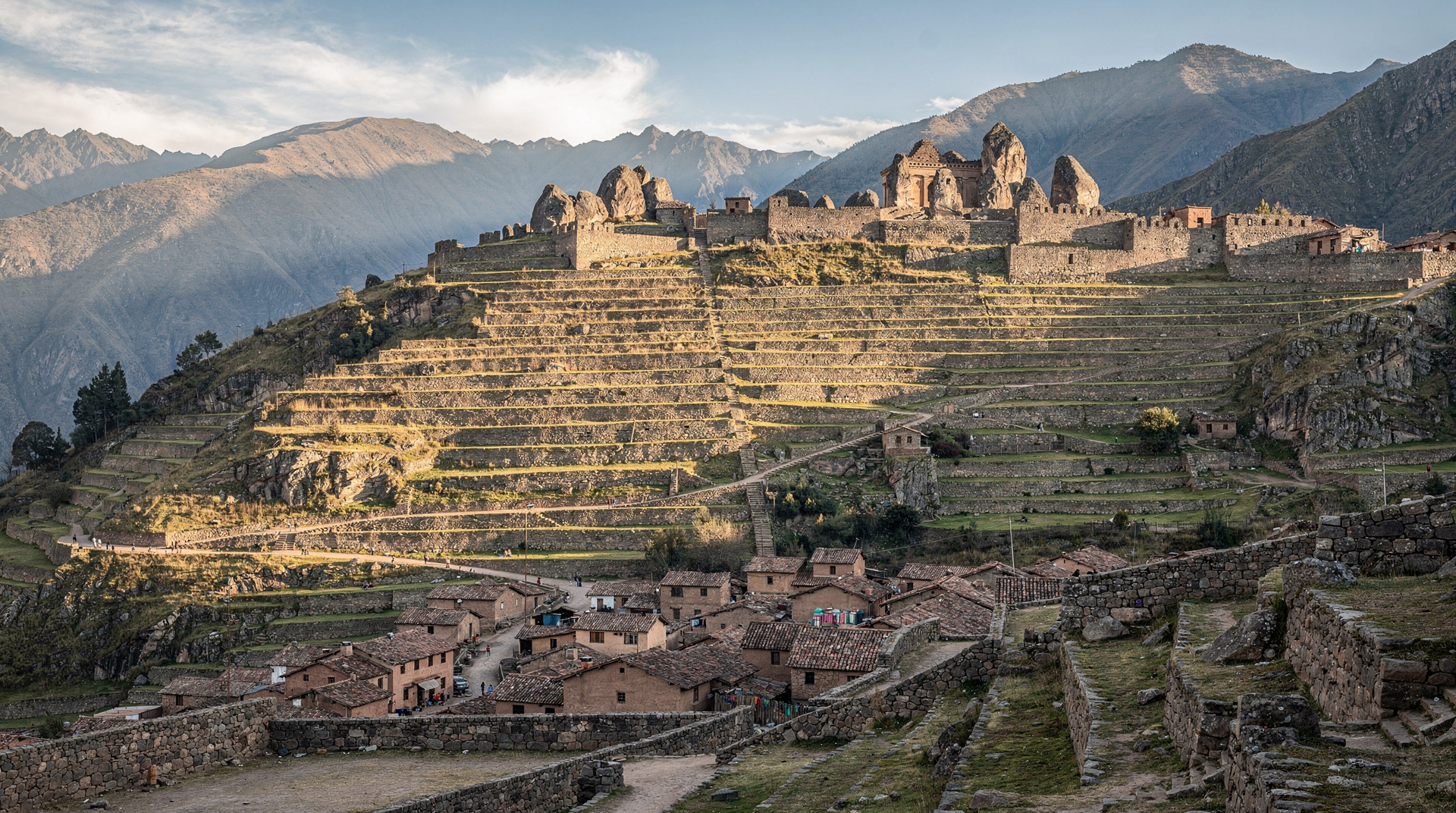
Bosses and protrusions: The T-shaped or cylindrical projections seen on some Inca stone faces (notably at Ollantaytambo) are construction aids — rope anchor points used during transport and positioning of blocks. In a finished building they were normally cut away. Their presence at Ollantaytambo indicates the site was incomplete at the Spanish conquest.
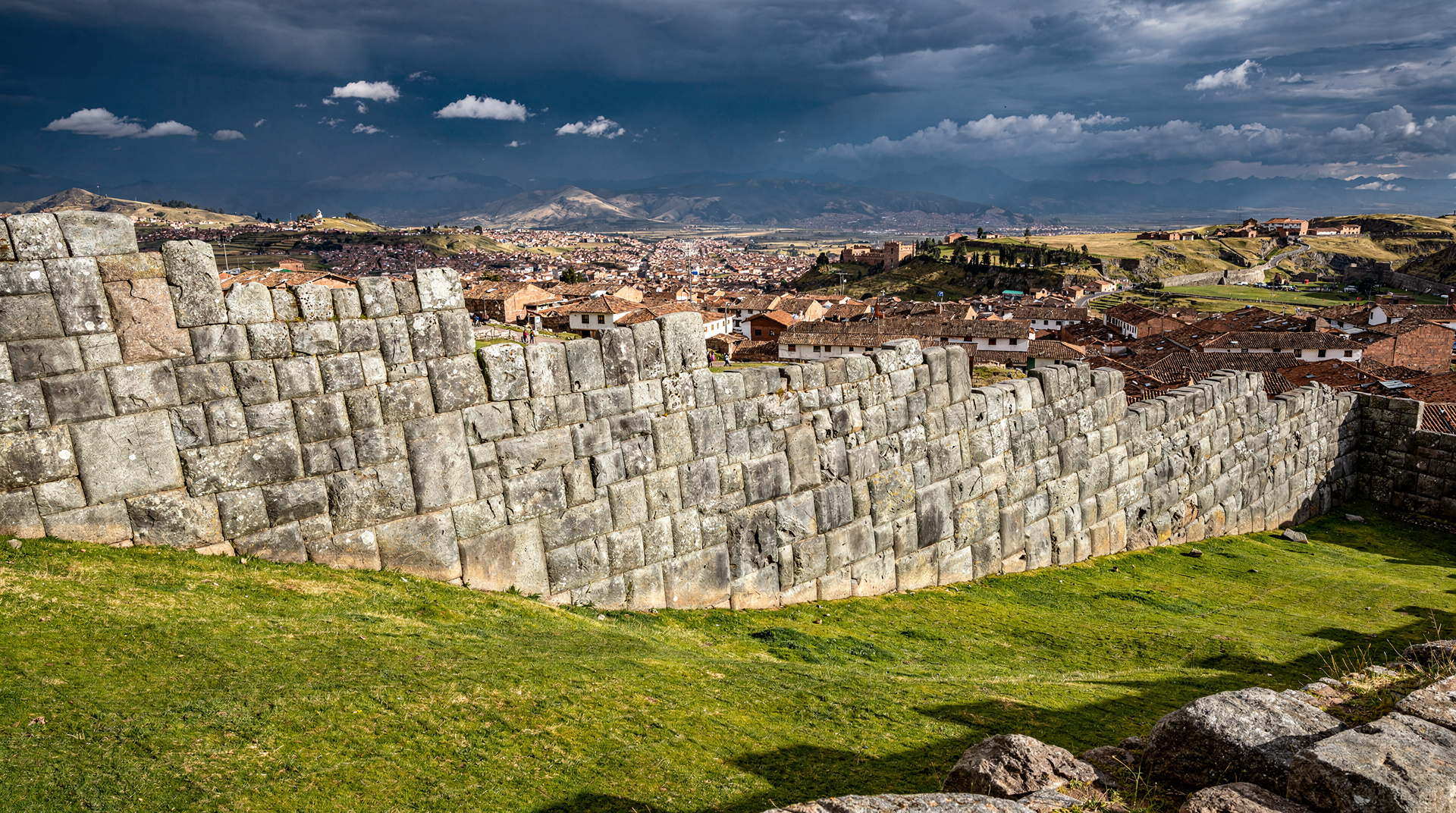
The distinction between Sacsayhuamán and Qorikancha: The polygonal masonry of Sacsayhuamán (large irregular blocks fitted like a puzzle) and the ashlar masonry of Qorikancha (regular rectangular courses of precisely cut stone) reflect different functions and possibly different construction phases. The ashlar technique requires more skilled labour and produces a more refined surface; it was reserved for the highest-status religious structures.
Before the Inca: the longer sequence
The Inca were not the first complex society in the Andes. The sequence of civilisations that preceded them is relevant because the Inca were themselves a product of this long history — they inherited road alignments, agricultural terracing techniques, textile traditions, and religious concepts from earlier cultures.
Chavín (c.900–200 BC): A highland religious complex in northern Peru whose iconography — the staff god, the fanged supernatural being — spread across the Andes and influenced later cultures for millennia.
Tiwanaku (c.100–1000 AD): Centred on Lake Titicaca, this civilisation developed raised-field agriculture, distinctive carved stone architecture, and a religious iconography that influenced Andean cultures widely. Some researchers trace elements of Inca sun worship to Tiwanaku origins.
Wari (c.600–1000 AD): An expansive empire based in Ayacucho that constructed provincial administrative centres across the Andes, including Pikillacta south of Cusco. Wari road systems, terracing, and administrative techniques foreshadow Inca practices — the relationship between the two is debated but significant.
Chanka: The confederation whose attack on Cusco precipitated Pachacuti’s rise. They are the immediate predecessor context for understanding why the Inca expansion began when it did.
It is worth resisting the common tendency to treat “pre-Inca” as a single undifferentiated category. The gap between Chavín and the Inca is roughly as long as the gap between the Roman Empire and the present day — these were distinct societies with distinct technologies, languages, and political structures, not a single continuous culture that merely changed its name. The Inca were the final and most successful phase of a genealogy of Andean state-building that had already been running for well over two thousand years by the time Pachacuti came to power.
The fall: disease, civil war, and conquest
The end of Tawantinsuyu is one of the most dramatic collapses of a major empire on record, and it was caused by a convergence of factors that the Inca could not have anticipated.
Disease: Smallpox arrived in the Andes before the Spanish themselves — carried through the indigenous trade networks from earlier contact points in Central America. By the time Francisco Pizarro arrived in 1532, estimates suggest that 50–90% of the Andean population had already died in successive waves of epidemic disease. The Inca emperor Huayna Capac died of smallpox (or a related disease) around 1527, triggering a succession crisis.
Civil war: Huayna Capac’s death left two sons — Huáscar, based in Cusco, and Atahualpa, based in Quito — in a war for succession. Atahualpa won shortly before Pizarro’s arrival, but the civil war had fractured the military and political coherence of the empire. Many recently conquered groups saw the Spanish as potential allies against Inca domination.
The Spanish conquest: Pizarro captured Atahualpa at Cajamarca in November 1532 through a combination of diplomatic deception and military shock. The ransom paid for Atahualpa — a room filled with gold — was the single largest looting event in the history of the Americas. Atahualpa was then executed. Cusco fell in November 1533. Inca resistance continued in the jungle stronghold of Vilcabamba until 1572, when the last Inca ruler Tupac Amaru I was captured and beheaded.
What the conquest destroyed
The standard frame for the Spanish conquest emphasises what was gained — wealth, territory, souls converted. The Inca frame requires accounting for what was lost: a sophisticated administrative system that managed food security for tens of millions of people across one of the most challenging environments on earth; an astronomical and calendrical knowledge system encoded in the ceque network and the quipu records; a textile tradition that used over 150 distinct natural colours and produced fabrics of extraordinary technical quality; and a living religious landscape in which the ancestors were present participants in daily life.
Most of the quipus were burned as idolatrous objects. Most of Qorikancha’s gold was melted down within months of the conquest. Sacsayhuamán’s upper structures were dismantled to build Cusco’s colonial city. The cemetery cliffs at Pisac were systematically looted. What you see today is what survived, not what existed.
Understanding this is not an exercise in guilt or political argument — it is simply the factual context without which the sites cannot be fully interpreted. The scale of what is missing makes the scale of what remains all the more significant.
A note on guided visits
Reading this guide before you visit will help. Reading it before a guided half-day city tour will help more. A guide who knows the history, the construction sequence, and the religious function of each building can give you in two hours what several books cannot fully convey — not because books are inadequate but because the combination of physical presence and explanatory context is qualitatively different from reading alone.
The guide to Inca archaeological sites around Cusco applies this historical framework to the specific sites you will visit in and near the city. The Sacsayhuamán guide and the Qorikancha guide go into site-specific detail. The 4-day Cusco and Machu Picchu itinerary builds the history learning into a day-by-day structure that puts sites in the right interpretive sequence.
The history is worth learning. The sites are worth the effort. And the story of how a small group of people in a highland valley built the largest empire in the western hemisphere in a single generation — using knotted strings for records, organised labour for infrastructure, and an astronomical religion to hold it all together — is one of the most remarkable stories in human history.
Choosing how to put the history into practice
If the stonework and religious landscape are what interest you most, a guided walk through the old centre pairs well with this primer: a city tour that covers Qorikancha and Sacsayhuamán lets you compare the ashlar and polygonal masonry described above within a single outing. If you would rather feel how the state moved people and goods, walking part of the road network does that better than any museum, and a guided multi-day trek on the Inca Trail follows stretches of that engineering on foot. Either choice works best once you have the timeline below in your head.
A rough timeline to keep in your head
Visitors often find it useful to hold a simple sequence in mind rather than a list of isolated dates, since almost everything you will see near Cusco compresses into a surprisingly short window:
| Period | Event | What survives to see |
|---|---|---|
| Pre-1000 AD | Wari and Tiwanaku influence spreads across the Andes | Pikillacta (Wari provincial centre) |
| c.1200s–1430s | Inca a regional power among many in the Cusco valley | Early Cusco street plan foundations |
| c.1438 | Pachacuti defeats the Chanka, expansion begins | Qorikancha, Sacsayhuamán begun |
| 1438–1493 | Pachacuti and Tupac Yupanqui expand the empire | Ollantaytambo, Moray terraces |
| 1493–1527 | Huayna Capac extends the northern frontier | Continued monumental construction |
| 1527–1532 | Smallpox epidemic, Huáscar–Atahualpa civil war | — |
| 1532–1533 | Pizarro captures Atahualpa, Cusco falls | Colonial buildings atop Inca foundations |
| 1533–1572 | Vilcabamba resistance, final Inca ruler captured | Vilcabamba ruins (remote, rarely visited) |
Connecting the history to what you will actually walk through
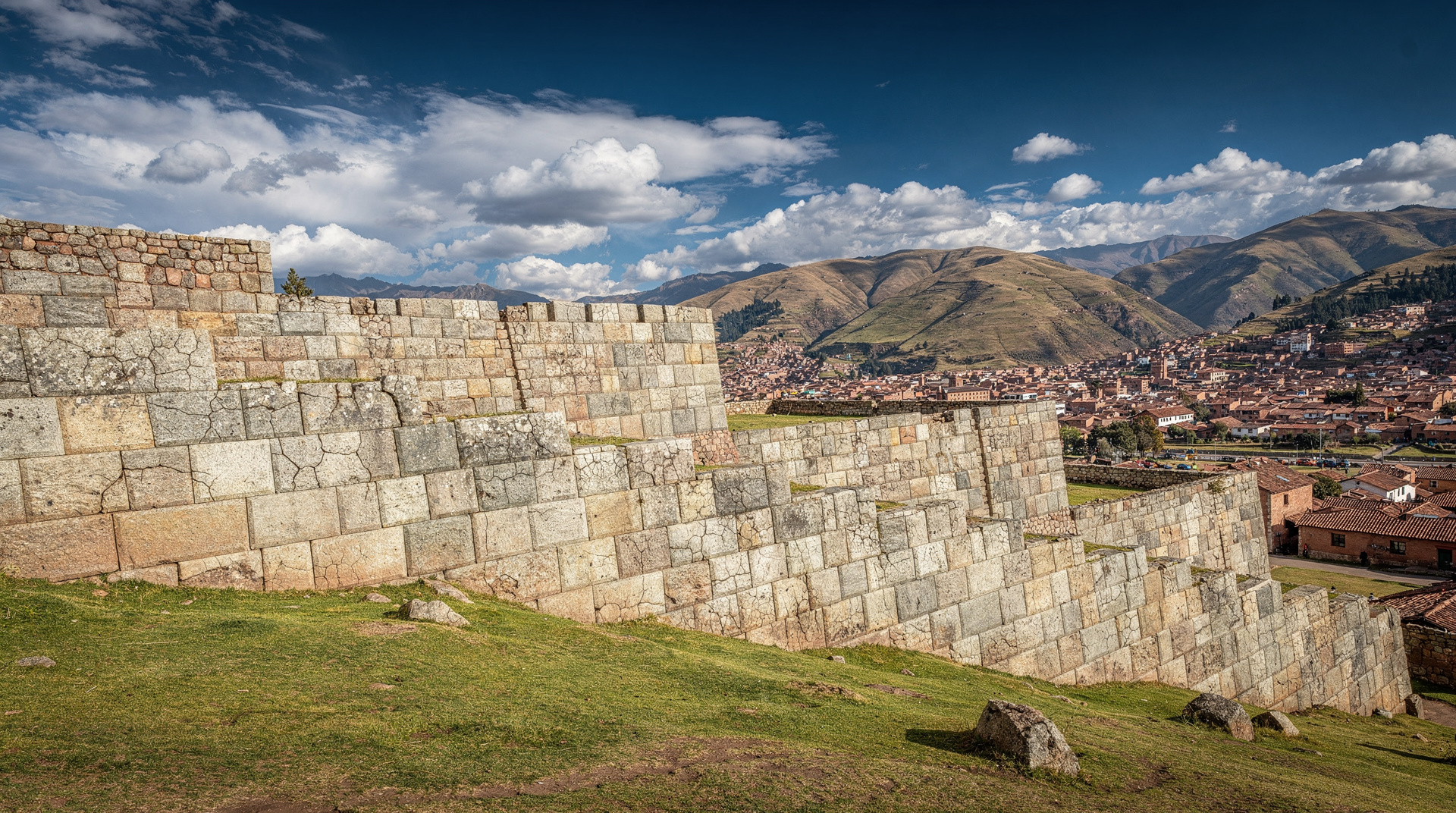
Reading this timeline is one thing; recognising it on the ground is another. When you stand at Sacsayhuamán looking at the three-tiered zigzag walls, you are looking at roughly the same decades that produced the ashlar stonework at Qorikancha and the unfinished terraces at Ollantaytambo — a single, extraordinarily compressed building programme rather than centuries of gradual accumulation the way most historic European or Asian capitals developed. The Pisac ruins above the market, similarly, belong to this same imperial expansion, sited to control the eastern approach to the Cusco valley and the agricultural terraces below.
Where to take the story next
Once the outline is in your head, the most useful step is to match each chapter of it to a place you can actually stand in. The pre-Inca layers show up at Pikillacta and Tipón in the south valley, and the south valley day trip is a quiet way to see them away from the main crowds. The agricultural ingenuity described above is easiest to grasp at Maras and Moray, and the Moray terraces guide and the Maras salt mines guide explain how farming and the state economy fitted together.
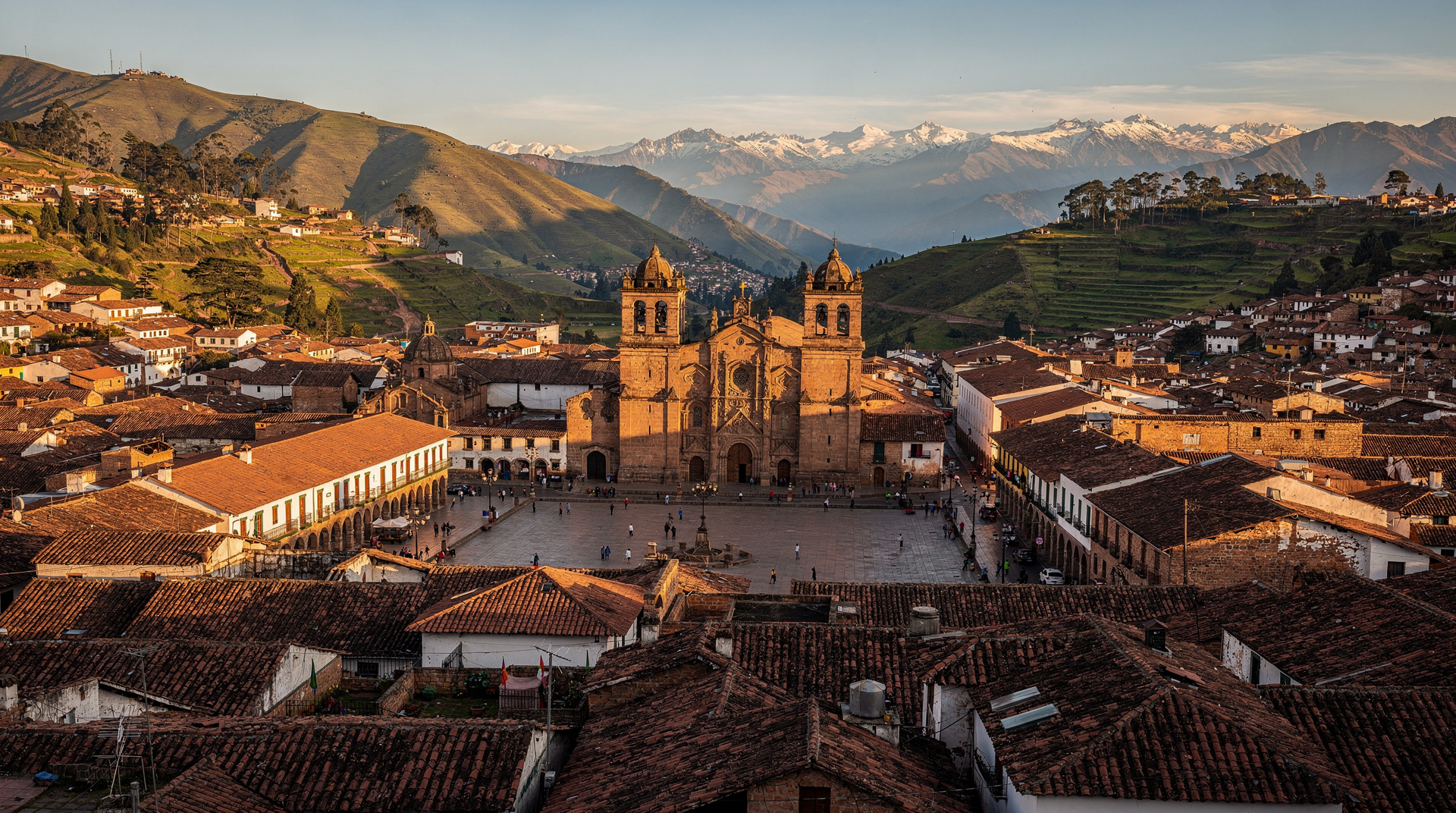
For the imperial centre itself, the historic centre of Cusco and the lanes of San Blas still follow Inca foundations, with colonial buildings sitting directly on top of older walls. The small shrines and water works at Tambomachay, Qenqo and Puka Pukara show the religious landscape in miniature, which is a good place to remember the ceque idea. Further along the valley, Pisac and Ollantaytambo show how the Inca organised and defended a frontier of terraces and fortified towns.
If you want to see how this played out on the ground at the empire’s most famous estate, Machu Picchu is the obvious next chapter, and the complete Machu Picchu guide covers how to approach it. Walking part of the old road network is another way to feel the scale of the state: the Inca Trail is the best known, while the Inca Trail complete guide helps you decide whether it suits you. For living culture rather than ruins, the Quechua culture guide and the Andean textiles guide connect the textile and language traditions mentioned above to people who still practise them today.
A final practical point: the history is easier to absorb when you are not struggling with the altitude, so give yourself time to settle in before the heavier site days. The Cusco acclimatization plan and the Sacred Valley guide are good companions when you are deciding how to order your first few days.