Chinchero
Chinchero sits above the Sacred Valley at 3,760 m, blending Inca stonework, a colonial church and living weaving cooperatives. Sunday market is its best
Cusco: Pisac, Maras, Moray, Ollantaytambo Small Group Tour
Quick facts
- Country
- Peru
- Altitude
- 3,760 m / 12,336 ft
- Currency
- Peruvian sol (S/) — USD widely used
- Best for
- Traditional weaving, Inca foundations, colonial church, local Sunday market
Above the valley, between two worlds
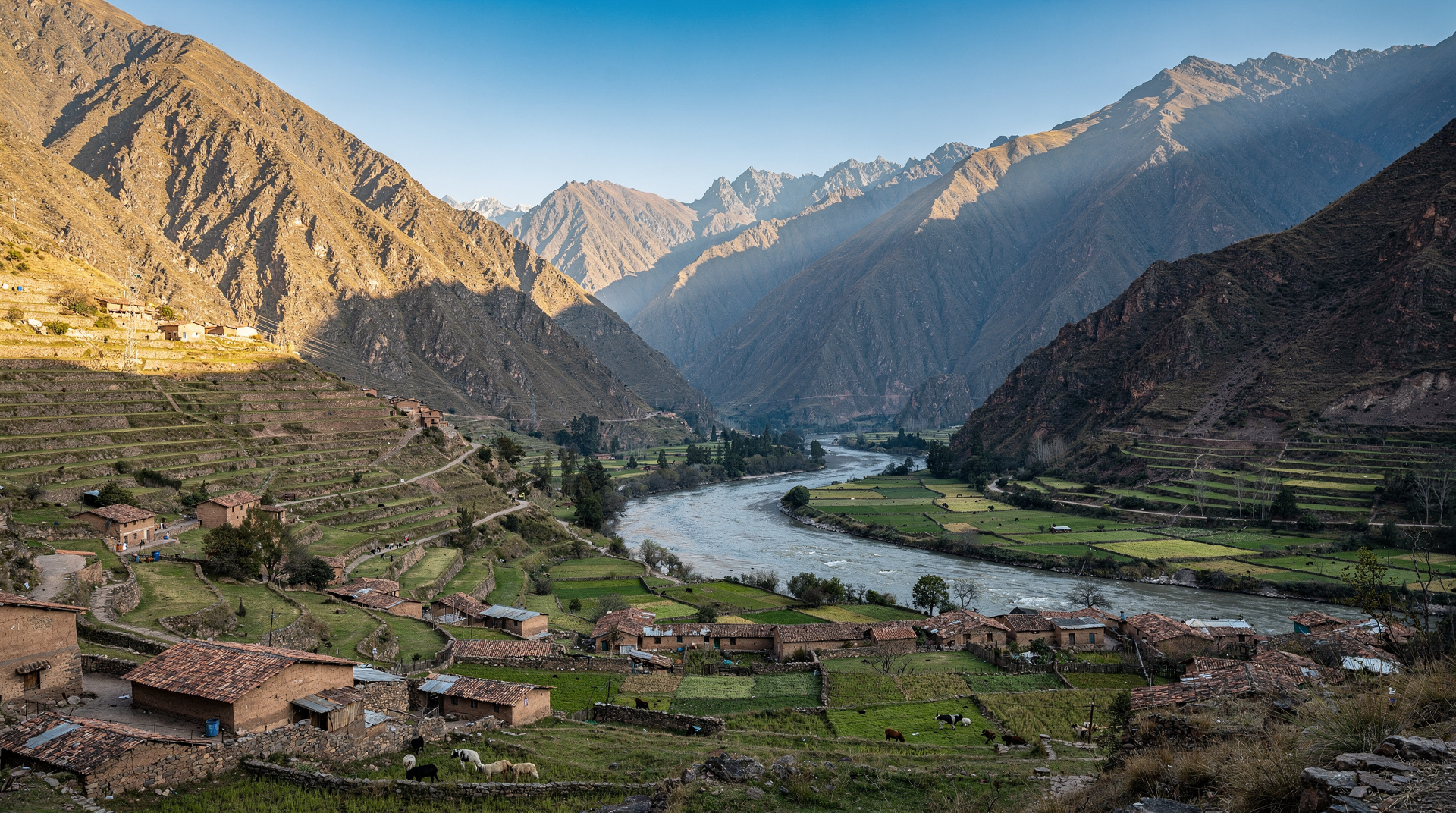
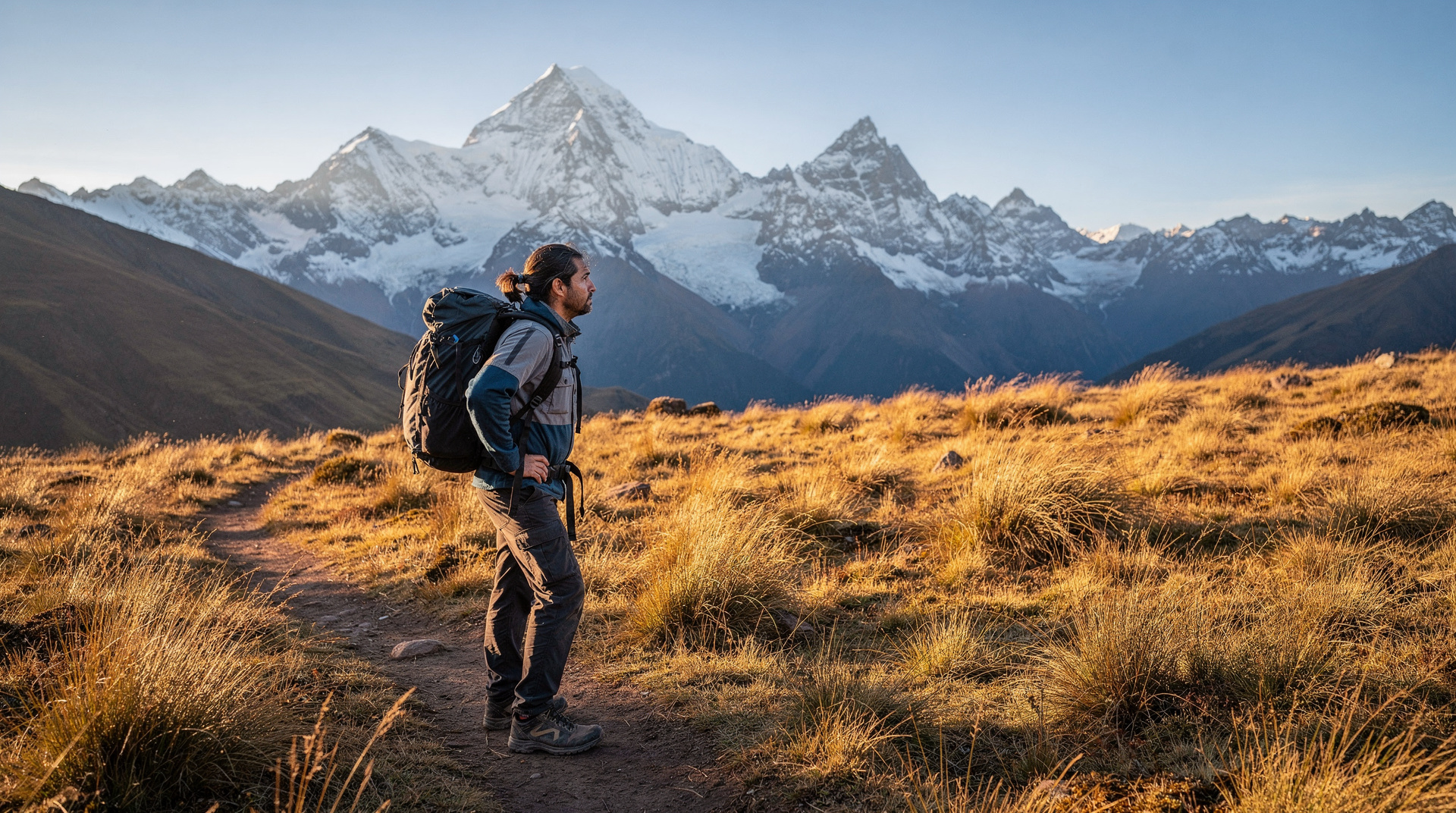
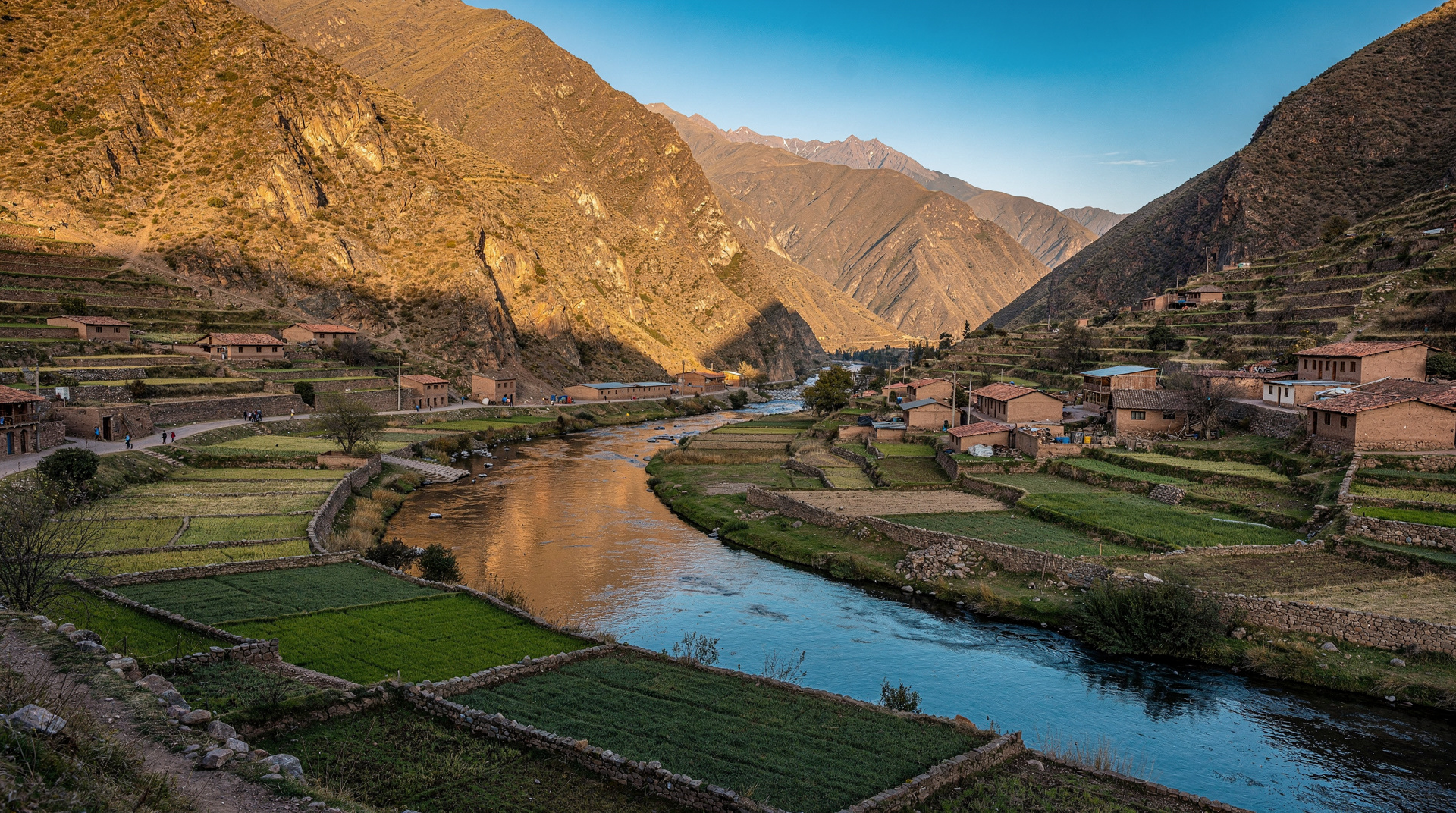
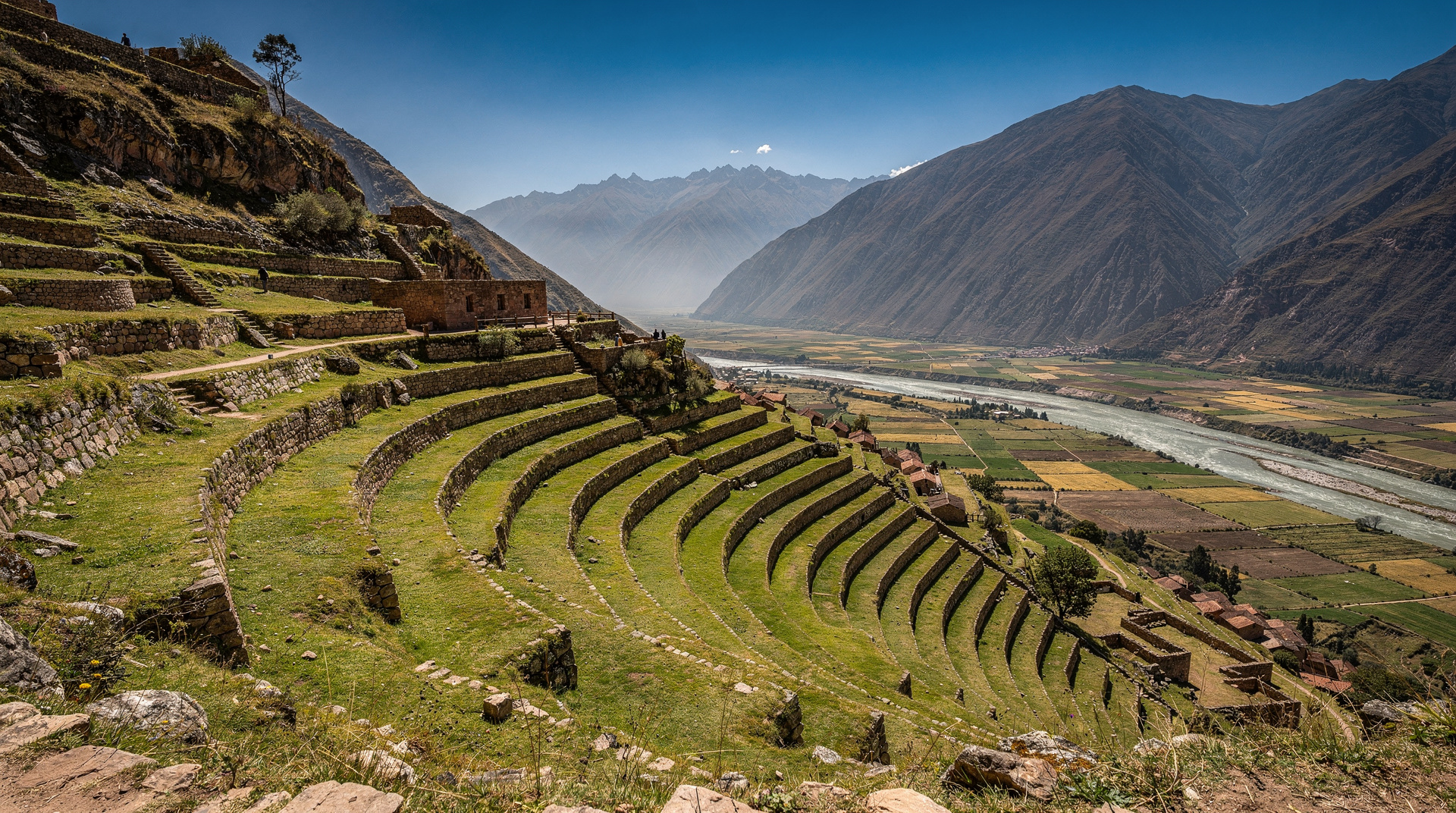
Chinchero does not sit in the Sacred Valley — it sits above it, on a broad plateau at 3,760 m that gives it a different character from the warmer, lusher valley floor below. You feel the extra altitude here: the air is noticeably thinner than in Pisac or Urubamba, the light is harder, and the surrounding landscape is treeless and windswept in a way that feels closer to the high puna than to the sheltered valley. The views back towards Cusco and across to the distant snowline are exceptional on clear mornings.
What brings travellers to Chinchero is a combination of three things: Inca stonework, a colonial church built directly on Inca foundations, and — more than either of those — a network of women’s weaving cooperatives that keep alive a textile tradition running continuously from before the Spanish arrived. Of the three, the weaving is the most distinctive and the hardest to find anywhere else in the region at this level of authenticity.
| Where | Sacred Valley plateau, 28 km northwest of Cusco |
| Time needed | 2–3 hours, half-day with Maras and Moray |
| Getting there | Collectivo ~S/5–7, taxi ~S/40–60, or guided tour |
| Cost | Church admission via Boleto Turístico (~S/130 full circuit) |
| Best time | Sunday for the market; mornings for the church |
Inca foundations and a colonial church
The Spanish practice of building Christian churches on top of Inca temples was partly theological — to replace one sacred site with another — and partly practical, since the Inca masonry was already there and already level. Chinchero’s church is one of the clearest examples of this process anywhere in Peru. The outer walls of the original Inca structure are still visible and intact: large, precisely fitted stones in the characteristic Inca style, slightly inset from the plastered colonial surface that rises above them. The contrast in construction method is stark and instructive.
Inside the church — which dates from the 17th century and is open to visitors during daylight hours — the walls are covered with vivid colonial frescoes depicting saints, the Virgin, religious processions and scenes from the life of Christ rendered in a style that blends European iconography with Andean colour and composition. This regional interpretation of Catholic imagery, sometimes called Escuela Cusqueña (Cusco School), is distinct from anything painted in Europe and well worth pausing over. Admission is covered by the Cusco Boleto Turístico (~S/130 for the multi-site circuit).
Adjacent to the church, the remains of the Inca complex include a large trapezoidal plaza, several carved rock niches and what appears to have been a royal palace associated with the Inca Túpac Yupanqui. The stonework quality is high, though the site is less extensively preserved than Ollantaytambo or the upper sections of the Pisac complex.
The weaving cooperatives
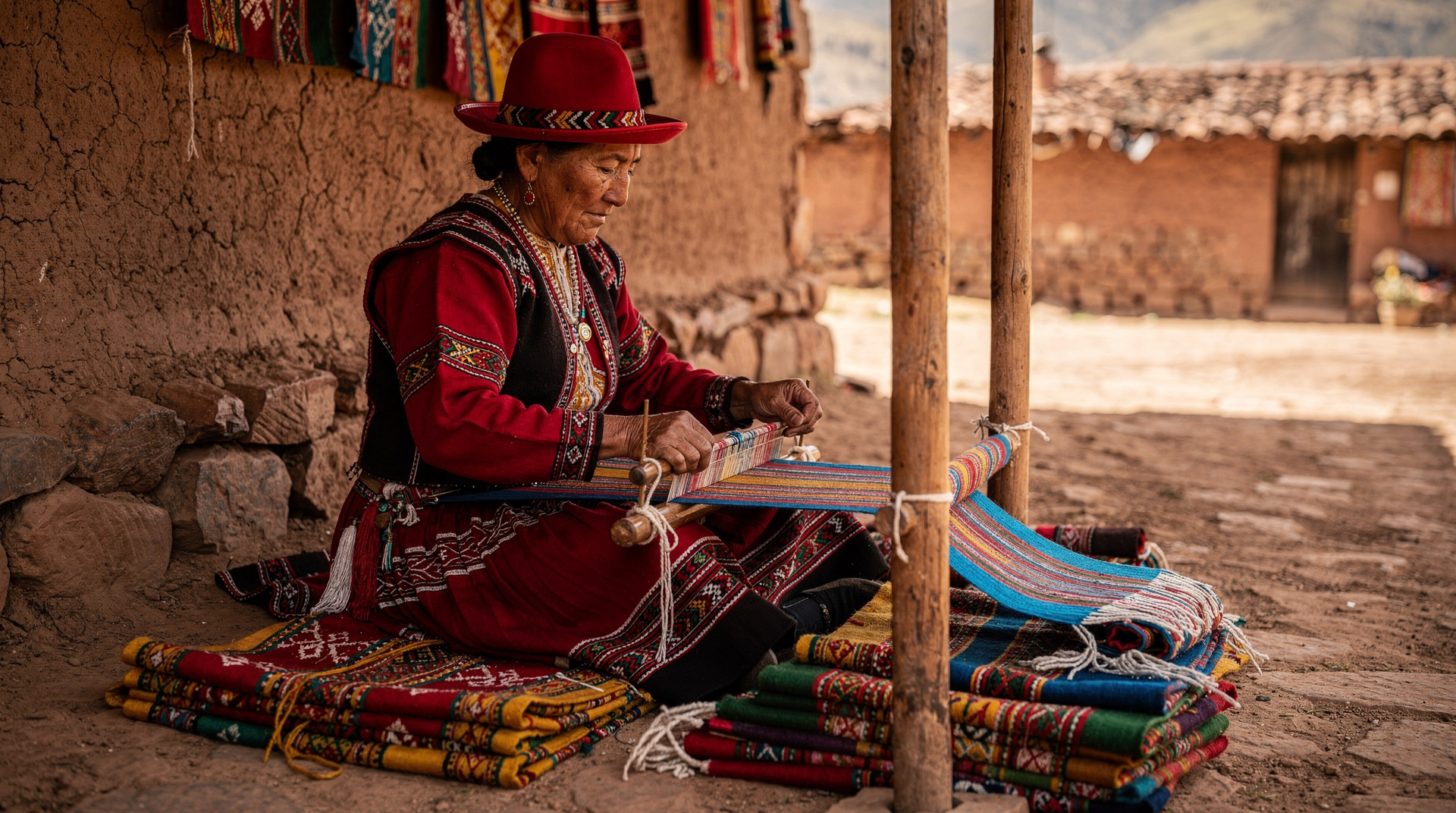
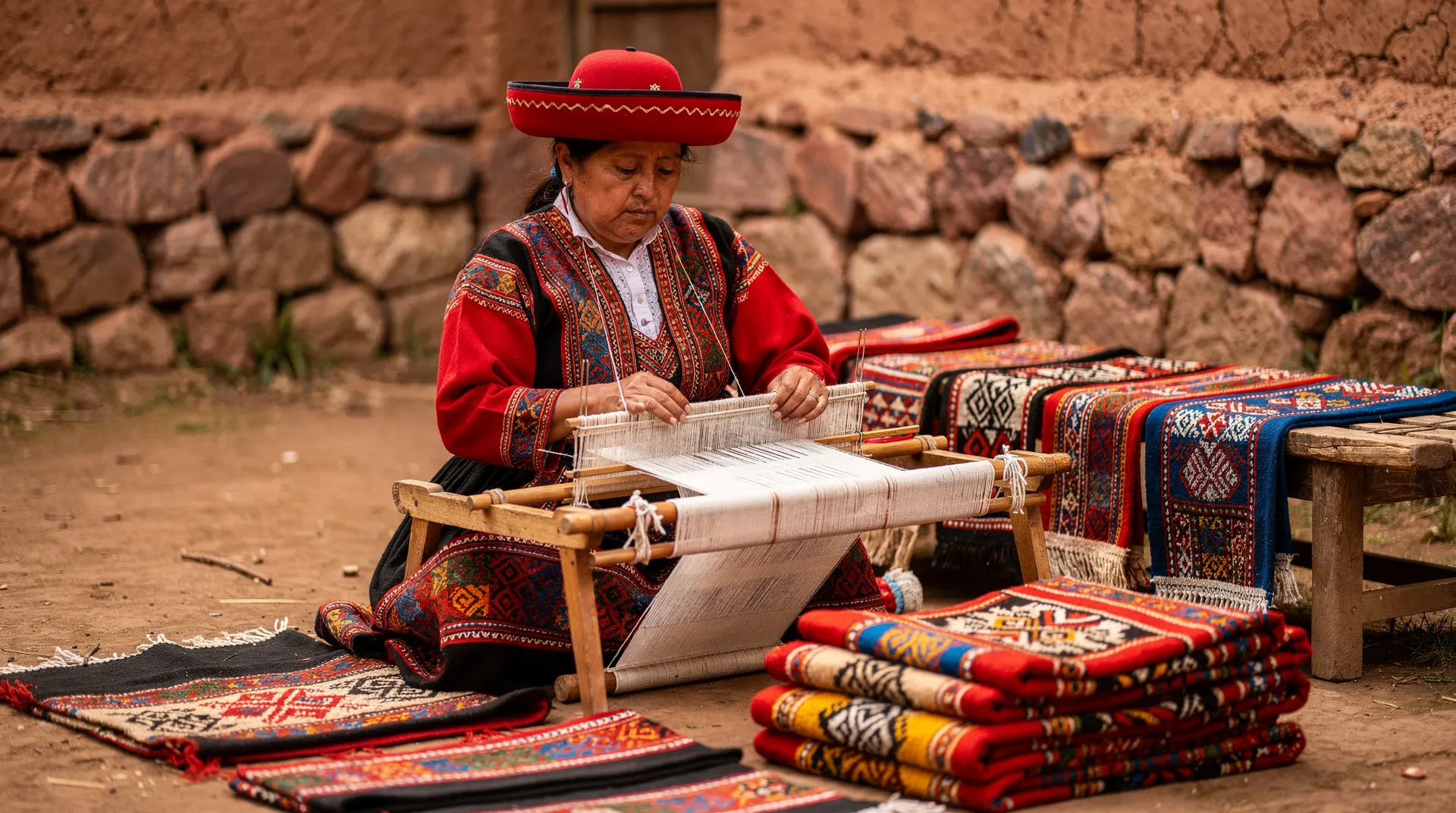
This is the real reason to spend time in Chinchero. Several women’s cooperatives operate demonstrations of the full Andean textile process, from raw fibre through to finished cloth, and they do so in the context of actual working sessions rather than theatrical performances for tourists.
The demonstrations typically begin with the raw material: fleece from sheep or alpaca, washed in natural solvents and then combed into roving. The dyeing stage is where the demonstrations become particularly absorbing. The natural dye palette used in Chinchero derives from plants found in the surrounding hills — cochineal (the dried bodies of an insect that feeds on prickly pear cactus) produces a range of reds and pinks depending on the mordant used; wild marigold gives yellows; and various bark and berry preparations produce greens, browns and purples.
A bucket of pale yellow-grey wool dropped into a pot of deep crimson dye and emerging a vivid scarlet ten minutes later is genuinely remarkable to watch, and the chemistry involved — controlling pH with lime or acidic substances to shift the colour — is explained clearly by the demonstrators.
Spinning follows dyeing, using both drop spindles and small wheel-type devices. Then backstrap loom weaving: the weaver loops the far end of the loom around a fixed post or tree and uses her own body weight as the tension mechanism, leaning back or forward to control the warp. The patterns — geometric, zoomorphic, cosmological — are stored entirely in the weaver’s memory; there are no written instructions or mechanical Jacquard cards. Watching a woman replicate a pattern her grandmother taught her, at a pace that is simultaneously rapid and meditative, is one of those experiences that stays with you.
The demonstrations are offered at no set charge, though a purchase from the cooperative’s finished goods is the expected reciprocation. Quality is genuinely high — these are working weavers producing pieces they sell at reasonable prices rather than factory-made goods dressed up for the tourist market. A small woven purse might cost S/30–50; a larger textile panel S/80–200. If you are going to buy woven goods anywhere in Peru, Chinchero’s cooperatives are among the most worthwhile places to do it. The Chinchero weaving guide has more detail on identifying quality, understanding the symbolism in different patterns, and which cooperatives to visit.
The Sunday market
Chinchero’s Sunday market is smaller and considerably less tourist-facing than Pisac’s Sunday market, which makes it more interesting to some visitors and less interesting to others. Local Quechua-speaking vendors sell highland agricultural produce — potatoes, dried legumes, grain, herbs — alongside household goods, second-hand clothing and a modest selection of crafts. The craft quality is good but the range is narrower than Pisac.
What the Chinchero market has that Pisac’s does not is an atmosphere of daily practicality. You are not walking through a space designed primarily for tourism; you are walking through a working highland market that happens to be accessible from Cusco. That distinction is visible in the crowd: mostly local faces, business conducted in Quechua, transactions made by weight and barter as much as by price.
Chinchero market versus Pisac market
Visitors doing the Sacred Valley circuit often have to choose which Sunday market to prioritise, since fitting both into a single relaxed morning is tight.
| Chinchero market | Pisac market | |
|---|---|---|
| Atmosphere | Working local market, mostly Quechua vendors | More tourist-oriented, larger craft selection |
| Crowds | Lighter, fewer tour buses | Heavier, especially after 10 am |
| Craft range | Narrower but good quality | Wider selection of textiles and souvenirs |
| Combine with | Maras, Moray, plateau circuit | Ollantaytambo, valley floor sites |
Neither is objectively better — Chinchero rewards those who want a more authentic, less commercial experience, while Pisac’s market offers greater range if souvenir shopping is a priority. Many itineraries visit Pisac in the earlier morning and Chinchero mid-morning on the same plateau loop, which is exactly the sequence covered by the Sacred Valley full-day tour.
Getting to Chinchero
Chinchero sits 28 km northwest of Cusco on the main road towards Urubamba, making it one of the easiest Sacred Valley destinations to reach independently.
By collectivo from Cusco: Shared minibuses leave from near the Calle Pavitos terminal throughout the morning and cost approximately S/5–7 for the 45-minute journey. The road climbs from Cusco to the plateau rather than descending into the valley, so the approach from the city is faster than reaching valley-floor sites.
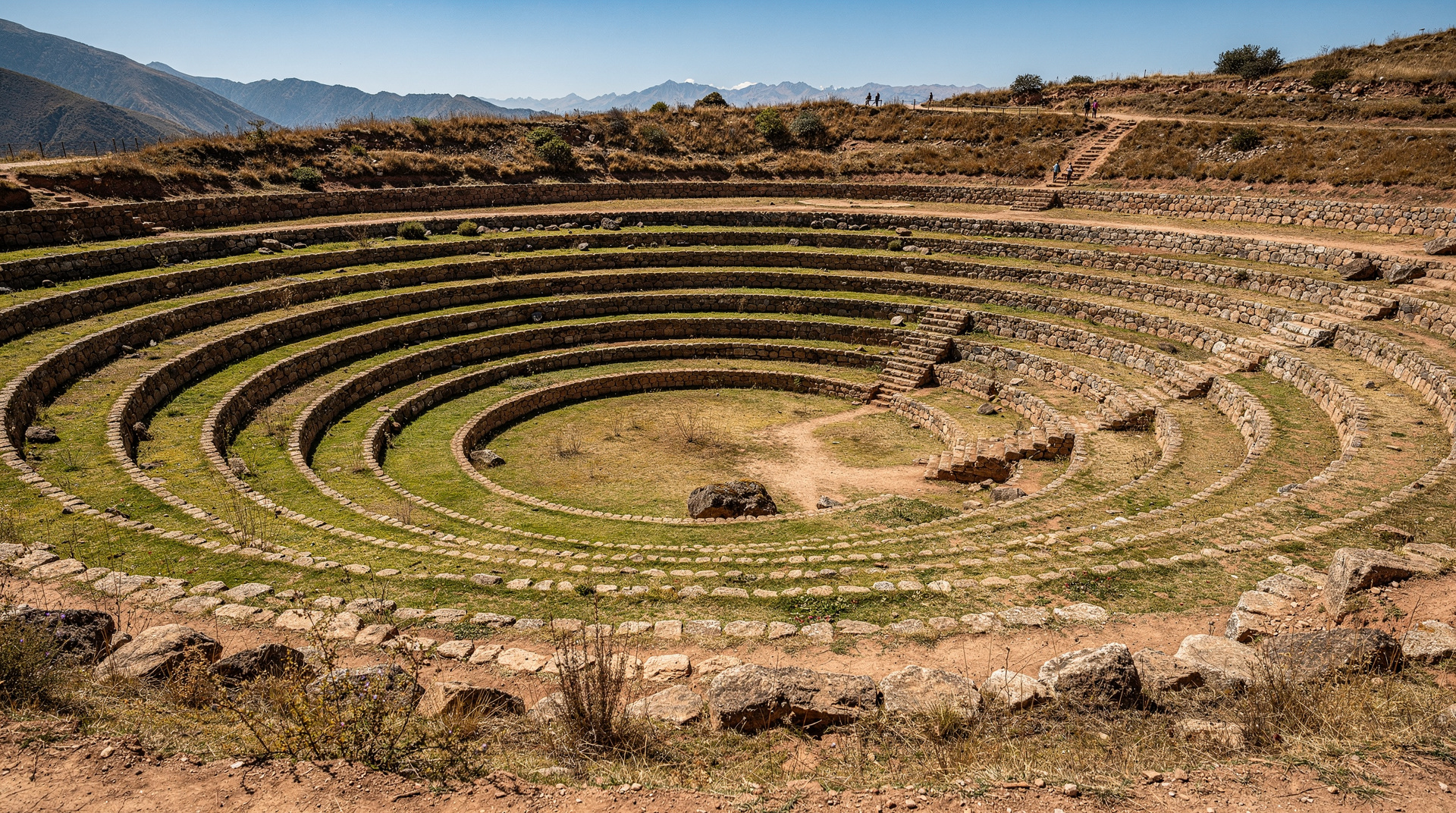
By taxi from Cusco: A private taxi costs S/40–60 one-way. If you are combining Chinchero with Maras and Moray on the same day, a full taxi hire for the plateau circuit (~S/100–150) makes sense since the salt pans and Moray terraces are not easily reached by collectivo.
On a guided tour: A guided Maras and Moray tour typically includes Chinchero as part of the circuit, combining the church and weaving demonstrations with the salt pans and agricultural terraces in a logical plateau loop. The Pisac, Maras and Moray tour links the full eastern-to-western plateau sequence — starting at Pisac market, crossing the plateau through Chinchero, stopping at Maras and Moray — in a single day from Cusco.
Buying textiles responsibly
If you plan to buy a woven piece anywhere in Peru, Chinchero is one of the most defensible places to do it, but a little care goes a long way toward making sure your money reaches the weavers rather than a middleman. Buying directly from a cooperative shop attached to the demonstration you watched puts money into the collective that trained and pays the weavers; buying from an unrelated stall nearby may not.
Ask whether a piece is handwoven on a backstrap loom (slower, more expensive, more irregular in a way that indicates genuine handwork) versus machine-assisted — both are sold in Chinchero, and prices should reflect the difference honestly. A handwoven piece with natural dyes will show slight colour variation and imperfect symmetry; a uniform, perfectly even pattern at a suspiciously low price is very likely machine-made or synthetically dyed regardless of what the vendor claims.
Fitting Chinchero into your itinerary
Chinchero is not a full-day destination on its own — two to three hours is sufficient to see the church, walk the Inca foundations and attend a weaving demonstration. It works best as part of a plateau circuit on the same day as Maras and Moray, since all three sit at similar elevations above the valley floor and are connected by decent roads.
The most satisfying Sacred Valley sequence puts Chinchero in the mid-morning, after an early start at Pisac’s market. By 10 am the Pisac plaza is crowded; heading up to the plateau at that point avoids the midday rush at both markets. From Chinchero, Maras is a 20-minute drive and Moray is 10 minutes further. The 7-day Sacred Valley and Machu Picchu itinerary uses this sequence as its second full day.
Honest tips
The altitude here is higher than Cusco. At 3,760 m, Chinchero sits above Cusco’s 3,400 m. If you are still acclimatising, take the walk around the ruins slowly and sit down during the weaving demonstrations rather than standing. The altitude sickness guide is worth reading before your first days in the region.
Visit the church early. It opens around 8 am and is usually quiet before 10 am. After the tour groups arrive, the interior becomes crowded and the frescoes harder to appreciate.
Do not skip the weaving demonstration even if textiles are not your interest. The process of natural dyeing alone — and the explanation of where each dye comes from in the surrounding landscape — is one of the most illuminating short experiences available in the Sacred Valley. Plan for at least 45 minutes with a cooperative, not 15.
Bring cash in small denominations. The weaving cooperatives and market stalls deal almost entirely in cash; S/10, S/20 and S/50 notes are most useful. Card machines exist in Chinchero but are unreliable.
The light on the plateau is harsher than in the valley. Cloud cover moves fast at this elevation, and the combination of thin air and open sky means midday sun is intense. Sunscreen and a brimmed hat are more important here than on the valley floor.
Chinchero is often treated as a brief stop between Pisac and Maras rather than as a destination in its own right, and it is true that a full day here is not necessary. But the hour you spend watching a weaver pull a centuries-old pattern from memory, explaining what each geometric motif represents as her fingers work the loom, is an hour you are unlikely to forget on a trip otherwise heavy with stone temples and railway tickets.
Top experiences
Bookable activities with verified prices and instant confirmation on GetYourGuide.