Lima
Lima is where most Peru trips begin: sea level, world-class food, colonial history and 1h 20min flights to Cusco. Here's how to make the most of it.
Lima: Historical, Colonial, and Modern City Tour
Quick facts
- Country
- Peru
- Altitude
- 154 m (sea level)
- Currency
- Peruvian sol (S/) — USD widely used
- Best for
- Gastronomy, colonial history, coastal clifftops, pre-Inca ruins, connecting flight to Cusco
Lima: the city most Peru travellers see first and underestimate
Lima arrives as a grey, overcast coastal metropolis for most of the year — the garúa, a persistent sea mist generated by the cold Humboldt Current, keeps the sky a flat white from May to November and makes first impressions underwhelming. Most travellers land at Jorge Chávez International Airport, shuffle through a chaotic arrivals hall, take a taxi to Miraflores, and mentally count down the hours until their connecting flight to Cusco. That is an understandable response to a city of eleven million people glimpsed through taxi windows in the rain.
It is also a mistake.
Lima has, over the past two decades, developed one of the most compelling food cultures in the hemisphere. Several Lima restaurants have held positions in the World’s 50 Best list for years. The ceviche served in a mid-range Miraflores restaurant on a Tuesday afternoon is, with no exaggeration, among the finest things you can eat in South America. The historic centre contains a UNESCO World Heritage ensemble of colonial buildings that competes with anything in the Spanish-colonial world. Miraflores and Barranco, the two tourist-facing residential districts, have excellent accommodation, good cafes, and clifftop parks overlooking the Pacific. Two days in Lima, properly used, produces memories that last as long as Machu Picchu.
| Where | Peru’s Pacific coast — sea level, most travellers’ Peru entry point |
| Cost | Ceviche lunch ~S/35–60; historic centre tour ~S/15–20 entrance |
| Time needed | 2–3 days (also works as a 1-day layover) |
| Getting there | International flights land at Jorge Chávez; 1h20 flight onward to Cusco |
| Best time | December–April for clear skies; food scene is excellent year-round |
Sea level and why it matters for your Peru trip
Lima sits at approximately 154 m above sea level — functionally at sea level for physiological purposes. This makes it the ideal first stop for any Peru itinerary that will eventually take you to Cusco at 3,400 m or to Puno and Lake Titicaca at nearly 3,812 m. Arriving in Lima two to three days before flying to Cusco does nothing for altitude acclimatisation — your body does not begin adapting until you are actually at altitude — but it does give you a sensible buffer of fully functional days to enjoy food, explore the city, and arrange logistics before the first challenging altitude nights.
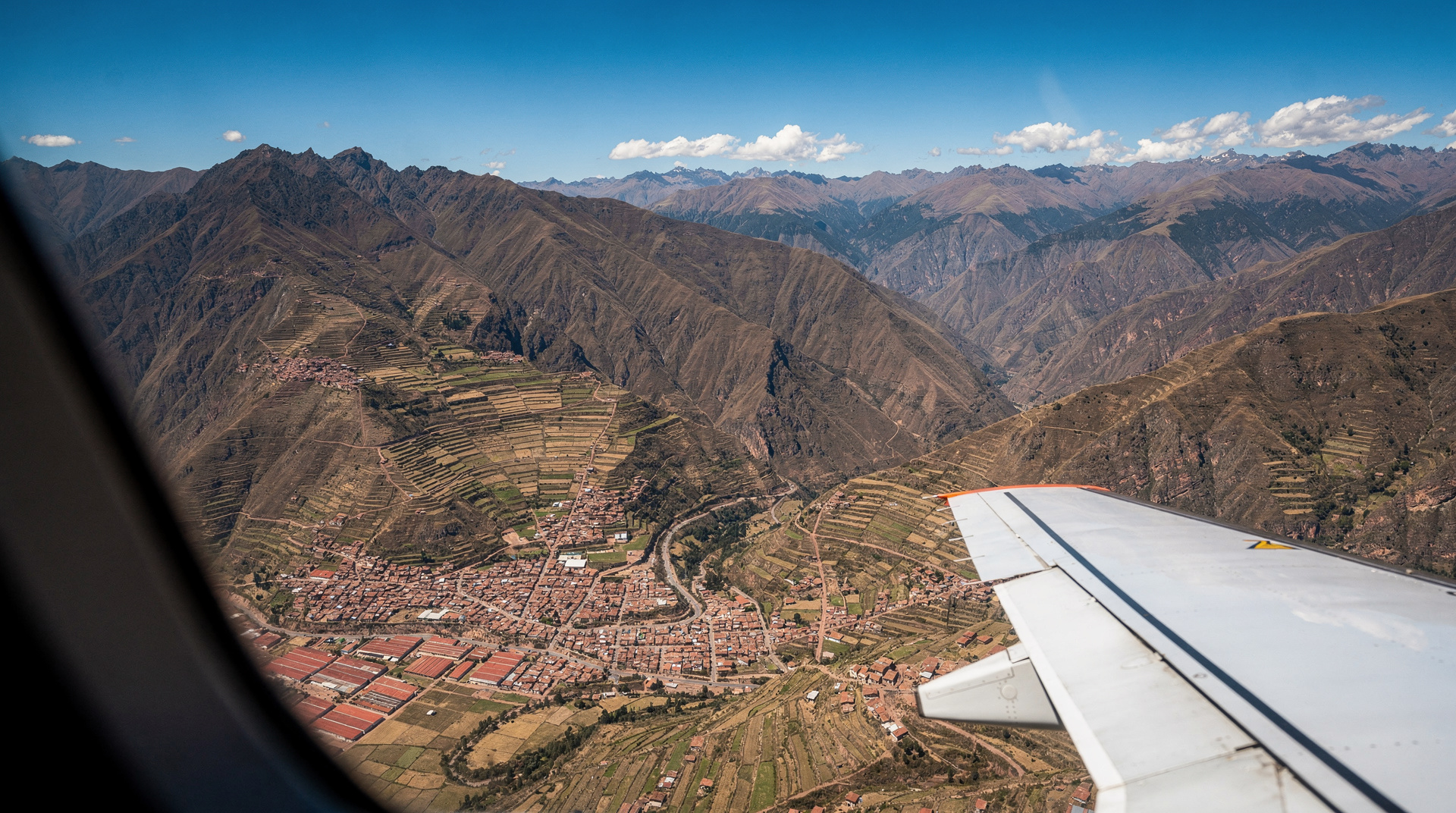
The flight from Lima to Cusco takes one hour twenty minutes and costs roughly $50–120 return depending on season and booking lead time. LATAM, Sky Airline, and Avianca all operate the route with multiple daily departures. See the Lima to Cusco flights guide for carrier comparisons, the cheapest booking windows, and tips on seat selection for Andean views. The full getting-to-Cusco guide covers all options including the multi-day overland alternative.
The historic centre
The Centro Histórico of Lima is a genuine 16th-century Spanish colonial city, largely intact, and thoroughly underappreciated by travellers who go directly from Miraflores to the airport. The Plaza Mayor (also called Plaza de Armas) is flanked by the Government Palace, the Cathedral of Lima, and the Archbishop’s Palace — all in warm ochre and white colonial stone. The Cathedral interior contains the supposed tomb of Francisco Pizarro, the conquistador, in a side chapel. The historical complications that entails are precisely the reason to stand in front of it.
The Monastery of San Francisco, a few blocks from the Plaza, is the highlight of the historic centre. The library holds thousands of colonial-era texts; the catacombs beneath the church served as Lima’s main burial ground for over two centuries and contain the skeletal remains of an estimated 25,000 people arranged in geometric patterns — femur circles, skull arrangements — by 19th-century restorers. Admission is around S/15–20 with a guided tour included, and the catacombs portion takes about 30 minutes. A guided historic centre tour connects the main sites with context that makes the colonial layer legible to visitors who arrive without prior knowledge of Peruvian history.
Conveniently, the historic centre also contains Chinatown (Barrio Chino), one of the oldest in South America — Lima’s Chinese community arrived as indentured labourers in the 19th century and their culinary contribution, the chifa cuisine, is now entirely woven into everyday Lima food culture.
Miraflores: the clifftop district
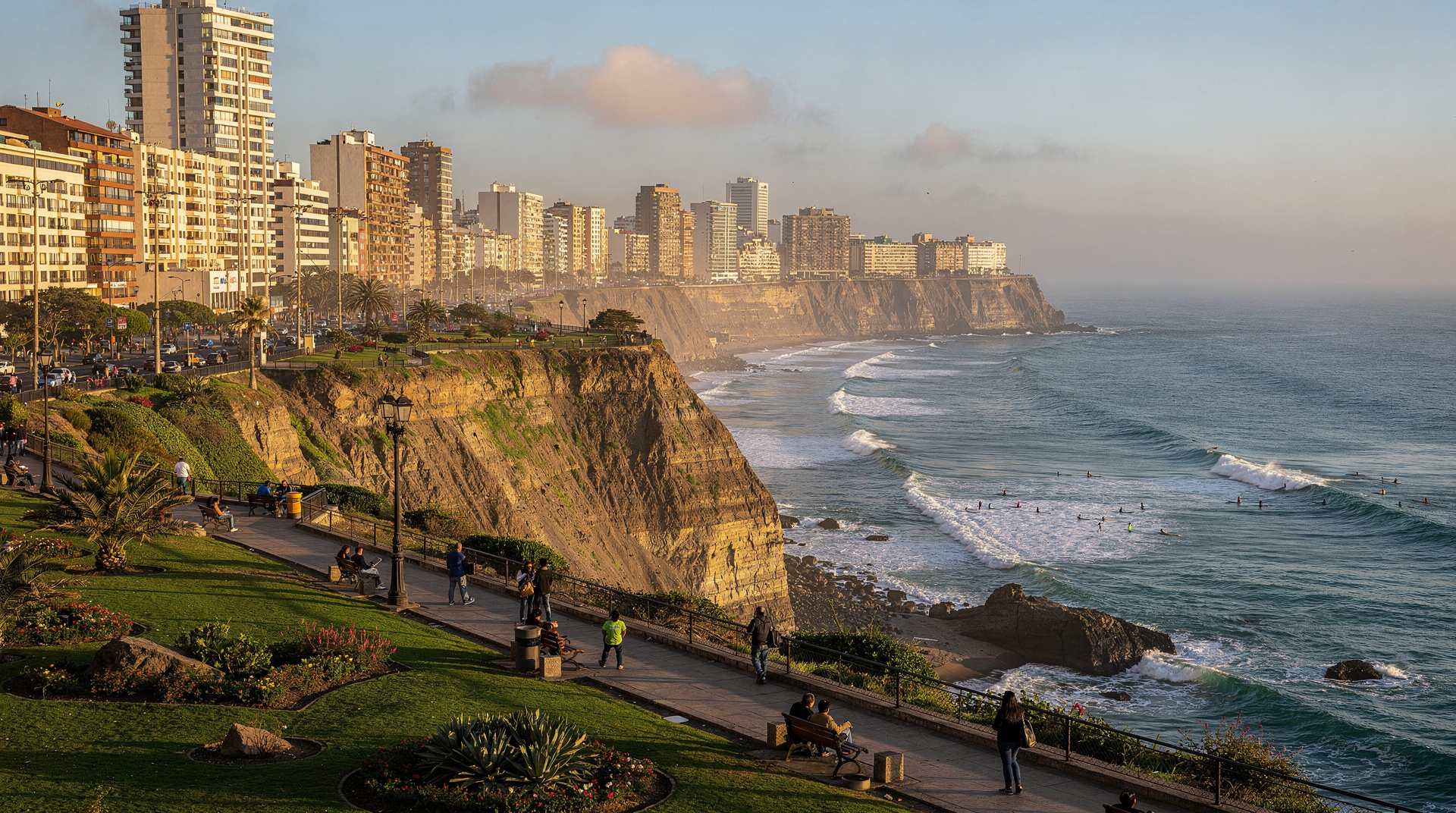
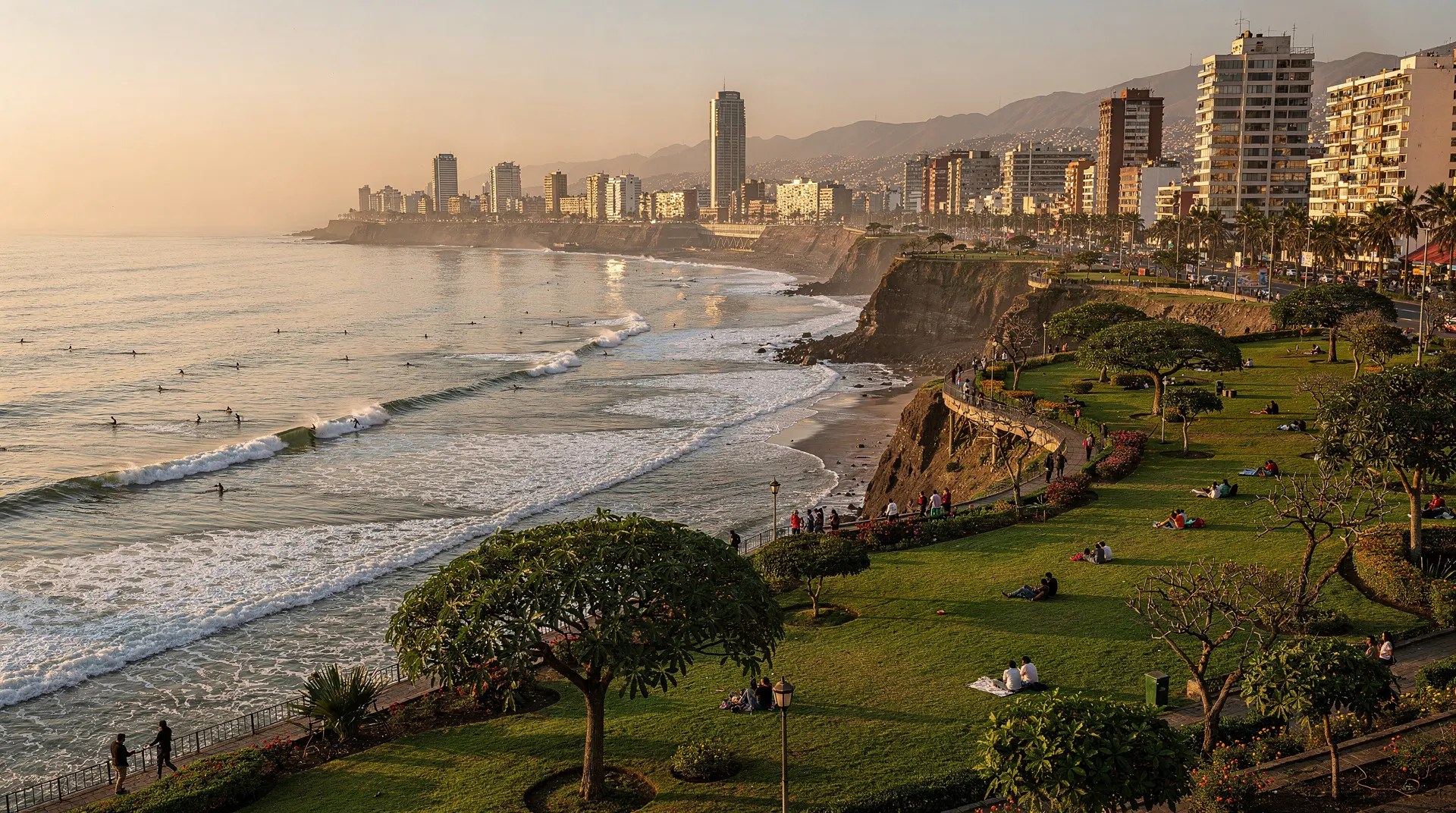
Miraflores is where the majority of budget-to-mid-range tourists stay, and for good reason. The district sits on clifftops 70–80 m above the Pacific Ocean, with Parque del Amor and Larcomar shopping centre at the cliff edge offering views down to the surfing beaches of Barranco and Chorrillos below. The Larcomar terrace at sunset, with paragliders drifting off the cliffs over the breakers, is one of Lima’s genuine pleasures that costs nothing beyond a coffee at one of the terrace cafes.
Huaca Pucllana, a 1,500-year-old pre-Inca adobe pyramid built by the Lima culture around 400 CE, sits in the middle of a Miraflores residential block — a surreal combination of third-century BC construction and 21st-century apartment buildings. The site is open for guided visits (S/15, with good English-language tours) and the adjacent restaurant is one of Lima’s more atmospheric places to eat, with the floodlit pyramid visible from the tables.
Accommodation in Miraflores is plentiful and reasonably priced by European standards. Mid-range hotels and guesthouses cluster around Parque Kennedy (the neighbourhood’s main square), with room rates from around S/150 for clean, reliable options up to S/600+ for the upmarket brands.
Barranco: bohemian Lima
Fifteen minutes south of Miraflores by taxi (around S/8–12) or by the Metropolitano bus (S/2.50), Barranco is Lima’s most aesthetically cohesive neighbourhood — and the one that best rewards slow walking. The district developed in the late 19th century as a seaside resort for Lima’s wealthy families and retains an architectural character of painted wooden balconies, tile-faced mansions, and narrow streets descending to the clifftop. It has since been colonised by galleries, bars, and restaurants, making it the centre of Lima’s art scene and nightlife.
The Bajada de los Baños, a pedestrian path winding down from the main plaza to the beach, and the famous Bridge of Sighs (Puente de los Suspiros) are the most-photographed spots. They earn their reputation. The MATE Museo Mario Testino and the MAC Lima (Museum of Contemporary Art) are both in Barranco and are worth a few hours for those interested in Peruvian photography and visual art.
Pre-Inca Lima: Huaca Pucllana and other ruins
Lima is sometimes framed purely as a Spanish colonial city, which underestimates its pre-Inca layers by several centuries. Huaca Pucllana, the truncated adobe pyramid in Miraflores mentioned above, is the most accessible, but the wider Lima metropolitan area contains dozens of adobe huacas from various pre-Inca cultures — the Lima culture (200–700 CE), the Wari (600–1000 CE), and the Ychsma (1000–1440 CE, before the Inca conquest). The Huaca Huallamarca in San Isidro, a well-excavated pyramid with a small museum, is a 15-minute taxi ride from Miraflores and visited by relatively few tourists despite being open to the public for around S/10.
The Larco Museum (Museo Larco), in the Pueblo Libre district about 30 minutes from Miraflores by taxi, is arguably the single best archaeological museum in Peru and one of the finest in the Americas. Its collection of 45,000 pre-Columbian artefacts — gold, ceramics, textiles — is displayed in a beautifully converted 18th-century colonial mansion with a deservedly famous courtyard garden.
Admission is approximately S/45. The erotic ceramics vault is a separately signposted but entirely open section that attracts more attention than it perhaps warrants but is genuinely interesting as a statement about Mochica culture and the curatorial decisions of past generations. Allow two to three hours and visit in the morning when the light in the galleries is best.
Where to base yourself: Miraflores, Barranco or the historic centre
| District | Vibe | Best for | Typical hotel price/night |
|---|---|---|---|
| Miraflores | Polished, clifftop, tourist-friendly | First-timers, families, safety | S/150–600+ |
| Barranco | Bohemian, artsy, nightlife | Independent travellers, art and food fans | S/120–350 |
| Historic centre | Colonial, busy, daytime-only | Half-day sightseeing, not overnight for most | Not recommended for staying |
Most visitors base themselves in Miraflores or Barranco and visit the historic centre as a guided day excursion rather than staying there overnight — accommodation options in the centre itself are limited and the area is quieter after dark than the two coastal districts.
Lima as the ceviche capital of the world
No city does ceviche better than Lima, and no meal in Peru is more worth taking seriously. The technique — raw fish cured in leche de tigre, the citrus-based marinade of lime juice, chilli, ginger and seasoning — produces something completely different from anything called “ceviche” elsewhere. The liquid left in the bowl, the leche de tigre itself, is served separately as a digestive and is fiercely good.
A mid-range cevicheria in Miraflores charges around S/35–60 for a main-course ceviche portion. The best value is found at the cevicherias that open only for lunch and close by 16:00 — the correct timing for ceviche, which is considered a daytime dish. Ask the hotel reception for their current recommendation rather than relying on a three-year-old guidebook listing.
Beyond ceviche, Lima’s restaurant scene encompasses causas (layered potato terrines with fillings), anticuchos (beef heart skewers, addictive), lomo saltado (a Chinese-Peruvian stir-fry), and a progression of modern Peruvian tasting menus at the upper end. A Lima city highlights tour typically includes a food component and makes good use of a single day in the city.
Day trips from Lima: Paracas and the southern coast
The most popular day trip from Lima leads south along the Panamerican Highway to Paracas and the Nazca Lines region, approximately four hours by bus. Paracas offers the Ballestas Islands boat trip, the Huacachina sand-dune oasis near Ica, and for those extending the trip, a Nazca Lines flight. A combined Paracas, Ica and Huacachina day trip from Lima covers the main southern coast highlights in a long but viable single day, typically departing Lima around 07:00 and returning by 22:00.
This excursion makes most sense for travellers spending two to three nights in Lima who want to see the south coast without building it into their main itinerary. The Paracas and Nazca destination guide has full detail on what each site involves.
Using Lima as a Cusco layover, not just a stopover
Because nearly every Peru itinerary funnels through Lima’s airport, it is worth deciding deliberately whether to treat it as a genuine stop or a pure transit point. A same-day connection is entirely workable if your flights allow 3+ hours between arrival and departure and you have no interest in the city.
But building in even one overnight — arriving a day before your Cusco flight — buys a proper night’s sleep at sea level after a long international flight, a first real Peruvian meal, and a buffer against delayed connections, which are common on the Lima–Cusco route during the rainy season when Cusco’s airport occasionally closes for weather. The getting-to-Cusco guide covers how tight a same-day connection can realistically be.
Practical information for Lima
Airport to city: Jorge Chávez International Airport is in Callao, about 15–20 km from Miraflores. Official taxis from the arrivals hall charge S/60–80 to Miraflores; unofficial drivers outside approach at lower prices but vary in reliability. Uber and InDriver operate from the airport pickup zone and typically cost S/35–50 to Miraflores. Journey time is 30–50 minutes depending on traffic — Lima traffic is notorious and the airport road is particularly bad.
Safety: Miraflores and Barranco are considered Lima’s safest districts for tourists and are broadly comfortable to walk in during the day and evening. The historic centre requires more awareness, particularly around the bus stations and market areas. Standard precautions — phones in pockets, minimal jewellery, splitting cash from cards — apply.
Weather: Lima is virtually never hot in the conventional sense. The garúa season (May–November) keeps temperatures between 12–18°C with overcast skies. December through April brings clearer skies and temperatures of 20–26°C. Pack a light jacket or fleece for the evening regardless of when you visit.
Money: ATMs are abundant in Miraflores and Barranco. The same S/12–18 per-transaction fee that applies across Peru applies here. Card payment is more widely accepted in Lima than anywhere else in Peru — most mid-range and upmarket restaurants take Visa and Mastercard.
The southern Peru two-week grand tour itinerary begins in Lima and sequences the city alongside Cusco, Lake Titicaca, Arequipa, and the coast into a coherent two-week circuit that avoids the exhausting back-and-forth that disorganised itineraries tend to produce.
Frequently asked questions about Lima
Is Lima safe for tourists? Miraflores and Barranco, where most visitors stay, are broadly safe with standard city precautions — avoid displaying phones and jewellery openly, split cash from cards, and use registered taxis or rideshare apps rather than hailing from the street. The historic centre needs more awareness, particularly around bus terminals.
Do I need more than a day in Lima before flying to Cusco? A single day works for a same-day or overnight layover, but two to three days lets you properly experience the food scene, the historic centre, and both Miraflores and Barranco without rushing. Given Lima’s food alone, most travellers who allow extra time say it was worth it.
Top experiences
Bookable activities with verified prices and instant confirmation on GetYourGuide.