Paracas and Nazca
Peru's south coast: Ballestas Islands sea lions and penguins, Huacachina desert oasis, and the Nazca Lines. Reachable from Lima or as a standalone circuit.
From Lima: Paracas, Ica, and Huacachina Day Tour
Quick facts
- Country
- Peru
- Altitude
- Sea level
- Currency
- Peruvian sol (S/) — USD widely used
- Best for
- Nazca Lines flight, Ballestas Islands, Huacachina oasis, sandboarding, sea lions
Peru’s south coast: desert, sea lions, and lines in the sand
Peru’s south coast is a stretch of Atacama-adjacent desert running from south of Lima down to the Chilean border, punctuated by river valleys, ancient civilisations, and one of the most enigmatic archaeological sites on earth. It is not on the standard Cusco-centric Peru circuit — many travellers do the full highland loop from Lima to Cusco, Machu Picchu, Lake Titicaca, and Arequipa without touching the coast south of Lima — but those who include it encounter a dramatically different Peru: flat, baking, arid, rich with colonial wine culture in the Ica valley, and prehistoric in a way that the Inca-focused north simply is not.
The three main draws are Paracas, a coastal reserve north of Ica; the Huacachina oasis near Ica; and the Nazca Lines south of Ica on the desert plain. They can be combined in a two-day circuit from Lima, or incorporated into a southern Peru overland journey between Lima and Arequipa.
All three sit at sea level, which means no altitude considerations — a significant relief for travellers arriving from Cusco or Puno and craving genuinely flat ground and warm air.
| Where | Peru’s south coast, 3.5–5 hrs south of Lima by road |
| Cost | Day trip from Lima ~S/130–200; Nazca flight ~$100–130 extra |
| Time needed | 2–3 days for all three sites; 1 long day for Paracas/Huacachina only |
| Getting there | Bus from Lima (Soyuz, Peru Hop) or a combined day/overnight tour |
| Best time | Year-round desert climate; June–November best for Ballestas wildlife |
The Ballestas Islands: the poor man’s Galápagos
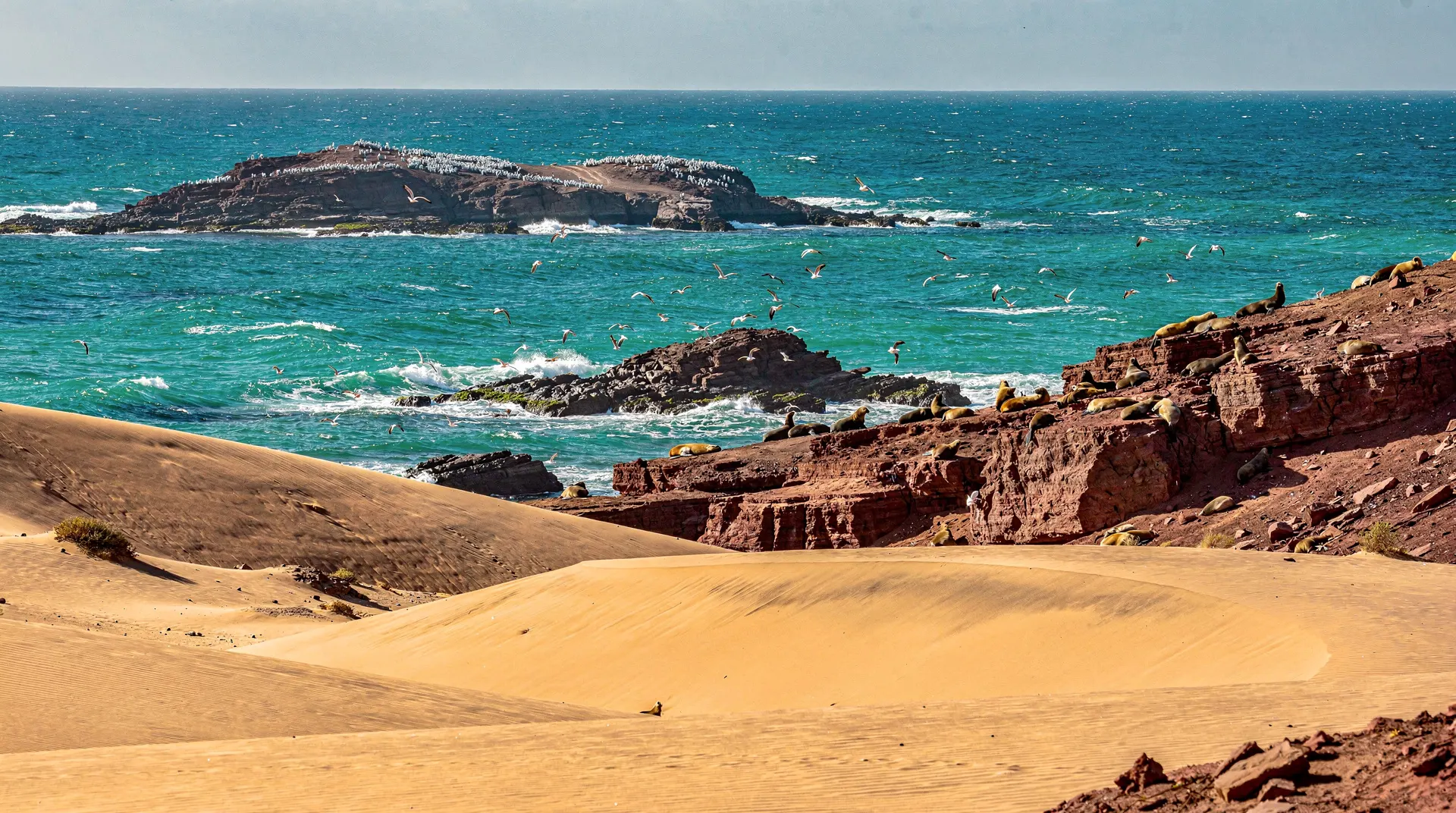
The Ballestas Islands are a group of rocky outcrops in the Pacific Ocean about 20 km west of Paracas town, inaccessible to human landing but circled by regular boat tours from the harbour. The islands support some of the largest concentrations of marine wildlife on the South American Pacific coast, including Humboldt penguins, South American sea lions, Peruvian boobies, Guanay cormorants, Inca terns, and, seasonally, Chilean flamingos in the salt flats behind the peninsula.
The “poor man’s Galápagos” nickname is affectionate and partially accurate. The islands are not the Galápagos — the diversity is narrower, the animals are less habituated to humans, and the boats circle the islands rather than landing — but the wildlife density is remarkable. A sea lion rookery with several hundred individuals, penguin colonies nesting in cliff crevices at eye level from a boat, and overhead clouds of seabirds creating constant noise and movement make for a two-hour circuit that earns its reputation. Boat tours depart the Paracas harbour from around 08:00 daily; tickets are approximately S/35–50 per person plus the reserve entrance fee (around S/30).
The approach to the islands passes the Candelabro (or Paracas Candelabra), a large geoglyph carved into the hillside above the peninsula — similar in concept to the Nazca Lines but visible from the sea, much larger in scale, and attributed variously to the Paracas culture, to pirates signalling to ships, and to pre-Inca astronomical traditions. No consensus has emerged; the mystery is part of the appeal.
The Paracas Reserve
The Paracas National Reserve covers 335,000 hectares of coastal desert, beaches, and marine zone and is one of Peru’s most important protected areas. Beyond the Ballestas boat circuit, the reserve contains the desert drive along the peninsula to Red Beach (Playa Roja, named for its volcanic red sand), viewpoints over the Pacific, and flamingo colonies in the lagoon at El Roto during certain seasons.
Paracas town, the gateway, is a small coastal resort with a decent selection of hotels, seafood restaurants, and tour agencies. The quality of the ceviche and tiradito here (fresh fish sliced rather than cubed, in a lighter citrus dressing) reflects the town’s fishing-community origins. Mid-range accommodation runs S/120–200 per night; budget options from S/60.
Huacachina: the oasis in the dunes
Forty kilometres inland from Paracas and adjacent to the city of Ica, Huacachina is a natural oasis — a small lagoon encircled by palm trees, surrounded on all sides by sand dunes that reach 100–150 m high. It is one of those places that looks like a postcard fabrication but is entirely real, and quite spectacular in person at golden hour when the dune faces are lit in amber and the lagoon reflects the sunset below.
The dunes around Huacachina are the primary adventure activity on the south coast. Dune buggy tours take groups up and over the dunes in modified four-wheel-drive vehicles — loud, physically demanding, and genuinely exhilarating or terrifying depending on your tolerance for controlled chaos. Sandboarding down the steep dune faces follows the buggy ascent. Tours typically run for two to three hours in the late afternoon (16:00–19:00), timed for the lower sun angle and cooler temperatures. Cost is approximately S/50–80 per person.
The Ica valley, which Huacachina sits within, produces Peru’s pisco — the grape brandy that underpins pisco sour, the national cocktail. Several bodegas (winery and distillery operations, some in traditional pit-press format) in the Ica surroundings offer visits and tastings, typically included in organised day tours or available independently for around S/15–20.
The Nazca Lines
The Nazca Lines are geoglyphs etched into the desert floor of the Nazca plateau, created by the Nazca culture between approximately 500 BCE and 500 CE by removing the dark surface layer of iron oxide-coated pebbles to reveal the pale yellow-grey ground beneath. The lines include both geometric figures (straight lines extending kilometres across the plain, trapezoids, spirals) and biomorphic figures (a 96-metre spider, a 180-metre monkey with a curled tail, a hummingbird, a condor, a human figure known as the “Astronaut”). They were made visible to the wider world following aerial surveys in the 1920s and 1930s; before aircraft, the full figures were impossible to comprehend from the ground.
The standard viewing platform on the Panamerican Highway, accessible from the road, gives adequate views of two or three line figures from ground level. The proper way to see the Nazca Lines is from a light aircraft.
Flights depart from the small Nazca airfield (Aeródromo María Reiche Neuman) and last approximately 30–45 minutes, covering the main figures in a series of banking turns that let passengers on both sides of the plane see each geoglyph. Cost is approximately $100–130 USD per person in 4–6 person Cessnas. Prices vary by operator; book through a licensed operator (ICA Aero, Aeroparacas, or similar) rather than on the street. Motion sickness is common — the repeated banking turns in a small propeller aircraft at low altitude affect a significant proportion of passengers. Take motion sickness medication (Dramamine or equivalent) an hour before the flight if you are at all susceptible.
The origin and purpose of the Nazca Lines remain genuinely unresolved. The most widely accepted current theory links them to water management rituals and cosmological alignments. The extraterrestrial theory, while popular in certain publishing circles, has no archaeological support.
Tours and how to combine these destinations
A Paracas, Ica and Huacachina day trip from Lima covers the Ballestas Islands boat circuit, the Paracas reserve, and the Huacachina dune buggy experience in a single very long day — departing Lima at approximately 07:00 and returning by 22:00–23:00. Cost is typically S/130–200 per person excluding Ballestas boat and reserve entrance. This format works for travellers with a single day to spare in Lima before or after their highlands trip and no interest in adding a separate south-coast leg.
For the Nazca Lines specifically, an overnight is required — the flight is best in the morning (calmer air, better light), and the road journey from Lima to Nazca takes four to five hours, making a dawn flight impossible on a single-day trip from Lima. A two-day Paracas, Huacachina and Nazca tour overnights in Ica or Paracas and includes the Lines flight on the second morning.
For those who are most interested in the Lines with minimal other content, a dedicated Nazca Lines flight and two-day tour focuses the programme on the geoglyphs and their context, including the Maria Reiche Museum and the Nazca aqueducts (Puquios), which are among the most sophisticated pre-Inca hydraulic engineering works in South America.
Choosing your south-coast format
| Format | Duration | Includes Nazca flight? | Best for |
|---|---|---|---|
| Paracas/Huacachina day trip | 1 very long day | No | Travellers with only one spare day in Lima |
| Paracas, Huacachina & Nazca 2-day | Overnight in Ica/Paracas | Yes | Most travellers wanting the full south coast |
| Dedicated Nazca flight tour | 2 days, Nazca-focused | Yes | Those most interested in the Lines specifically |
If time allows only one choice, the two-day combined tour gives the most complete picture of the south coast without the exhausting single-day round trip from Lima.
Getting to Paracas and Nazca from Cusco and Lima
From Lima, Paracas is about 3.5 hours by bus on the Panamerican Highway. Regular bus services (Soyuz, Peru Hop) operate from Lima’s bus stations from S/30–50. Ica and Huacachina add another hour. Nazca is about 4.5–5 hours from Lima.
From Cusco, the south coast is not reached directly. The practical route goes either Lima–south coast by bus, or Cusco–Arequipa–Lima with a south coast stop in between. The southern Peru two-week grand tour itinerary maps one version of the full circuit that incorporates Paracas and Nazca into the Cusco and highlands loop without requiring unnecessary backtracking.
Practical advice for the south coast
Weather: The south coast of Peru has an extremely arid desert climate. Rain is essentially absent. Temperatures at Paracas and Nazca run 18–28°C in summer (December–March) and 14–22°C in winter (June–September). The coast is windier than the inland desert; an afternoon southerly wind in Paracas can be strong enough to close the Ballestas boat tours. Morning departures reduce wind-related cancellation risk.
UV exposure: Both Paracas and Nazca have extremely high UV indices due to the thin, dry desert air at sea level. Sunscreen, a hat, and lightweight long sleeves are more necessary here than almost anywhere else in Peru, including high altitude.
Nazca flight safety: The Nazca Lines air tour sector has had accidents historically, with several fatalities over the years at smaller operators. Book with a licensed operator, verify the aircraft’s age and maintenance record if possible, and avoid the cheapest unlicensed options offered near the airfield.
Cash: Ica and Nazca have ATMs but they are fewer than Lima or Cusco. Withdraw enough cash in Lima or Ica before heading further south. Reserve entrance fees, dune buggy tours, and the Nazca flight are all cash transactions in most cases.
The Lima destination guide covers the logistics of using Lima as a base for south coast day trips. The southern Peru grand tour shows the full two-week circuit that connects Lima, the coast, Arequipa, Colca, Puno, and Cusco into one coherent trip.
Why the south coast is worth the detour from a Cusco-only trip
Travellers planning a Cusco-and-Machu-Picchu-only trip sometimes dismiss the south coast as an unnecessary extra leg, given it requires backtracking through Lima. That calculus changes for anyone spending more than a week in Peru. The desert landscape, the wildlife density at the Ballestas, and the sheer strangeness of the Nazca Lines are unlike anything in the highlands, and the logistics — a manageable bus ride or short flight from Lima — are considerably easier than most Andean side trips.
For travellers doing the full southern Peru circuit that also takes in Arequipa and Colca Canyon, adding the coast is close to a natural extension of the route rather than a detour at all.
Frequently asked questions about Paracas and Nazca
Is the Nazca Lines flight worth the cost and the motion sickness risk? For most travellers, yes — nothing else in Peru shows a comparable scale of ancient landscape art, and the figures are genuinely impossible to appreciate from the ground viewing platform. Take motion sickness medication an hour beforehand if you are prone to it, and book with a licensed operator rather than the cheapest option at the airfield.
Can I visit Paracas and Huacachina without doing the Nazca flight? Yes, and it’s a reasonable choice if time is tight — the Ballestas Islands and Huacachina dune buggy/sandboarding experience form a complete, satisfying day on their own, reachable from Lima without the extra overnight the Nazca flight requires.
Top experiences
Bookable activities with verified prices and instant confirmation on GetYourGuide.