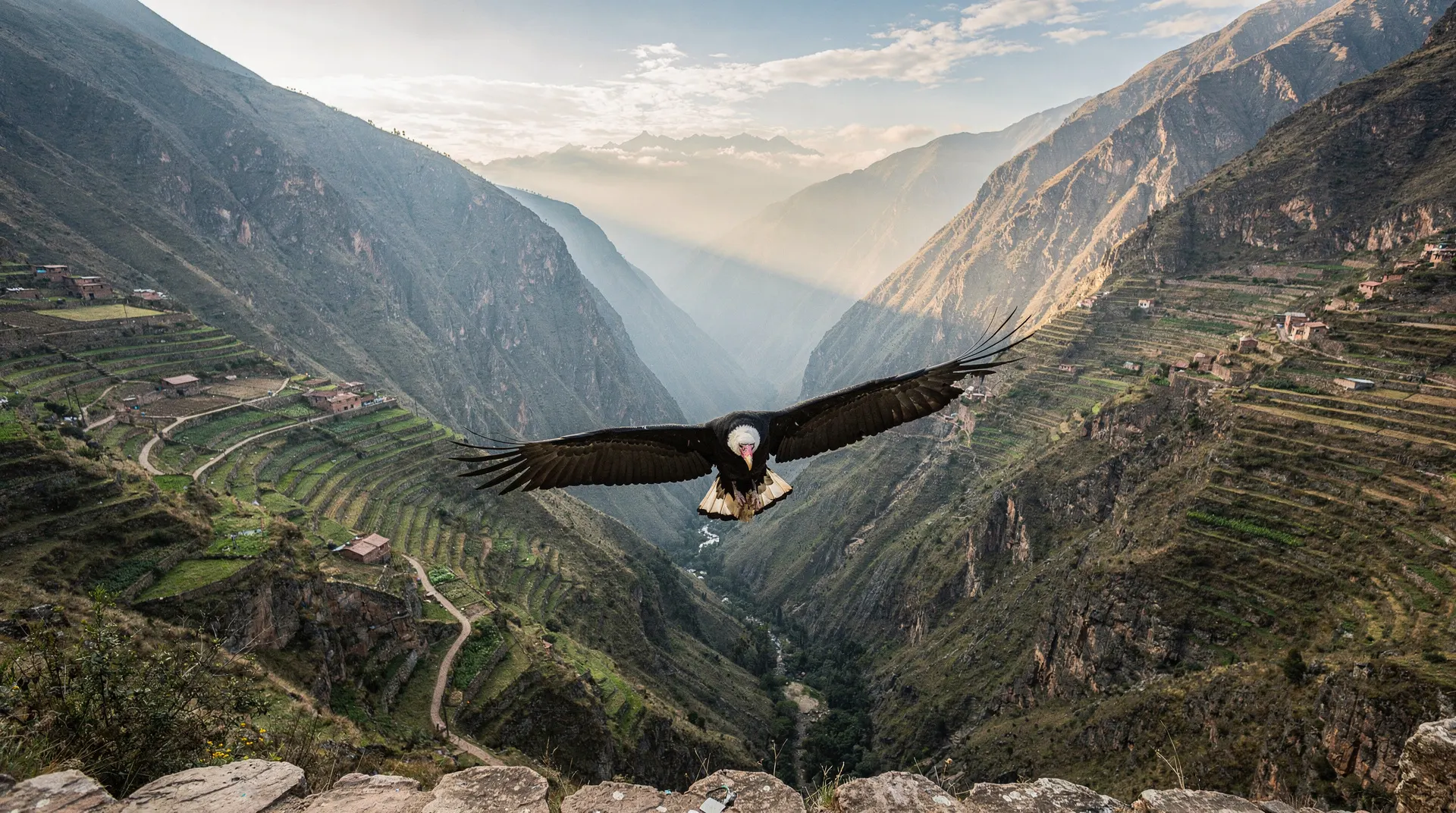
Colca Canyon
One of the world's deepest canyons and the best place to see Andean condors. Plan your Colca Canyon trip from Arequipa or Cusco.
Arequipa: 2-Day Classic Colca Canyon Tour
Quick facts
- Country
- Peru
- Altitude
- 3,270 m / 10,728 ft (Chivay village); 4,200 m at Cruz del Cóndor
- Currency
- Peruvian sol (S/) — USD widely used
- Best for
- Andean condors, deep canyon trekking, pre-Inca terracing, thermal hot springs
One of the deepest canyons on earth
The Colca Canyon is one of those places where the statistics help rather than overwhelm. At its deepest measured point, the canyon reaches 3,270 m below the rim — approximately twice the depth of the Grand Canyon in Arizona. The canyon was formed by the Río Colca cutting through volcanic sediment and older rock over millions of years, eventually producing a gorge so extreme that its full depth was not confirmed until expeditions in the 1980s. A deeper canyon, Cotahuasi, exists nearby and is technically more profound, but Colca is more accessible and more visited for the straightforward reason that it is also home to the most reliable Andean condor viewing in South America.
The canyon is reached from Arequipa, approximately four hours by road northwest of the city via a high-altitude crossing of the Pampa Cañahuas at around 4,800 m — a crossing that passes through puna grassland grazed by wild vicuñas and alpacas and offers, on clear mornings, views of the snowcapped volcanoes Ampato and Sabancaya. The journey itself is part of the experience.
| Where | ~4hrs northwest of Arequipa by road |
| Time needed | 2 days recommended for condors and canyon village |
| Cost | Around S/70–100 full-day; S/180–250 two-day |
| Altitude | 3,270–4,800 m depending on route point |
| Best time | April–November for reliable condor sightings |
Cruz del Cóndor: the best condor viewpoint in the world
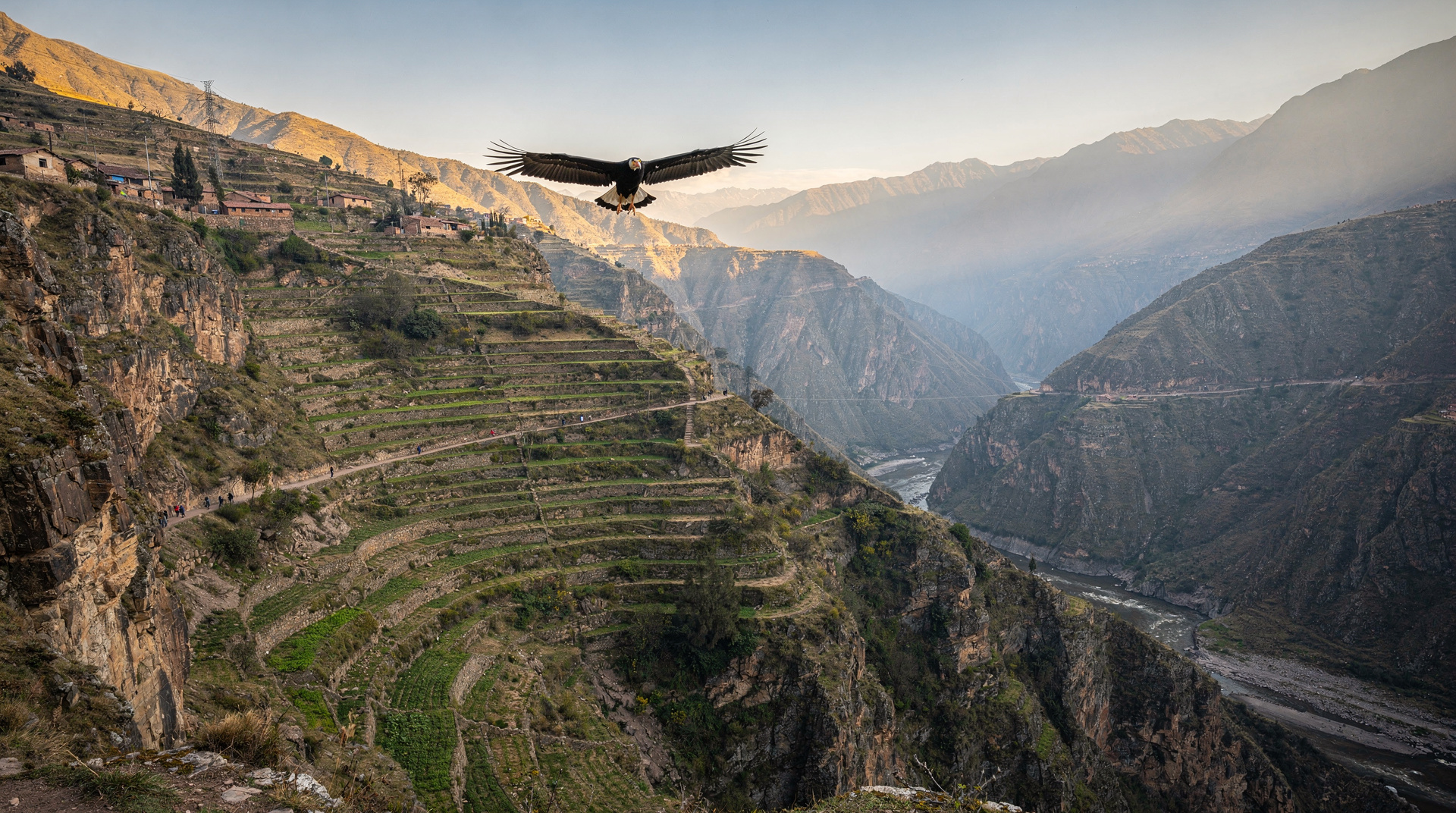
Cruz del Cóndor is a cliff-edge observation platform at approximately 4,200 m on the canyon’s north rim, about two hours by road from the main canyon village of Chivay. The viewpoint exists because a particularly deep section of the canyon creates powerful thermal updrafts from early morning — warm air rising from the canyon floor that provides the lift the Andean condor (Vultur gryphus) needs to become airborne. The condors roost on the cliff faces below the viewpoint and ride these thermals out into the open sky from approximately 07:00–09:00 most mornings between April and October.
The Andean condor is the largest flying bird on earth by wingspan — up to 3.2 m — and one of the rarest. Globally there are fewer than 10,000 individuals. At Cruz del Cóndor on a good morning, you may see fifteen to twenty birds in the air simultaneously at eye level or below you, their primary feathers spread like fingers, banking in long lazy arcs without a wingbeat. It is an extraordinary sight and one of the genuine natural spectacles of South America. The Colca Canyon condors guide covers the best months, times, and what affects sightings.
A full-day tour from Arequipa can reach Cruz del Cóndor in time for the late-morning thermals, though the best viewing window is early morning — which is the primary reason the two-day tour is more recommended than the one-day version for serious wildlife interest. A two-day Colca Canyon tour overnights in Chivay and allows a 07:00 departure for Cruz del Cóndor on the second morning, when condor numbers are at their peak and the tour groups from Arequipa have not yet arrived.
The canyon villages and pre-Inca terracing
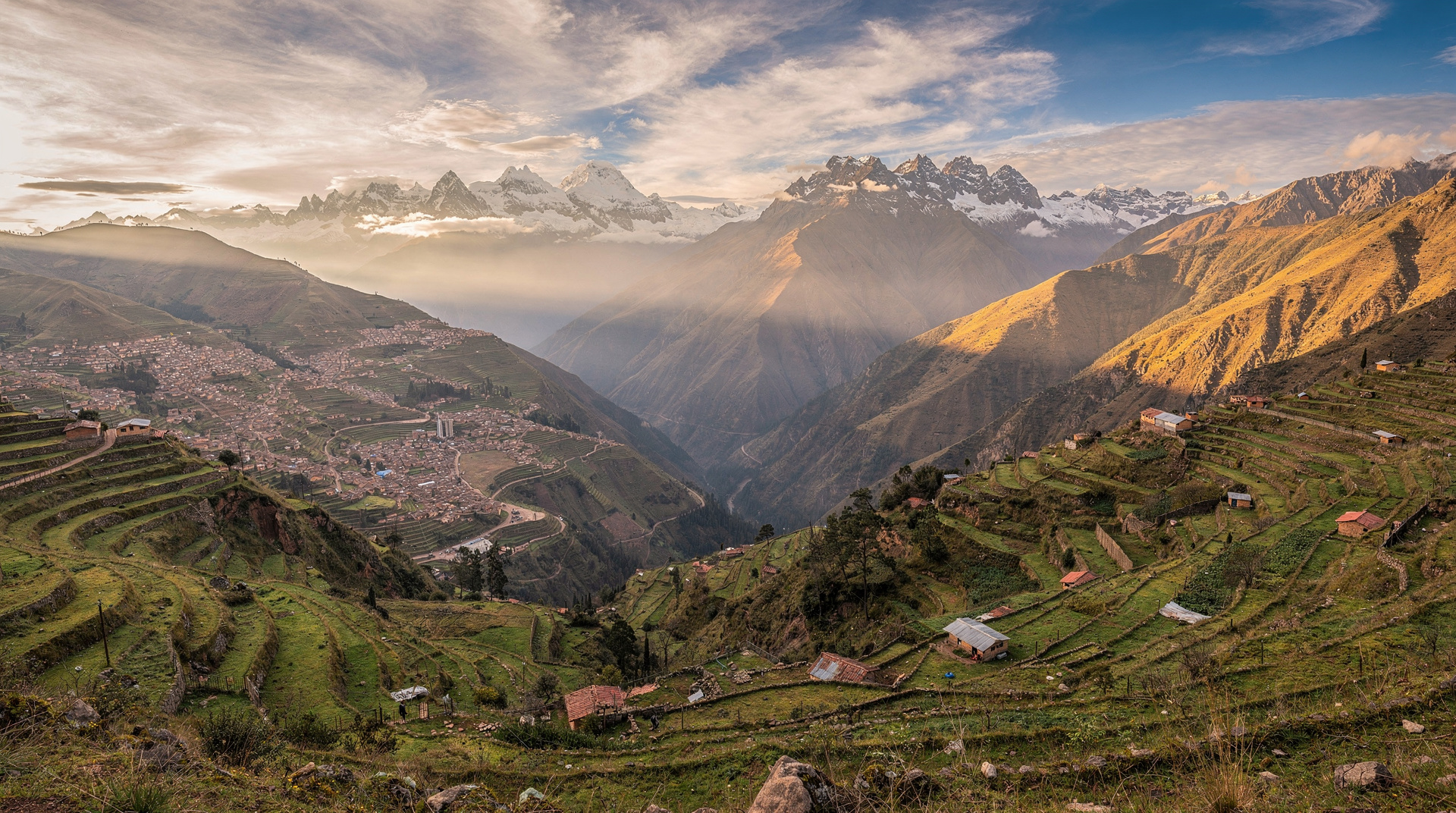
The Colca Canyon valley is not wilderness — it is one of the most extensively farmed mountain landscapes in the Andes. Pre-Inca civilisations (the Collagua and Cabana peoples) constructed the terraced agricultural systems that still cover the valley sides above the river. These andenes — stone-walled terraces that have been in continuous cultivation for over a thousand years — represent an engineering achievement in a different register from Machu Picchu, less dramatic but arguably more impressive in scope. They cover hundreds of kilometres of canyon slope and continue to produce quinoa, potatoes, and maize for the valley communities.
The main canyon village of Chivay sits at around 3,630 m and serves as the overnight base for most canyon tours. It is a working agricultural town, not a tourist resort, with a daily market, a central plaza, and a handful of hotels ranging from basic to reasonable. The thermal hot springs at La Calera, about 4 km from Chivay, are genuinely excellent — pools of geothermal water at around 30–38°C in a canyon-edge setting, and a justified treat after a day’s hiking. Admission is around S/20.
Further down the canyon, the villages of Yanque, Maca, and the hillside town of Cabanaconde mark the transition from the upper valley (accessible by road) to the deep canyon trekking zone. Cabanaconde is the last road-accessible point before the trail descends into the canyon proper.
Trekking into the canyon
The classic Colca trek descends from Cabanaconde into the canyon over two to three days, overnighting at the oasis of Sangalle at the canyon floor (approximately 2,700 m, with its famous natural swimming pool), before climbing back out. The descent takes about three to four hours; the ascent back to Cabanaconde takes five to six hours and is strenuous. A guide is strongly recommended rather than mandatory — the trails are generally clear but route-finding at canyon junctions can be confusing, and medical emergencies in the canyon are logistically complex.
The two-day tour format, which departs Arequipa on day one and returns on day two after Cruz del Cóndor, does not include the canyon floor trek — that requires a dedicated two-to-three day trekking arrangement beyond the standard tours. The Colca Canyon condors guide covers both the viewing circuit and the trekking options in detail.
Full-day versus two-day: an honest assessment
A full-day Colca Canyon tour from Arequipa departs around 06:00–07:00, crosses the Pampa Cañahuas, stops at viewpoints and vicuña areas along the way, visits Cruz del Cóndor for the later-morning thermals (typically 10:00–11:00, when condor numbers have already reduced from peak), and returns to Arequipa by early evening. Cost is approximately S/70–100 per person including transport and guide, excluding canyon entrance (around S/30, the Colca boleto turístico) and meals.
The condor viewing on the full-day format is good but not optimal. The birds are most active in the early morning. Arriving at Cruz del Cóndor at 10:30 instead of 07:30 means you see five to ten birds rather than fifteen to twenty, and by 11:00 the thermal window is closing. If condors are a primary motivation for your visit — and for many visitors they are — the overnight tour is worth the additional cost.
The two-day tour costs approximately S/180–250 per person including accommodation in Chivay (typically a mid-range hotel, not basic), two meals, transport, and guide, plus the canyon entrance separately. It also allows a more relaxed afternoon in the upper valley and time at the Chivay hot springs.
Other wildlife and viewpoints along the way
Cruz del Cóndor is the headline sighting, but the drive itself and the upper valley reward attention. The Pampa Cañahuas crossing, part of the Salinas y Aguada Blanca National Reserve, is one of the more reliable places in southern Peru to see wild vicuña at close range — herds of a few dozen animals grazing the bunch-grass puna are common on clear mornings, and the road often slows deliberately to let groups cross.
Further along, the mirador at Patapampa (around 4,910 m, sometimes called Mirador de los Volcanes) gives a wide panorama of up to six snowcapped volcanoes on a clear day, including Ampato, Sabancaya, and Hualca Hualca, and is a worthwhile short stop if your tour includes it — check the itinerary in advance, as not all operators build in the time.
Andean geese, giant hummingbirds, and the occasional viscacha (a rabbit-like rodent related to chinchillas that suns itself on rocks near Chivay) round out the wildlife interest for visitors who enjoy more than the condors alone.
Getting to Colca Canyon from Cusco
There is no direct route from Cusco to Colca Canyon. The standard approach goes through Arequipa — fly or take an overnight bus from Cusco to Arequipa, spend a night, then join a canyon tour the following day. The Cusco to Arequipa transport guide covers the bus and flight options.
A particularly useful variant for those doing the southern Peru circuit is the two-day Colca Canyon tour that ends in Puno rather than returning to Arequipa. This tour departs Arequipa, covers the canyon over two days including Cruz del Cóndor, and then continues east across the Altiplano to arrive in Puno — effectively combining the canyon visit with the Arequipa-to-Puno transit. It is one of the most logistically efficient options in southern Peru for travellers doing the full circuit toward Lake Titicaca.
The Andean condor up close
It is worth spending a moment on what the condor actually is before visiting, because seeing one at Cruz del Cóndor in person is different from any image you may have previously encountered. The Andean condor is a New World vulture — a scavenger, not a predator — and its enormous size evolved to allow it to soar over vast distances in search of large mammal carcasses in mountain and coastal ecosystems. At 3.2 m wingspan, it is visually overwhelming at close range. The white shoulder patches on adults, the bare, wrinkled red head, the white collar, and the sheer scale of the wings become apparent only when a bird passes at eye level or below you along the cliff.
Condors do not flap. They use lift almost exclusively — thermal updrafts from warm ground, ridge lift from wind deflecting off cliff edges. At Cruz del Cóndor, the combination of morning sun warming the canyon floor and the sharp thermal gradient between the cold rim air and the warmer air lower down creates exactly the conditions the birds exploit. A condor gaining altitude above the viewpoint in widening circles before banking out over the open canyon and disappearing in three minutes without a single wingbeat is a piece of physics made visible, as much as it is a wildlife sighting.
The condors that use Cruz del Cóndor roost on the cliff faces below the observation platform and on the opposite canyon wall. Adults and juveniles use the same sites; younger birds (without the white shoulder patches, with grey rather than black primary feathers) are often more numerous and more acrobatic. The sightings guide at the Colca Canyon condors guide page covers what to look for in distinguishing age classes.
Seasonality: when the condors actually show up
Condor sightings at Cruz del Cóndor are not evenly distributed across the year, and understanding the seasonal pattern helps set realistic expectations.
| Months | Conditions | Condor activity |
|---|---|---|
| April–June | Dry, clear mornings, cool nights | Very reliable, strong thermals |
| July–August | Peak dry season, coldest nights, most crowded | Reliable but viewpoint is busiest |
| September–October | Dry, warming, thinner crowds | Reliable, good balance of weather and quiet |
| November–March | Wet season, cloud and rain common | Less reliable, thermals disrupted by weather |
The honest takeaway: any month from April to November gives a good chance of sightings, with September and October offering the best balance of reliable weather and lighter crowds than the June–August peak. Wet-season visits (December–March) are the least predictable — cloud cover over the canyon can suppress the thermal updrafts the condors rely on, and some mornings produce very few sightings.
Altitude and practical preparation
The Colca circuit involves significant altitude variation. Arequipa sits at 2,335 m; Chivay is at 3,630 m; the Pampa Cañahuas crossing reaches 4,800 m; and Cruz del Cóndor is at 4,200 m. Visitors who have not acclimatised in Arequipa first often feel the altitude sharply on day one of a canyon tour, particularly at the high-altitude crossing. Spending two nights in Arequipa before the canyon excursion reduces this significantly.
The crossing of the Pampa Cañahuas is the highest point of the entire tour and happens on the road, in the vehicle — you do not need to be physically active at 4,800 m, but susceptible individuals sometimes feel nausea or headache during this section. Keep water accessible, avoid eating heavily before the crossing, and tell your guide if you feel unwell.
Cold nights in Chivay require warm layers even in May and June. Pack a down jacket or thermal underlayers regardless of the daytime temperatures in Arequipa.
Canyon entrance fee: The Colca boleto turístico costs around S/30 per person and is required for entry to the Cruz del Cóndor viewpoint and the canyon villages. It is collected at a checkpoint before Chivay.
Photography at Cruz del Cóndor: A telephoto lens (200 mm or more on a full-frame camera) is useful but not essential — the condors often pass at close range at eye level. Arrive before 07:30 and position yourself on the left side of the main viewpoint platform for the best sightline over the canyon.
The two-week southern Peru grand tour itinerary shows how Colca Canyon connects naturally with Arequipa, Puno, and Lake Titicaca in a logical loop that avoids backtracking.
Top experiences
Bookable activities with verified prices and instant confirmation on GetYourGuide.