Lake Titicaca
Everything you need to know about Lake Titicaca: Uros floating islands, Taquile, Amantani homestays, and how to get there from Cusco. Honest, detailed
Puno: Full-Day Tour of Lake Titicaca and Uros & Taquile
Quick facts
- Country
- Peru
- Altitude
- 3,812 m / 12,507 ft
- Currency
- Peruvian sol (S/) — USD widely used
- Best for
- UNESCO islands, Uros reed culture, Andean homestays, birdlife
The highest navigable lake in the world
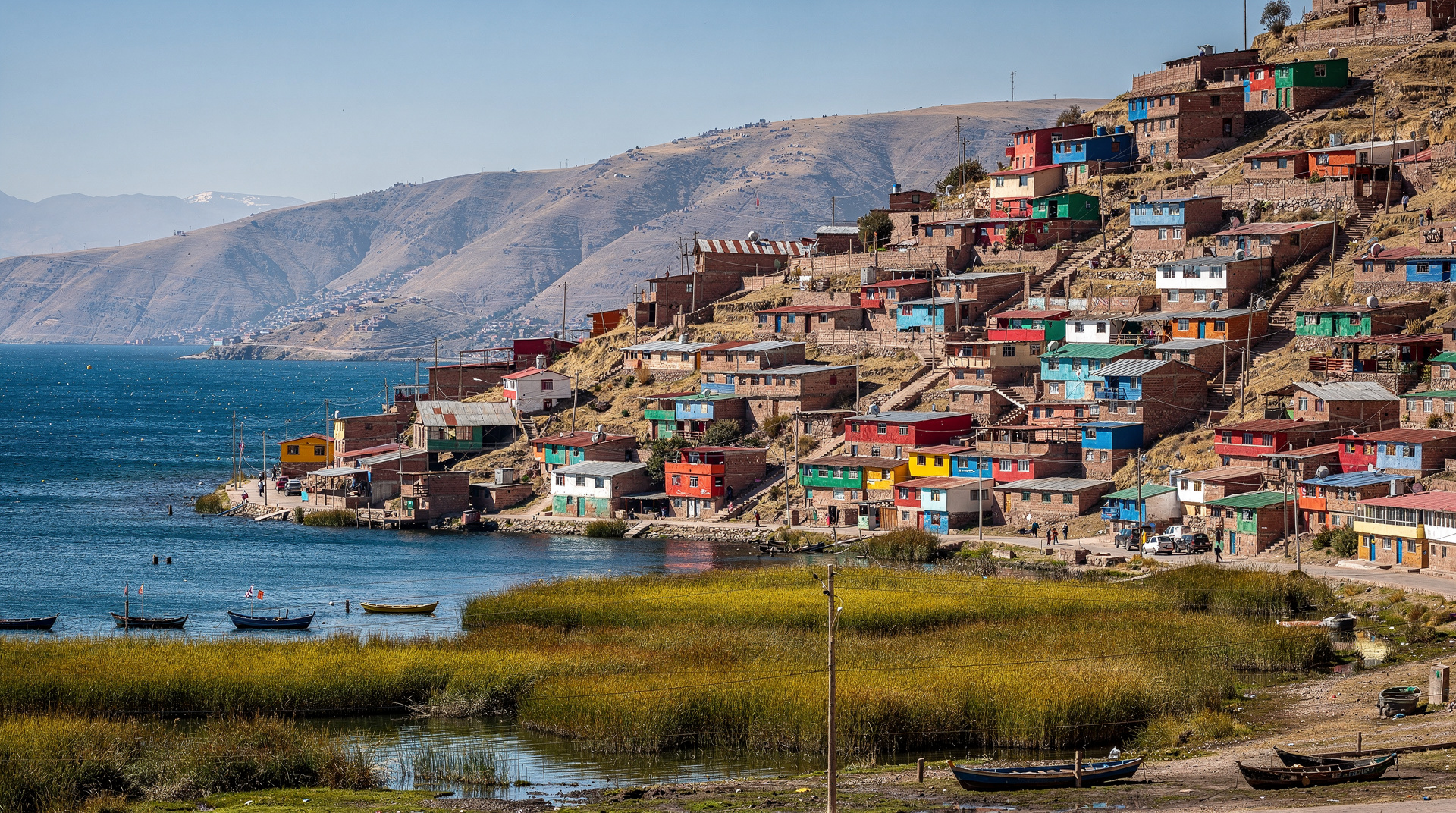
Lake Titicaca sits at 3,812 m above sea level on the Altiplano plateau shared between Peru and Bolivia, covering roughly 8,372 square kilometres — about the size of Puerto Rico. It holds two-thirds of its surface area on the Peruvian side and one-third in Bolivia, straddling the border in a way that gives it an almost mythological quality: not quite one country’s, not quite another’s, belonging instead to the Aymara and Quechua peoples who have lived on its shores and islands for millennia.
The superlative “highest navigable lake” is accurate and earns its place in the introduction because the altitude is not merely a geological curiosity — it shapes everything about visiting, from how you breathe on the boat crossing to how well you sleep on an island homestay at nearly 4,000 m. Visitors arriving directly from Lima, at sea level, will feel the elevation acutely. Those coming from Cusco at 3,400 m are better prepared but still not immune to the additional 400 m of altitude that Puno, the main gateway city, sits at.
Factoring in acclimatisation before attempting the lake is not overcautious advice — it is the single thing that most determines whether your Titicaca experience is memorable for the right reasons.
| Where | Altiplano, southern Peru — gateway town Puno, 3,830 m |
| Cost | Full-day Uros/Taquile tour ~S/90–130; homestay add-on ~S/130–180 |
| Time needed | 2–3 days (1 full lake day plus acclimatisation buffer) |
| Getting there | Bus/tourist coach from Cusco to Puno, 6–9 hours overland |
| Best time | May–October (dry season, calmer water, clearer skies) |
What makes Lake Titicaca worth the journey
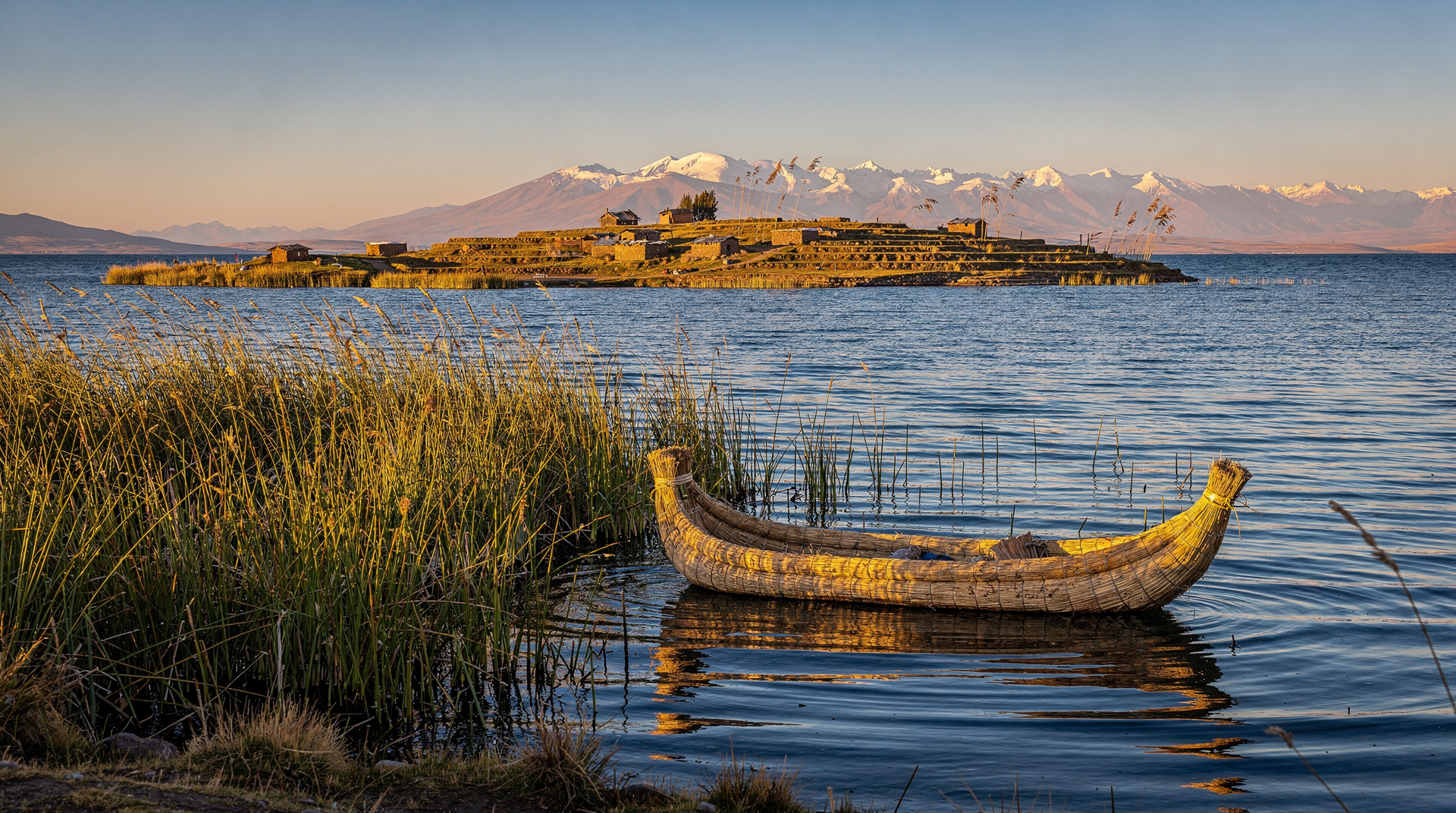
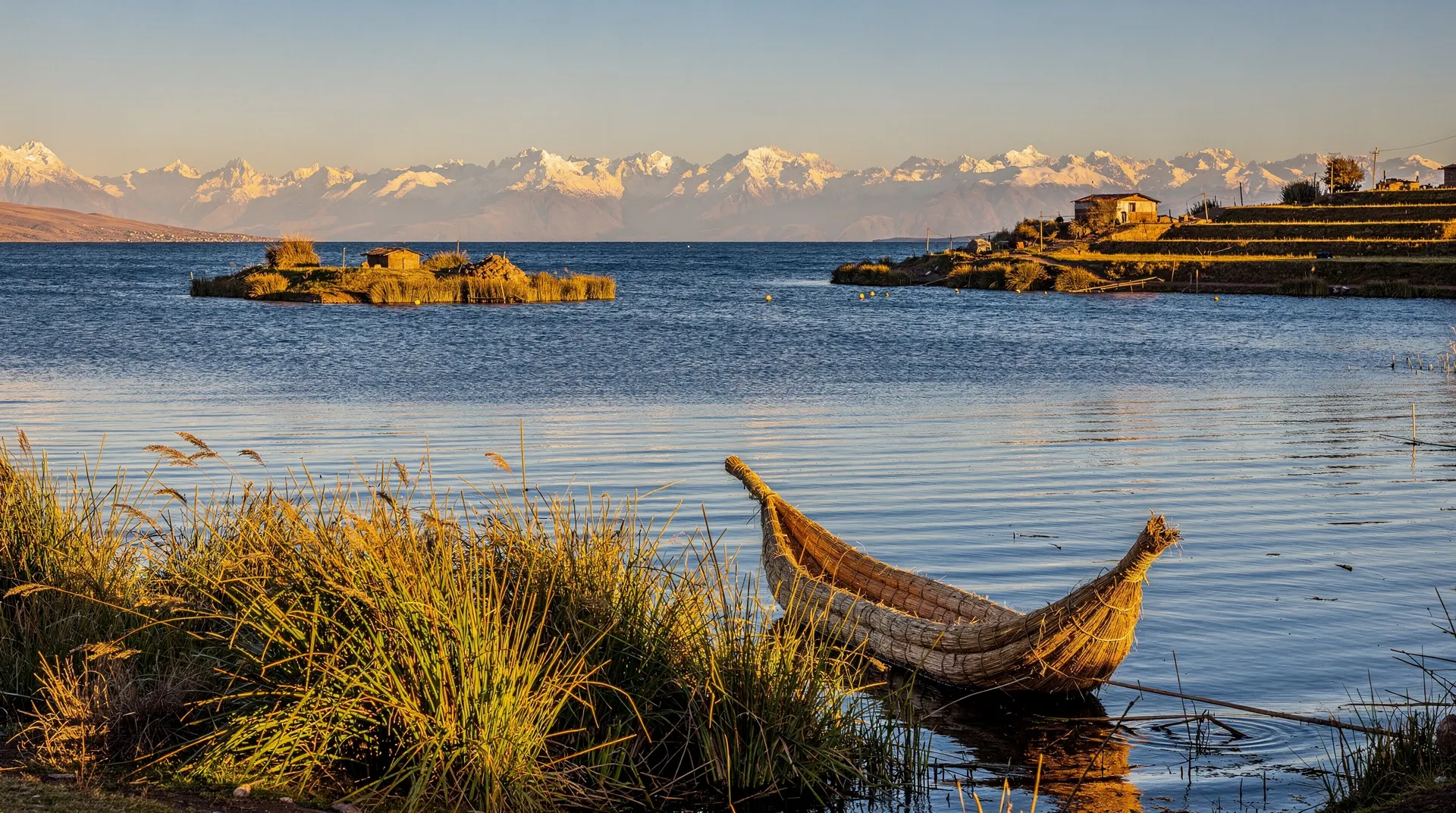
The lake is extraordinary on multiple levels simultaneously. Ecologically, it supports an endemic flora and fauna including the giant frog (Telmatobius culeus, the scrotum frog, improbably named), several species of flamingo, Andean coots, and the totora reed ecosystem that underpins the entire Uros island culture. The water is a remarkable shade of deep blue under clear skies, contrasting with the straw-gold of the reed beds, the terracotta of the island soil, and the snowcapped mountains on the Bolivian side.
Culturally, the lake is the origin point of Andean civilisation in Inca mythology — Manco Cápac and Mama Ocllo, the founding children of the sun, are said to have emerged from its waters at the Island of the Sun (Isla del Sol, on the Bolivian side) and walked north to found Cusco. That mythological weight gives every visit a dimension beyond the merely scenic.
Practically, the main draws are the three island communities accessible from Puno: the floating reed islands of the Uros people, Taquile Island with its UNESCO-inscribed textile tradition, and the more remote Amantani Island with its overnight homestay programme.
The Uros floating islands
The totora reed islands of the Uros people are the lake’s most famous sight and the most heavily visited. There are around 90 inhabited floating islands in the bay south of Puno, constructed from layer upon layer of compressed totora reeds — the same plant that forms the islands’ boats, houses, watchtowers, and even basic food (the soft white root of fresh reeds is edible and slightly sweet).
The islands are genuinely man-made and genuinely floating. The base layer of reeds rots continuously below the waterline; new reeds are added on top at regular intervals, meaning the islands are in constant slow renewal. The largest support several families, a community building, and now solar panels and mobile phone coverage. Some islands have an elevated reed watchtower from which you can see across the entire bay.
A full-day Uros and Taquile tour departs Puno harbour at approximately 07:30 and arrives at the Uros islands in about 30–40 minutes by slow boat. You will stop for around 90 minutes, during which a community member explains the island construction and history (typically with good English translation), you can step aboard a traditional reed boat for a short crossing between islands, and there is time to look at the handicrafts for sale. The community earns meaningful income from tourism, and the S/10–20 spent on a reed-woven coaster or small boat model is a legitimate exchange.
The honest caveat: the Uros visit is managed, structured, and somewhat theatrical. The presentation is rehearsed and the sales pitch is part of it. This does not make it inauthentic — the islands are real, the people live there, and the engineering is remarkable — but go without expecting spontaneity. The experience is more like a guided cultural exhibit than a chance encounter.
For those short on time, the speedboat tour to Uros and Taquile cuts crossing time dramatically and is useful if you need to be back in Puno by early afternoon.
Taquile Island: UNESCO textiles and terraced hillsides
Taquile Island is the destination on the lake that rewards visitors who slow down and look carefully. The island rises steeply from the water, its terraced agricultural fields running up to a summit ridge at about 3,950 m. A population of around 2,000 Quechua-speaking residents maintains a community cooperative system that has no private land ownership and distributes tourism income collectively.
The UNESCO inscription of Taquile’s textile culture in 2005 recognised something specific: it is the men who are the master weavers and knitters. Men on Taquile knit continuously — during conversations, on the path to market, sitting in the plaza. The hats they produce (chullos) carry coded meaning in their patterns: a man’s marital status, the community district he comes from, and whether he holds a community leadership role can all be read from the specific patterns in his hat. The cooperative market on the main plaza sells textiles at fixed prices; buying directly from the cooperative (rather than from resellers in Puno) ensures the income goes to the weavers.
Getting to Taquile from Puno takes about two hours by slow boat, making it a committed full-day excursion. The hike from the boat landing to the main plaza is about 40 minutes uphill on steep steps at nearly 4,000 m — take it slowly and stop whenever you feel breathless. A set lunch of fresh trout, quinoa soup, and potatoes is included in most guided tours and is served in the main plaza restaurants.
Amantani Island and the overnight homestay
Amantani is the most rewarding and the least visited of the three main islands. Larger than Taquile, rounder, with a darker agricultural landscape and no mobile phone coverage, it sits further out in the lake — approximately 35 km from Puno — making it accessible only on multi-day programmes.
The two-day homestay tour typically runs as follows: morning boat from Puno to Uros (brief stop), then full crossing to Amantani, arrival early afternoon, assignment to a family home for the overnight, shared dinner, an optional evening of traditional dress and dancing organised by the community, and the following morning a crossing to Taquile for a few hours before returning to Puno. A two-day Uros, Amantani and Taquile tour with full homestay costs approximately S/130–180 per person all-inclusive.
The family homes are basic by any urban standard: a room with several beds, blankets piled high against the cold, cold-water washing facilities, and dinner served by lamplight or a single bulb. The families have done this for years and are relaxed and practiced hosts. Conversations happen in a mix of Spanish and Quechua, often mediated by the guide. The experience is not immersive in the way that extended cultural exchange programmes are, but it is genuine and very different from anything available in the main tourist cities.
Night temperatures on Amantani drop below 0°C in the dry season months of June and July. Warm layers are not optional.
Birdlife and the totora reed ecosystem
The reed beds fringing the lake’s shallow bays support one of the highest concentrations of waterbirds in the Andes. Andean coots, pied-billed grebes, great grebes (the lake’s own endemic subspecies), various duck species, Andean flamingos, and several heron species can all be seen without leaving the boat. The giant grebe of Lake Titicaca (Rollandia microptera) is flightless and found nowhere else on earth — an extraordinary evolutionary outcome of island ecology applied to a lake.
The totora reed beds themselves are significant habitat; slow boat crossings allow decent birdwatching without any specialist equipment. Early morning departures from Puno, which the standard tour timing already uses, coincide with peak bird activity.
Uros, Taquile or Amantani: choosing your island day
The three main island experiences differ enough in pace and depth that picking the right one (or combination) matters more than most itineraries suggest.
| Island | Time from Puno | Feel | Best for |
|---|---|---|---|
| Uros | 30–40 min | Structured, brief, photogenic | First-timers wanting the iconic floating-island sight |
| Taquile | ~2 hrs | Slower, textile culture, hill walk | Travellers who want to see a community up close in a day trip |
| Amantani | ~3.5 hrs, overnight | Immersive, basic, genuine | Anyone with the extra day for a homestay |
Most full-day tours combine Uros with either Taquile or a speedboat return; the homestay format is the only way to add Amantani, since its distance makes a same-day round trip impractical.
Peru side versus Bolivia side
Most travellers doing the classic overland route see only the Peruvian side of the lake, based around Puno. The Bolivian side, based around Copacabana and reached via a border crossing at either Kasani or Desaguadero, offers a different set of sights — most notably Isla del Sol, the mythological birthplace of the Inca founders in Andean legend, which has a longer and more varied hiking network than any of the Peruvian islands.
If your itinerary allows a few extra days and a Bolivia visa is not an obstacle for your passport, continuing from Puno to Copacabana adds real breadth to the Titicaca experience rather than duplicating it. Most visitors, however, get a complete and satisfying picture of the lake from the Peruvian side alone, particularly with the Amantani homestay included.
How to reach Lake Titicaca from Cusco
Puno is the practical gateway and sits 390 km by road from Cusco. The overland journey takes six to seven hours by bus or around eight to nine hours on the Ruta del Sol tourist service with its archaeological stops. See the Cusco to Puno transport guide for timing, operator comparisons, and what to book in advance.
There is no direct flight from Cusco to Puno — the nearest airport is Juliaca, 45 minutes from Puno, and LATAM operates Lima–Juliaca flights. For most travellers arriving from Cusco, overland is both cheaper and more scenically rewarding.
The 10-day Cusco and Lake Titicaca itinerary shows exactly how to connect the two destinations in a logical sequence, with the right number of nights in each location. The two-week grand tour of southern Peru incorporates the lake as part of a larger circuit that continues to Arequipa and the coast.
Practical information
Best time to visit: May through October is the dry season and the clearest weather for lake crossings. The water is calmer, the skies are deep blue, and the photographic conditions are exceptional. November to March brings rain and occasional rough lake conditions that can cancel boat departures. The lake is colder and greyer in the wet season but still navigable.
Altitude: At 3,812 m, Lake Titicaca is higher than Cusco. Arrive acclimatised from Cusco before attempting island excursions, and take the first evening in Puno very slowly. Headaches and shortness of breath are normal; severe symptoms like confusion or inability to walk straight require immediate descent.
What to bring on the lake: Sunscreen rated SPF 50 minimum — the UV index at altitude over reflective water is extreme and burn time is far shorter than at sea level. A windproof layer for the boat crossing; even in May the wind off the open lake is cold. Layers that can be added or removed as the sun moves.
Money: Cash in soles is essential for everything on the islands — port fees (around S/5), island entrance fees (S/10 for Taquile), meals, and handicraft purchases. The harbour taxi boats and tours can be paid by card in most cases when booked through reputable operators, but carry cash regardless.
From the lake to Bolivia: The standard route from Puno continues to Copacabana and La Paz, making Lake Titicaca a natural exit point from Peru for overlanders. Tourist buses cover the border crossing to Copacabana in approximately five to six hours.
The destinations overview lists all the other major places on the cusco-spirit.com coverage area, and the tours section shows every bookable experience from Puno harbour.
Frequently asked questions about Lake Titicaca
Do I need to acclimatise before visiting Lake Titicaca, even if I’ve already spent time in Cusco? Yes, to some extent. Titicaca and Puno sit around 400 m higher than Cusco, so even well-acclimatised visitors sometimes feel a mild return of symptoms on arrival. Take the first evening slowly, hydrate well, and avoid alcohol before your first island day.
Is the Uros islands visit worth it if it feels touristy? Most visitors still find it worthwhile — the islands are genuinely floating, genuinely inhabited, and the engineering is remarkable even within a structured, briefly-paced visit. Go in with realistic expectations about the rehearsed presentation and it remains a memorable stop rather than a disappointment.
Top experiences
Bookable activities with verified prices and instant confirmation on GetYourGuide.