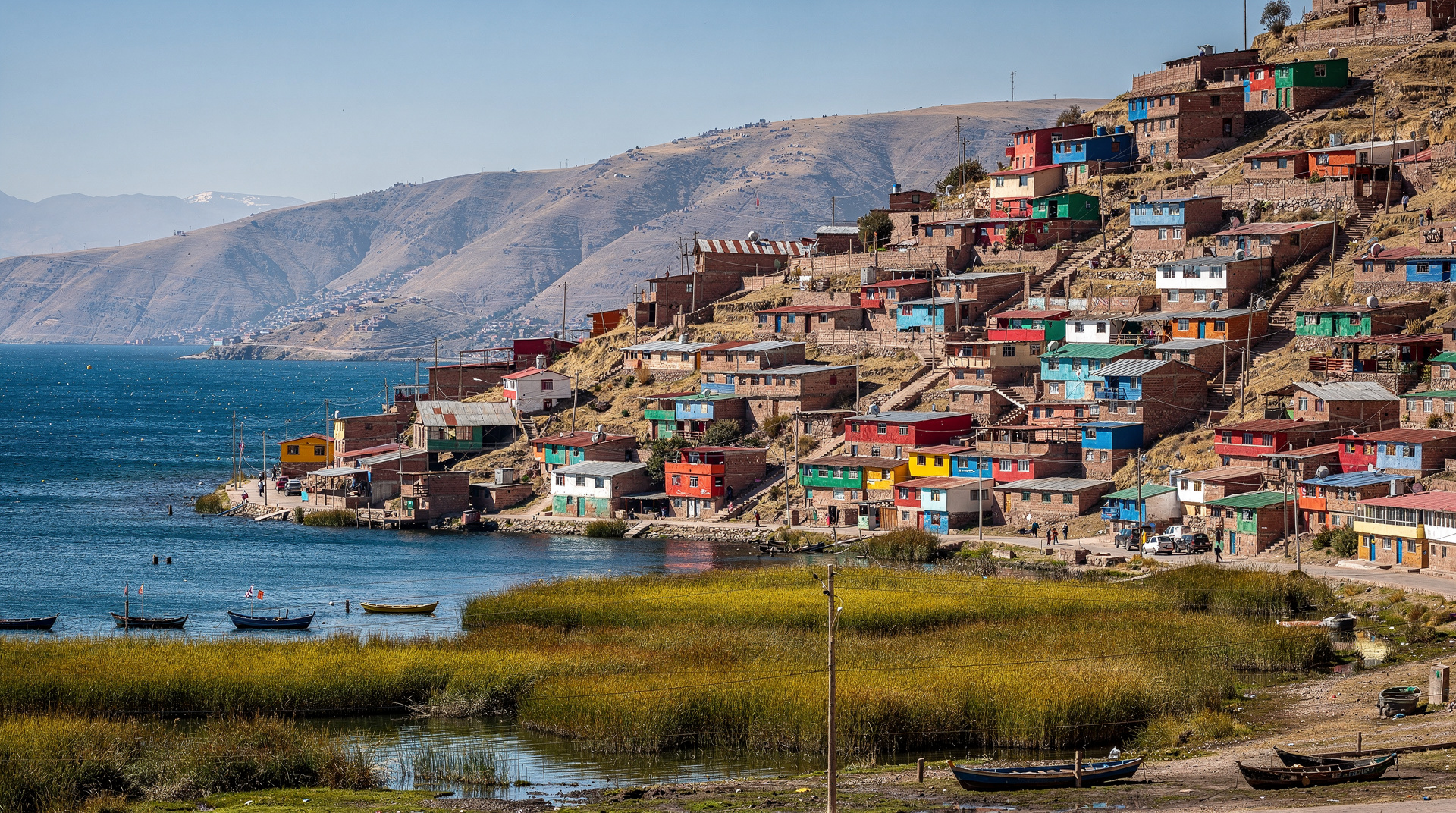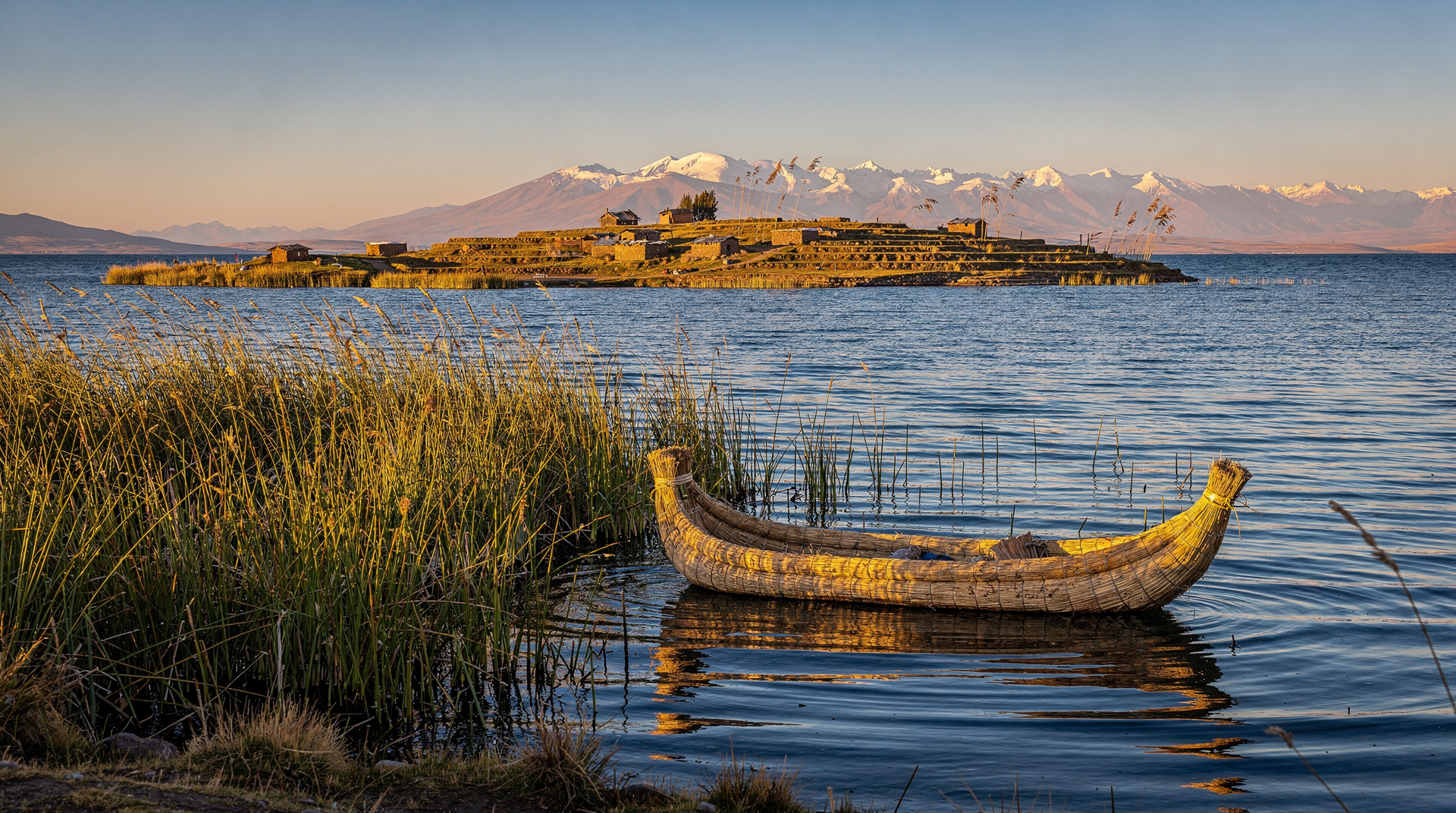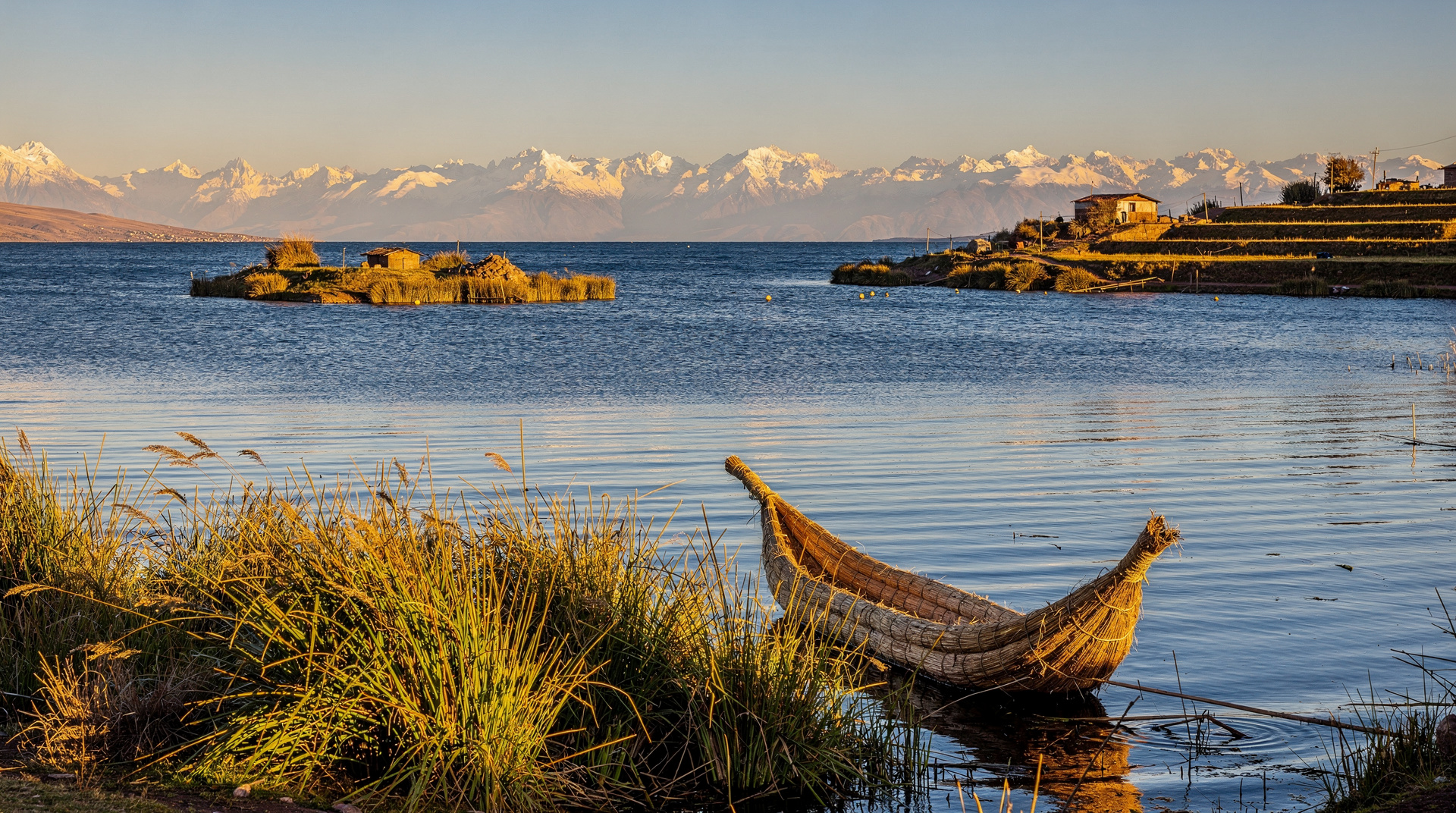
Taquile Island
Visit Taquile Island on Lake Titicaca: UNESCO textile tradition, terraced hillsides, fresh trout and the community where men are master knitters.
Puno: Full-Day Tour of Lake Titicaca and Uros & Taquile
Quick facts
- Country
- Peru
- Altitude
- 3,950 m / 12,959 ft
- Currency
- Peruvian sol (S/) — USD widely used
- Best for
- UNESCO textiles, Andean community culture, lake scenery, photography
An island where the men knit
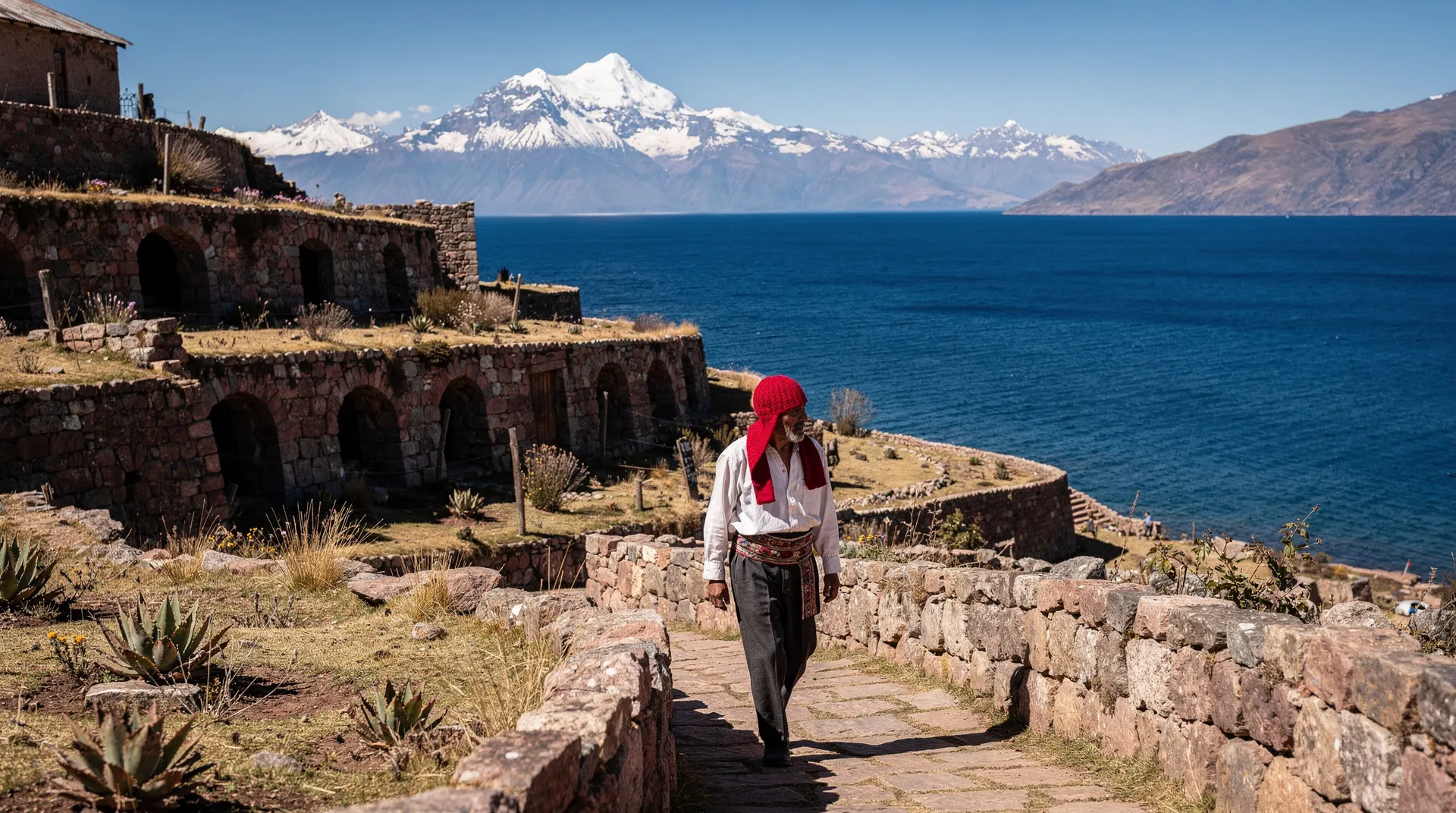
Taquile Island sits in the Peruvian sector of Lake Titicaca, about 45 km east of Puno across open lake water. Its population of roughly 2,000 Quechua-speaking residents lives on terraced hillsides that climb from the lake’s edge to a summit ridge at approximately 3,950 m. It is not an easy place to reach or to walk around. But the reason it earned a UNESCO intangible cultural heritage listing in 2005 is one of the most disarming details in Andean culture: on Taquile, it is the men who knit.
That inversion of what most visitors expect from “traditional weaving” is the island’s most memorable single fact, and it barely scratches the surface. The textile tradition of Taquile is a complete social communication system — the patterns, colours, and structure of the chullos (knitted hats) worn by Taquile men communicate marital status, social role, and community affiliation to anyone who knows how to read them. A single hat can take weeks to produce and represents a level of technical skill that takes years to develop. UNESCO did not inscribe the tradition because the hats are pretty. It did so because the tradition is a living information technology embedded in daily life.
| Where | Lake Titicaca, ~45 km / 2 hrs by boat from Puno |
| Cost | Full-day tour around S/100–150; island entrance fee ~S/10 |
| Time needed | Full day from Puno (07:30–18:00 approx.) |
| Getting there | Public/tourist boat or speedboat from Puno harbour |
| Best time | May–October (dry season), morning arrival before crowds |
The physical reality of the island
The boat journey from Puno to Taquile takes approximately two hours on the slow public and tourist boats, less on speedboats. There is no harbour infrastructure in the modern sense — boats moor at one of two basic landings at the foot of the island, and from there the only way up is on foot.
The main landing on the western side involves a climb of roughly 500 steps, most of them steep, cut directly into the hillside. At nearly 4,000 m this is a serious physical undertaking for visitors who have not acclimatised. The steps are uneven, the altitude is felt immediately in the lungs, and the sun at this elevation on the reflective surface of the lake is intense. Most visitors take 35–50 minutes to reach the main plaza at the top, stopping several times. This is not a failure — it is the correct approach. Rushing up the steps at altitude causes headaches and nausea that spoil the remainder of the visit.
Carry at least one litre of water per person, apply sunscreen before you leave the boat, and wear layers. The air at the top is cold in the morning even in the dry season.
The main plaza and what you find there
The central plaza of Taquile is a roughly rectangular stone-paved space at the island’s highest inhabited point, ringed by low stone walls and a small church. The views from here — lake water in every direction, mountains in Bolivia visible on clear days, the reed-fringed Peruvian shore diminishing into haze — are genuinely spectacular without any tourist-board hyperbole. On a clear May or June morning this is one of the most beautiful high-altitude views in Peru.
The cooperative market occupies one side of the plaza and is unlike any artisan market you will encounter in Cusco’s tourist streets. The prices are fixed and non-negotiable (the community cooperative sets them collectively), the quality is high, and the sellers are the weavers themselves. A traditionally knitted men’s hat costs approximately S/80–150 depending on complexity. Woven belts (chumpi), table runners, and smaller items start from around S/30. If you want to support the textile tradition directly and take home something that is the genuine article, this is where to do it — not from the Pisac market or the San Blas shops in Cusco, where Taquile-style items are often mass-produced off-island.
Tours and how the day works
The standard way to visit Taquile is as part of a full-day tour from Puno combining the Uros floating islands and Taquile. The boat departs Puno harbour at approximately 07:30, stops at the Uros islands for 90 minutes in the morning, then continues to Taquile, arriving around midday. After the climb to the plaza, you have about two to two-and-a-half hours on the island before the boat returns. The return journey to Puno takes about two hours and typically arrives back at the harbour by 18:00–18:30.
Lunch is included in most guided tours and is served in one of the plaza restaurants — typically a set menu of quinoa soup followed by fresh lake trout with potatoes and rice, for around S/20–30 if you are paying separately. The trout, farmed in the lake, is genuinely good. Sitting on a terrace at nearly 4,000 m with a plate of fresh fish and a view of the lake is one of the uncelebrated pleasures of the Lake Titicaca circuit.
For visitors with limited time in Puno, the speedboat version of the same tour significantly cuts the crossing times, compressing the return journey to under an hour each way. The trade-off is that speedboats are noisier and less comfortable for the full crossing, and they allow less time to take in the lake scenery at water level. The time saved (roughly 2–3 hours over the day) may or may not be worth it depending on your schedule.
What the community cooperative means in practice
Taquile has operated as a cooperative community since the 1970s, predating the tourism economy that now partly sustains it. There is no private land ownership on the island in the conventional sense — land use is allocated by the community, tourism income is distributed through the cooperative, and community decisions are made collectively through assemblies.
This social structure is visible in how the island’s tourism operates. The boats that ferry visitors are owned by the island community, not by outside operators. The restaurants in the plaza are run by island families on a rotation system, not by competing individual businesses. The cooperative market, as noted, distributes income centrally. When you buy a hat or a meal on Taquile, a larger proportion of what you spend stays on the island than is typical for tourist economies almost anywhere else in Peru.
That is worth knowing before you visit, because it changes the nature of your spending decisions on the island.
Getting from Cusco to Taquile
There is no direct route from Cusco to Taquile. The journey goes through Puno: Cusco to Puno by bus (six to seven hours via direct bus, or a full day on the Ruta del Sol with stops), then overnight in Puno to acclimatise, then the morning boat departure from Puno harbour. See the Cusco to Puno transport guide for the overland leg.
The 10-day Cusco and Lake Titicaca itinerary shows how to fit Taquile into a broader trip that includes Cusco, Lake Titicaca, and the journey in between.
The textiles in context: what to look for
For those interested in Andean textiles beyond the commercial exchange, a few details make the Taquile market more legible. The most technically complex items are the chullos — the knitted hats — which are worked in the round at extremely fine gauge using five needles simultaneously.
The pattern zones on a chullo are not decorative in isolation: the upper section typically carries geometric patterns associated with the sky and celestial events, the middle zone with agricultural cycles, and the lower band with community-specific motifs. Reading this layering requires knowledge the weavers carry but rarely have time to explain in a brief market encounter; a guided tour that includes a textile explanation is worth requesting specifically for this purpose.
Women on Taquile weave rather than knit, producing the belts, blankets, and woven cloths using backstrap looms in a technique common across the Andes. The visual contrast on the island between men knitting casually in the plaza and women at their looms in the compounds behind is a constant reminder that the gender division here is the precise inversion of almost every other textile culture in the world.
The best time to observe knitting activity is in the morning, before the day-trip tourists arrive and while the men are going about ordinary business on the paths and in the plaza. After about 11:30, when the main boat groups arrive, the market becomes the focus of activity.
Honest expectations: what the visit is and is not
Taquile is genuinely extraordinary in certain respects — the textile heritage, the cooperative social organisation, the views, the lunch — but it is also a managed day-trip site that has been operating for several decades. The community is experienced with tourism and the interaction with visitors is practiced. You will not encounter people going about undisturbed daily life. The market will include a sales element. The launch of boats back to Puno at the same time each afternoon creates a brief, concentrated bustle.
None of this diminishes the visit. The island’s qualities are real and the two to three hours you spend at the top are genuinely memorable. But arriving with calibrated expectations produces a better experience than arriving expecting something purely unmediated. The most rewarding visitors to Taquile are those who slow down, buy something from the cooperative market with genuine intent rather than obligation, eat the lunch carefully, and take time to look at the views from the terrace walls of the main plaza.
The island combined with Amantani overnight, via the Lake Titicaca two-day tour, gives a meaningfully deeper experience than Taquile alone, if your schedule allows it.
Taquile versus the Uros islands and Amantani
| Taquile | Uros floating islands | Amantani | |
|---|---|---|---|
| What it is | Permanent stone island, UNESCO textiles | Man-made reed islands | Permanent island, homestay culture |
| Typical visit | Half day within a full-day tour | 60–90 min stop | Overnight homestay |
| Authenticity | High — cooperative-run, lived-in community | Mixed — partly maintained for tourism | High — genuine homestay experience |
| Best for | Textile and culture-focused day-trippers | A quick, easy add-on to any lake tour | Travellers with an extra day for depth |
Most standard day tours combine Uros and Taquile in one day; adding Amantani requires an overnight and is worth it for travellers who want more than a few hours of contact with lake communities.
Practical advice
Entrance fee: Taquile charges an island entrance fee of around S/10 per person, paid at the boat landing. This is separate from tour fees.
Photography: Taquile’s landscape and the textile market photograph beautifully. Ask before photographing individuals — most residents are not averse to it but a direct request is courteous and usually met positively. Do not photograph the church interior without explicit permission.
Weather: The dry season (May–October) offers the clearest lake conditions and most reliable boat crossings. The wet season (November–March) brings afternoon rain and the possibility of boat delays; the island is less visited and somewhat greener, but the risk of a cancelled return crossing is real.
What to bring: Sunscreen at SPF 50 or above (UV intensity at this altitude over reflective water is extreme), at least one litre of water, a windproof layer for the boat, and comfortable walking shoes with grip for the stone steps. Do not bring large wheeled luggage — everything goes on your back or in a day bag for the uphill section.
Money on the island: The cooperative market operates on fixed cash prices. Bring small denomination soles (S/10 and S/20 notes) — change is available but limited. There are no ATMs; the nearest are in Puno.
The Lake Titicaca page covers the broader lake context and Amantani Island options. The Puno destination guide has logistics for the city, accommodation recommendations, and harbour departure details. The 10-day Cusco and Titicaca itinerary shows the full context of how Taquile fits into a southern Peru circuit from Cusco.
Frequently asked questions about Taquile Island
Is Taquile Island worth the two-hour boat ride each way? Yes for most travellers with a genuine interest in textiles or Andean community culture — the UNESCO-listed knitting tradition and the cooperative social structure are unlike anything else on the standard Lake Titicaca circuit. If you’re pressed for time, the Uros floating islands alone make a shorter, easier add-on.
How fit do I need to be for the climb from the boat landing? Reasonably fit and prepared for altitude — the roughly 500 steps from the western landing to the plaza sit at nearly 4,000 m and take most visitors 35–50 minutes with several rest stops. This is normal, not a sign of poor fitness; rushing is what causes altitude discomfort.
Top experiences
Bookable activities with verified prices and instant confirmation on GetYourGuide.