Lima to Cusco flights — airlines, booking strategy and what to expect
Lima: Historical, Colonial, and Modern City Tour
How long is the flight from Lima to Cusco?
Approximately 1 hour 20 minutes airborne. Total journey time from Lima's Jorge Chavez Airport (LIM) to Cusco CUZ airport, including boarding and baggage claim, is typically 2–2.5 hours. LATAM is the dominant carrier with 8–10 daily departures; Sky Airline, Avianca and JetSmart also operate the route. Book morning departures — afternoon flights face significantly higher disruption rates from Andean weather at Cusco.
| Flight time | around 1 hr 20 min airborne |
| Airlines | LATAM, Sky Airline, Avianca, JetSmart |
| Cost | around S/130–450 depending on carrier & lead time |
| Best departure | Morning (arriving before 11 am) |
| Airport | Lima Jorge Chávez (LIM) → Cusco (CUZ) |
The most-flown domestic route in Peru
The Lima–Cusco corridor is one of the busiest domestic air routes in South America. Multiple airlines operate dozens of services per day, the journey takes 1 hour 20 minutes, and prices are competitive enough that flying is the default choice for virtually every visitor to southern Peru. There is no passenger train from Lima to Cusco — the geography of the Andes makes one impractical — and overland alternatives from the coast take 22–25 hours. The plane is not one option among many; it is the practical choice.
This guide covers every airline on the route, pricing, booking strategy, the morning-versus-afternoon question, the Juliaca diversion situation, and the transition from Lima’s coastal air to the thin 3,400 m air over Cusco.
Lima’s airport: Jorge Chavez International (LIM)
All flights on this route depart from Lima Jorge Chavez International Airport (IATA: LIM), located in the Callao district approximately 12 km west of Miraflores. Jorge Chavez is Peru’s only major international gateway — all intercontinental flights to and from Peru use this airport. Domestic flights including the Lima–Cusco services operate from a separate domestic terminal (Terminal 1) a short walk from the international arrivals building.
If you are connecting from an international flight to your Lima–Cusco domestic flight on the same day:
- Allow minimum 3 hours between international arrival and domestic departure
- Collect all checked bags from international baggage claim
- Proceed through immigration and customs
- Transfer to the domestic check-in area (Terminal 1, a short internal walk or brief bus connection)
- Recheck bags for your domestic flight if not through-checked
- Clear domestic security and proceed to gate
On alliance partnerships (LATAM’s oneworld connections, Avianca’s Star Alliance connections), bags may be through-checked to Cusco. Confirm this with your ticketing airline before travel. Many passengers find out only at international baggage claim that their bags require manual rechecking — be prepared either way.
The airlines
LATAM Peru
LATAM is the dominant carrier with 8–10 daily Lima–Cusco departures. First flights out typically leave around 5:30–6:00 am; last departures are in the early evening. LATAM operates the route with Airbus A320 family aircraft optimised for high-altitude short-field performance.
Economy fares on LATAM: S/280–450 (approximately $75–120 USD) depending on booking lead time, day of week, and season. Peak season (July–August) and holiday periods (Christmas, Semana Santa) push fares toward the upper end. Booking 6–8 weeks ahead in peak season and 4–6 weeks in shoulder season accesses the lower fares.
Included baggage: standard LATAM economy includes 1 carry-on plus 1 checked bag up to 23 kg. This is relevant for comparison with low-cost carriers where luggage is an add-on.
LATAM’s reliability record on the Lima–Cusco route is good. For travellers with timing-critical connections — Inca Trail start dates, pre-booked train services to Machu Picchu — LATAM’s schedule depth (multiple departures per day) provides resilience if one flight is disrupted.
Sky Airline
Chilean low-cost carrier with a growing Peru network. Sky operates Lima–Cusco with base fares from S/130–200 (approximately $35–54 USD) with advance purchase, rising to S/280–400 near departure. Checked baggage is extra (approximately S/45–75 per bag depending on weight), which closes most of the price gap with LATAM for travellers with standard luggage. Where Sky genuinely wins is for light travellers — a carry-on-only passenger booking 8+ weeks ahead can fly for S/130–180 on Sky versus S/280+ on LATAM.
Sky operates the route with a smaller schedule than LATAM — fewer departure times per day, which matters less for flexible travellers but more for those with specific timing requirements.
Avianca Peru
Avianca (formerly TACA) operates Lima–Cusco with service quality and pricing comparable to LATAM. Useful as an alternative when LATAM’s preferred times are sold out or priced higher. Star Alliance membership means connections from international carriers on the alliance (United, Lufthansa, Air Canada, Singapore Airlines) may be seamless at Lima.
JetSmart
Ultra-low-cost operator. Lowest advertised base fares, but strict cabin bag dimensions and fees for virtually everything beyond the seat. For travellers who pack very light and want the cheapest seat, JetSmart’s headline fares can be S/100–160 for advance-purchase departures. Factor in baggage fees and the comparison with Sky or LATAM narrowed considerably.
Morning flights: the essential recommendation
This deserves emphasis because it affects real itineraries. Cusco airport sits at 3,399 m, surrounded by Andean terrain on three sides. The approach requires precision navigation and has specific weather minima. In the afternoon, the region’s thermal dynamics reliably generate cloud build-up, turbulence, and reduced visibility — more severely in the wet season (November–March) but present even in dry months.
The consequence: afternoon flights to Cusco have a materially higher rate of diversion to Juliaca, delay, or cancellation than morning flights. This is not theory — it is a statistical fact visible in any analysis of Cusco arrival data across a year.
Morning flights (arriving Cusco before 11:00 am): High on-time performance across all seasons. These are the 5:30–8:00 am departures from Lima.
Midday flights (arriving 11:00 am–1:00 pm): Generally good performance in the dry season (May–September), higher risk in the wet season.
Afternoon flights (arriving 2:00 pm–6:00 pm): Significant diversion/delay risk, particularly November–March. In wet season, 1 in 5 or 1 in 6 afternoon arrivals at Cusco is disrupted.
Book the earliest available morning departure from Lima. If the 5:30 am LATAM is full, take the 6:30 am. If that is full, the 7:30 am. The cost of a Juliaca diversion — overnight in Juliaca, 3-hour bus to Cusco the next morning, missed first-day activities — is considerably higher than any price difference between morning and afternoon seats.
If you have a full day in Lima before your morning Cusco flight, a guided tour of the historic centre and Miraflores is an excellent use of the day — Lima’s colonial architecture, the Larco Museum and the Pacific-front Malecón in Miraflores are all worth the time.
The Juliaca diversion: what actually happens
When Cusco weather prevents landing, the flight diverts to Juliaca Airport (JUL), the airport serving Puno on the altiplano, approximately 170 km southeast of Cusco by road.
On landing at Juliaca, passengers are informed of the situation. Airlines typically provide:
- Bus transport from Juliaca to Cusco (approximately 3 hours), usually at the airline’s expense
- Hotel accommodation in Juliaca or Cusco if the delay runs overnight
- Rebooking onto the next available Cusco flight if conditions clear
What passengers are not provided: refund of pre-booked activities that cannot be rescheduled, train tickets to Machu Picchu that have a fixed date, or Inca Trail permits that begin the next morning. These are losses absorbed by the traveller.
The mitigation: book morning flights and purchase travel insurance covering trip disruption. A S/150 travel insurance policy purchased at time of booking covers the cost of a disrupted first day (missed tour, hotel night in Juliaca) that could otherwise run S/400–600+.
Lima: more than a transit hub
Many visitors rush through Lima to catch the Cusco connection, treating the capital as an inconvenient layover. This is a missed opportunity. Lima is one of South America’s most interesting food and cultural cities, with a UNESCO-listed colonial centre, world-class museums, and arguably the best restaurant concentration in the continent.
A useful Lima structure: arrive at Jorge Chavez in the afternoon or evening; stay in Miraflores or Barranco; spend one full day exploring the historic centre, the Larco Museum (pre-Columbian textiles and gold, extraordinarily good) and the cliffside Malecón; catch the 6:30 am flight to Cusco the next morning. This gives Lima its due without significantly lengthening the overall trip.
The Lima destination guide covers neighbourhoods, museums and the food scene in full. For visitors with a tight Lima connection, the Lima city highlights tour covers the main sights efficiently.
If you have more days on the coast before flying up to the Andes, a day trip from Lima combining the Ballestas, Huacachina and a flight over the Nazca Lines is one way to see a very different side of Peru before the mountains.
Booking: where and when
Direct booking: LATAM.com, skyairline.com, avianca.com, jetsmartairlines.com. All accept international credit cards and provide English interfaces. Prices shown are generally reliable (no hidden additions for LATAM; baggage add-ons visible for Sky and JetSmart at checkout).
OTAs: Google Flights, Expedia, and Despegar.com (the Latin American Expedia equivalent) aggregate all operators and allow direct price comparison. Useful for finding availability across multiple carriers quickly.
Timing: Book 6–8 weeks ahead for July–August departures. 4–6 weeks for May, June, September. 2–4 weeks for the rest of the year except Christmas week (treat as peak season).
Midweek vs weekend: Tuesday, Wednesday and Thursday departures are generally cheaper than Friday–Monday. Flexible travellers should compare across the week on Google Flights.
What to expect once airborne
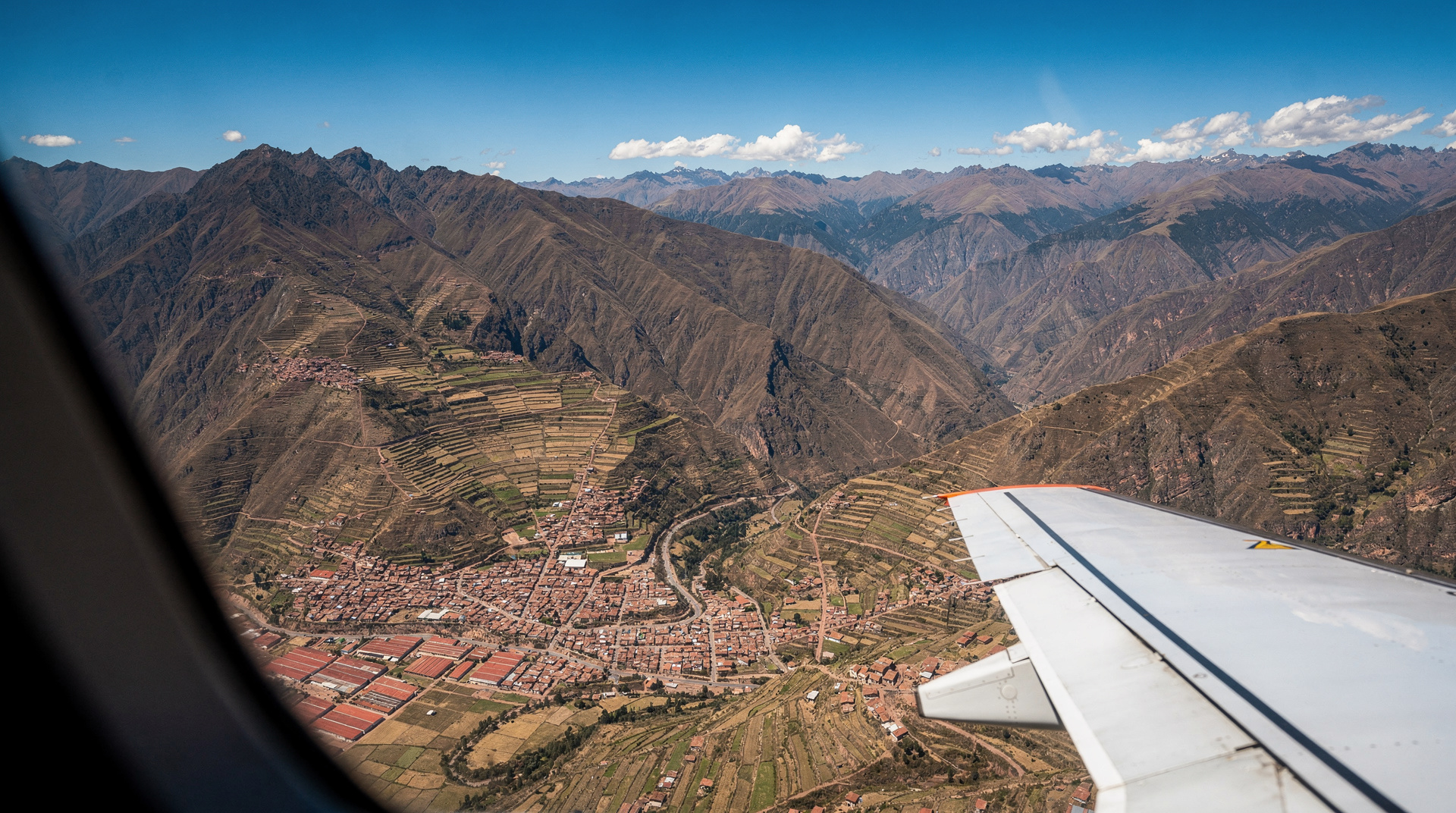
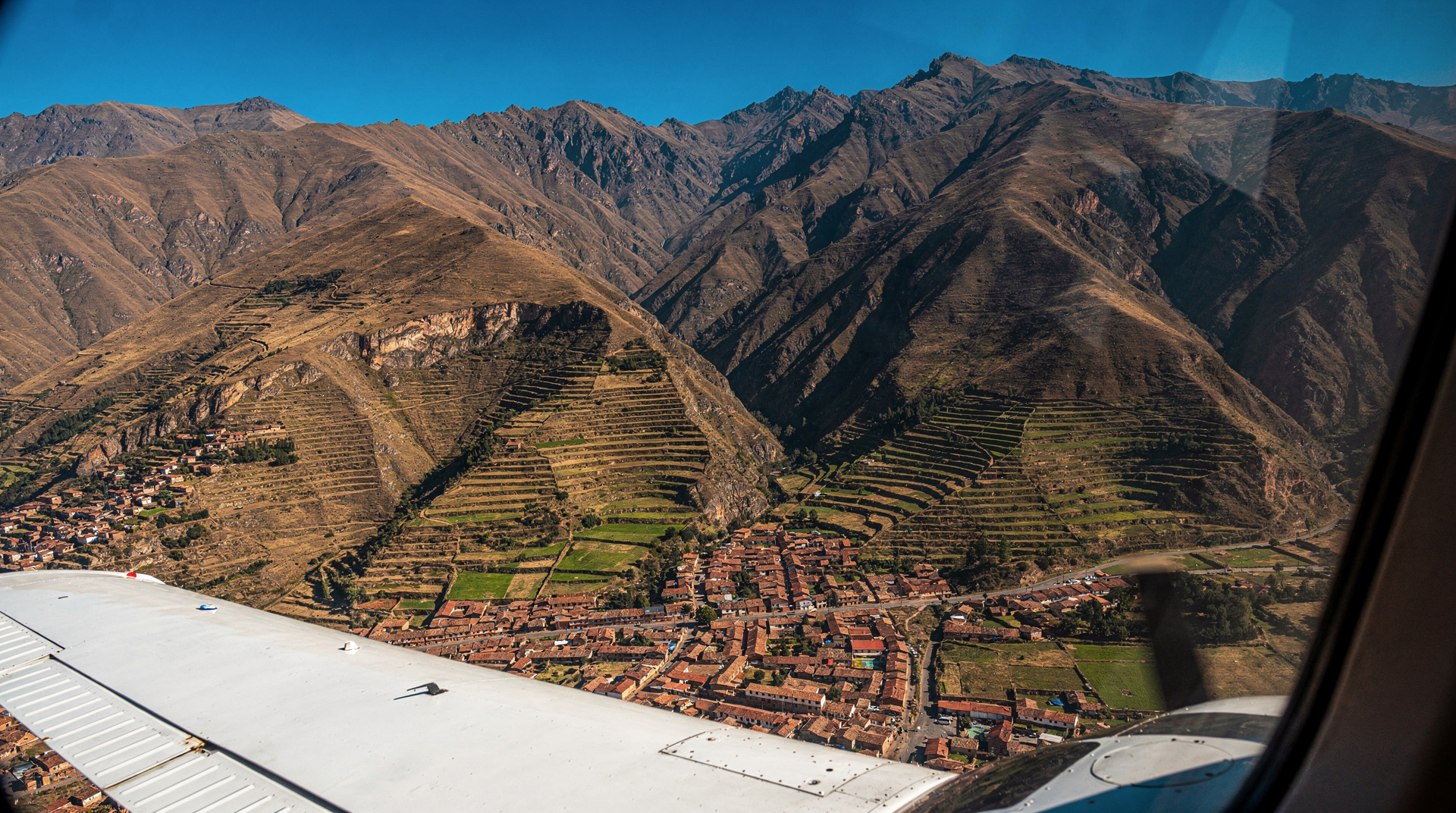
The Lima–Cusco flight is one of the more visually spectacular domestic air routes in South America, although this depends heavily on weather and seating position. On clear days, the aircraft climbs from the Pacific coast, crosses the desert strip of the Peruvian coastal plain, then begins climbing over the western Andes. The scale of the mountains is apparent from the window — snow-capped peaks, glaciated ridges, the dramatic ascent from coast to altiplano in less than 30 minutes of flight.
On a clear morning on a window seat (right side of the plane tends to give Andean views on the approach to Cusco from Lima), the Andean landscape is extraordinary. If the clouds close in, which they often do, you see what looks like a standard overcast flight — and then suddenly the runway appearing between mountain walls for landing.
The approach to Cusco is not a standard instrument approach. Pilots trained for Cusco operations follow specific mountain valley procedures. First-time visitors who are nervous flyers should know that this route has specific training requirements for crews and that both the frequency and safety record of Lima–Cusco operations is well-established.
After landing at Cusco
The altitude hits immediately. You have moved from sea level (Lima) to 3,399 m in 80 minutes. Walk slowly through the terminal, collect bags without rushing, drink water before getting in a taxi. The Cusco airport guide covers the arrivals process in full, including taxi fares (S/25–35 to the city centre), Uber availability, and how to handle the first 30 minutes at altitude.
The key decision upon landing at Cusco is where to base first. The acclimatisation guide argues strongly for spending the first 1–2 nights in the Sacred Valley (2,600–2,800 m) rather than in Cusco (3,400 m) itself — an approach that most altitude-medicine practitioners endorse and that makes a measurable difference to how you feel on days two and three.
If you are still deciding how much time to give the region, the how many days in Cusco guide helps you work out which flight slot fits your plan. Anyone who prefers to ease in gently will also find the Sacred Valley vs Cusco base comparison useful, and the altitude sickness guide explains what the first evening can feel like and how to handle it.
Matching your flight to the rest of the trip
The flight is rarely the only fixed point in a Cusco itinerary, so it pays to read it alongside everything booked after it. If your plans include a train, check the Machu Picchu by train guide before locking in a flight, and keep a buffer between landing and any departure that cannot be moved. Trekkers with a fixed start date should read the Inca Trail permits guide and arrive in Cusco well ahead of the briefing rather than on the same day.
Once you are safely on the ground and rested, a Machu Picchu day trip by tourist train with the entrance ticket included takes the booking logistics off your hands, which is useful when the flight is the one thing you cannot control.
For a first visit, a sensible rhythm is to treat the flight day as a light day: land, rest, eat simply and save the sightseeing for the following morning. The Cusco and Machu Picchu 4-day itinerary and the getting to Cusco guide both show how the arrival fits into a wider plan. If you would like to compare the trip with a first-hand account, the first time in Cusco story describes what arriving feels like, and the Cusco trip planning 2026 guide ties flights, tickets and timing together.
Disruption risk by departure time
| Departure window | Dry season (May–Sept) | Wet season (Nov–Mar) |
|---|---|---|
| Before 8:00 am | Low risk | Low–moderate risk |
| 8:00–11:00 am | Low risk | Moderate risk |
| 11:00 am–1:00 pm | Low–moderate risk | Moderate–high risk |
| After 2:00 pm | Moderate risk | High risk (up to 1 in 5–6 disrupted) |
Travel insurance and disruption costs
Given the Juliaca diversion risk on afternoon flights, travel insurance with trip-disruption coverage is worth budgeting for specifically on this route, not as a generic add-on. A basic policy costing around S/150 at time of booking typically covers unrecoverable costs from a missed connecting activity, an unplanned hotel night in Juliaca, or rebooking fees — costs that can otherwise run S/400–600 or more for a single disrupted day.
When comparing policies, check specifically whether “flight delay” and “missed connection” clauses apply to domestic diversions within Peru, since some international travel policies are written with international connections in mind and treat domestic legs differently. Screenshot or save your booking confirmation and any airline diversion notice, since claims typically require documentation of the specific disruption.
Seat selection and the window-seat debate
If your itinerary has flexibility, paying the small fee many airlines charge for advance seat selection is worth it purely for the views on a clear day. Window seats on the right-hand side of the aircraft (facing north when flying south from Lima) tend to give the better Andean panorama on the approach into Cusco, though this varies with the specific flight path and prevailing winds on the day. Aisle seats offer easier access for the flight’s short duration, which matters less on an 80-minute domestic hop than on a long-haul sector. For travellers prone to motion sickness, seats over the wing offer a steadier ride during the mountain approach, which can involve more perceptible turbulence than a typical coastal descent.
The things to do hub and destinations hub provide the planning structure for the trip itself. The flight from Lima is simply the opening act.