Andean textiles guide: weaving, buying and what it all means
Cusco: Pisac, Maras, Moray, Ollantaytambo Small Group Tour
Where can I buy genuine Andean textiles in the Cusco region?
The weaving cooperatives in Chinchero are the best source of genuinely handwoven, naturally dyed alpaca textiles in the region. Artisan shops in Cusco's San Blas neighbourhood carry some quality pieces. San Pedro market and Plaza de Armas stalls are predominantly machine-made acrylic. A backstrap-loom woven alpaca scarf with natural dyes costs S/60–120 — significantly below this price means it is not what it claims to be.
The most significant craft tradition in the Americas
Andean textile production is one of the oldest, most technically sophisticated and most culturally embedded craft traditions in the world. The Inca were themselves the heirs to much older textile cultures — the coastal Paracas civilisation (400 BCE – 200 CE) produced embroidered funerary textiles of extraordinary complexity; the Wari empire (600–1000 CE) wove tapestry cloth that has not been surpassed in technical density by any subsequent tradition. The backstrap loom and the natural dye techniques in use at Chinchero’s weaving cooperatives today are part of a lineage that reaches back more than 2,000 years.
This is not hyperbole for marketing purposes. It is the consensus of textile scholars who have studied the archaeological record and the living tradition, and it is the context that makes buying a piece of genuine handwoven Andean cloth a different proposition from buying a souvenir.
This guide covers the textile tradition, how to buy honestly, and where to find the real thing in the Cusco region.
| Where to buy genuine pieces | Chinchero cooperatives, San Blas artisan workshops |
| Cost | Scarves S/60–120; wall hangings S/200–450 |
| Time needed | 30–60 min for a cooperative demonstration + buying |
| Avoid | Market stalls selling “handmade” acrylic at S/15–35 |
| Best combined with | Sacred Valley tour (Chinchero, Pisac, Maras, Moray) |
The tradition: what Andean textiles are and why they matter
In Andean societies, cloth was not primarily utilitarian. Textiles were among the most valued objects in the Inca economy — more valuable than gold or silver by most accounts of Inca society’s priorities. They were used as tribute, as offerings to the sacred, as records (the quipu, the knotted cord system that served as the Inca recording device, was itself a textile object), as markers of identity, status and community affiliation, and as gifts that created and maintained social relationships.
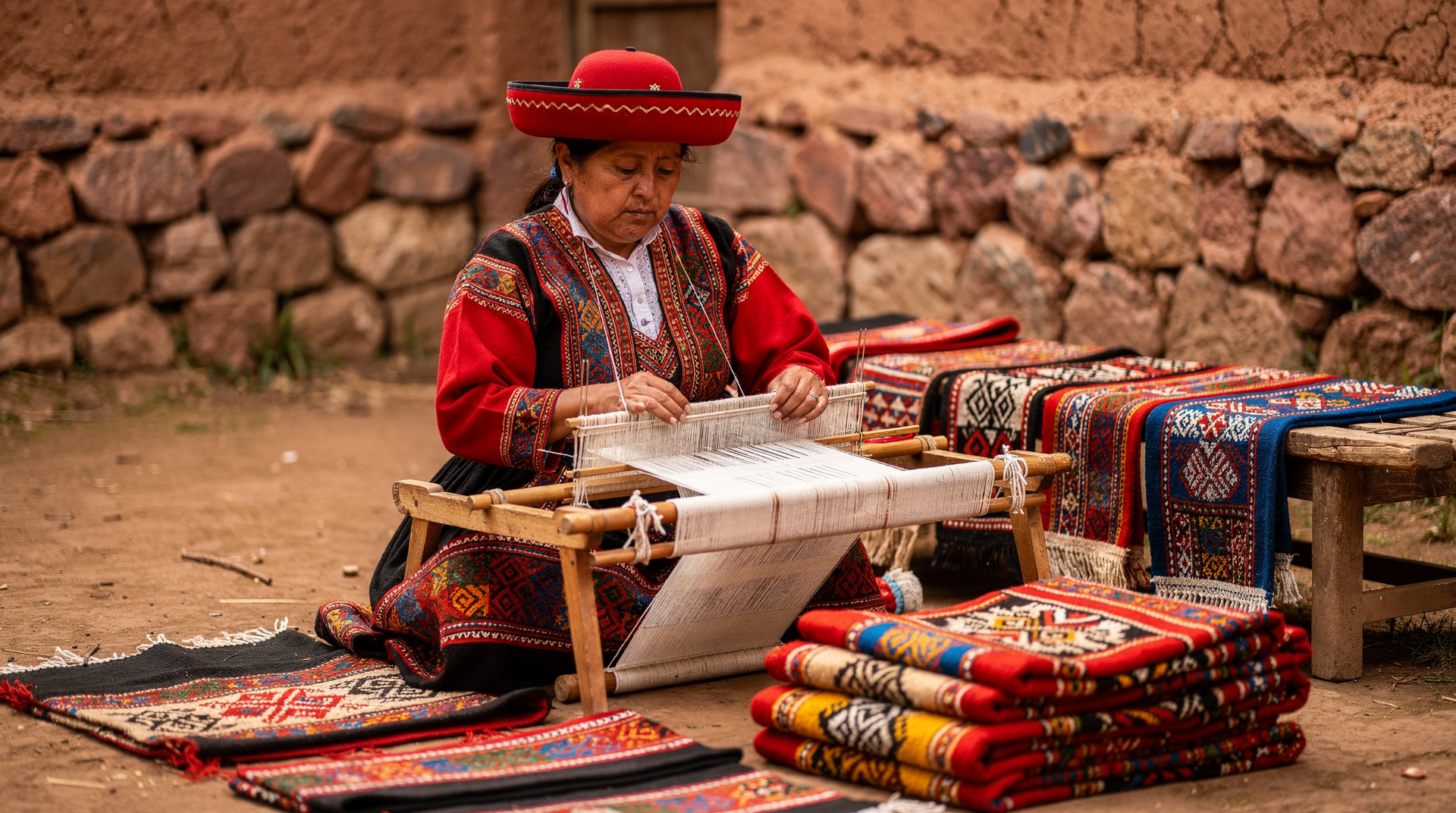
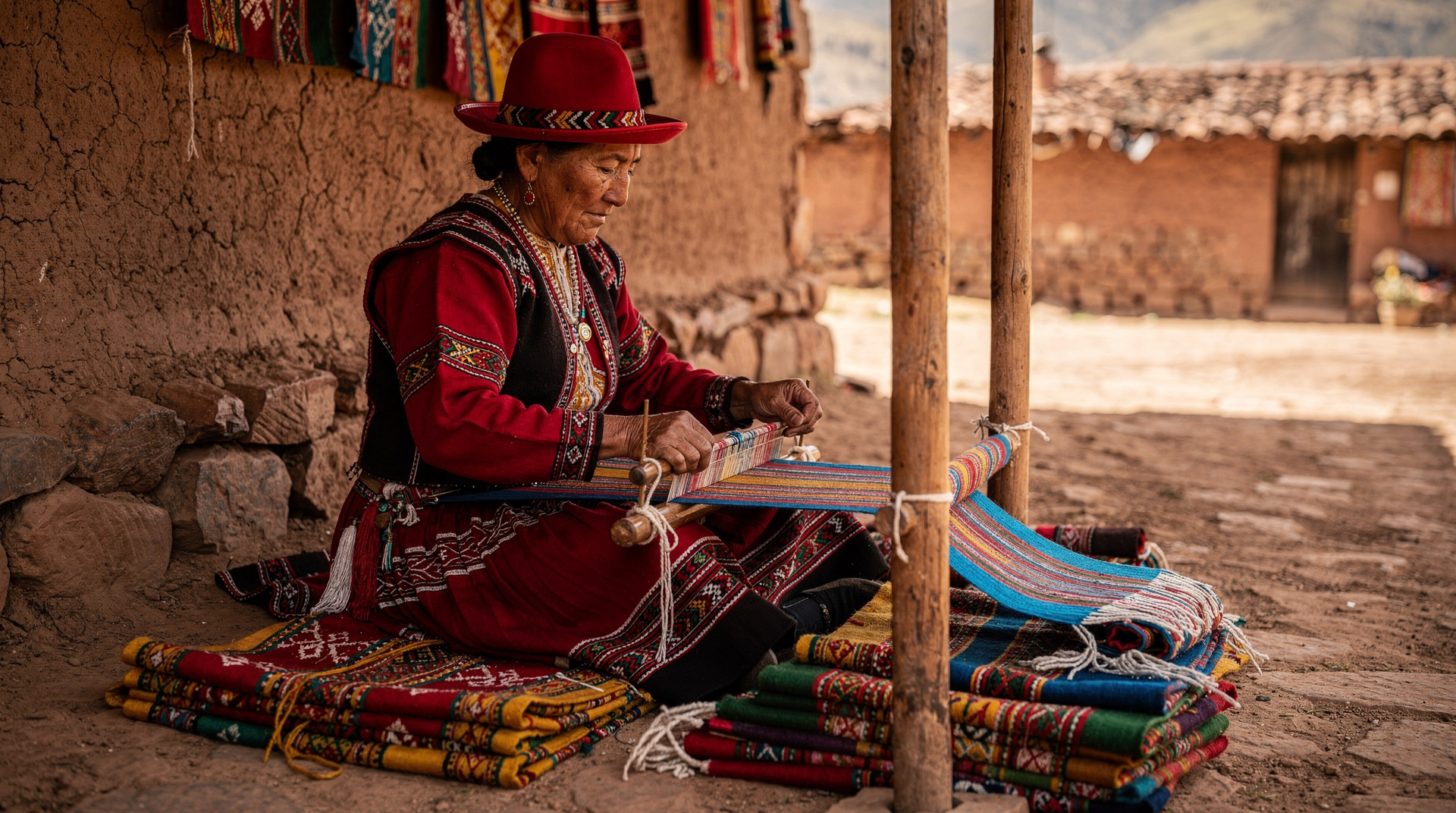
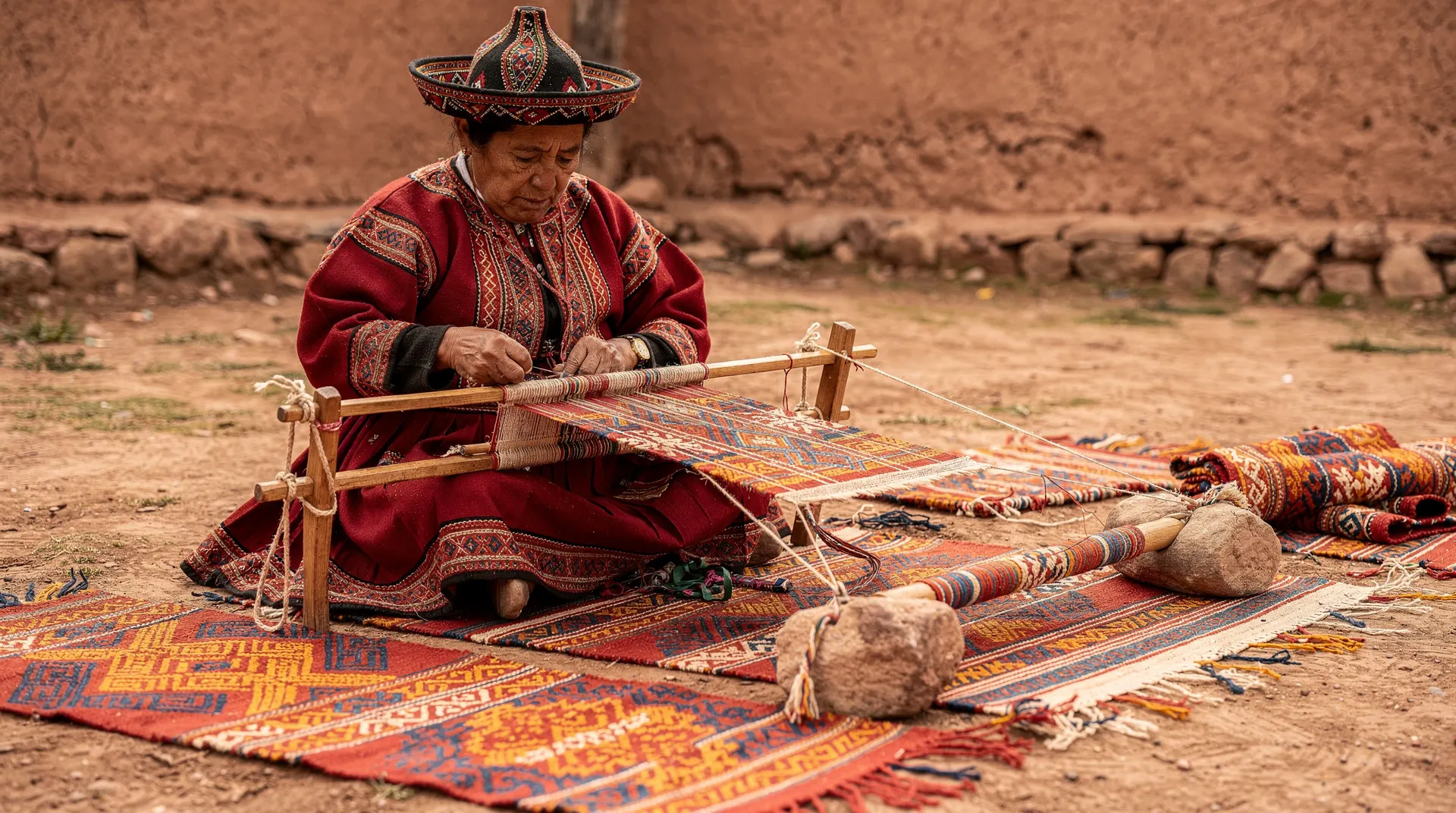
The Inca operated textile factories (akllawasi) in which specialist weavers produced the highest-quality cloth (cumbi) for state and ritual use. At the same time, textile production was distributed throughout Andean communities, with women in particular responsible for producing cloth for household and local ceremonial use. The backstrap loom — a simple but highly versatile device consisting of two end-rods, a series of heddles to separate warp threads, and a back-strap worn by the weaver to control tension — was the primary tool. It is still in use today in exactly the same form.
The suppression of Andean cultural practices under colonial rule included an assault on the textile tradition — specifically the complex iconographic patterns that encoded Andean cosmological and political identity. Spanish colonial administrators recognised the political content in Andean textiles and required simplified or Catholic-iconographic patterns in tribute cloth. The complete iconographic tradition did not survive intact; what exists in the contemporary cooperatives is a partial recovery, informed by museum collections and community memory, of a system that was partially disrupted.
The four steps: spinning, dyeing, warping, weaving
The full production cycle of a genuine Andean textile involves four stages, each of which requires substantial skill and time:
Spinning: Raw alpaca or sheep fleece is cleaned, carded (aligned) and spun on a hand-held drop spindle into thread. The drop spindle is a wooden shaft with a weighted disc; the spinner twirls it and drops it while drawing out the fibre with the other hand, controlling tension and thickness throughout. A skilled spinner working at full speed takes two to three days to spin enough thread for a single scarf. The thread produced by hand-spinning has natural variation in thickness — slightly thicker and thinner sections at irregular intervals — which is absent in machine-spun yarn and which gives the finished textile its characteristic slight irregularity.
Natural dyeing: Natural dyes produce the full colour range of traditional Andean textiles without chemical additives. The main dye sources are: cochineal (dried scale insects farmed on cacti, producing reds and purples), indigo (producing blues and blue-greens), weld (yellows and golds), onion skin (warm yellows), and iron-containing mordant baths (grey-greens and blacks). The specific colour achieved depends on the mordant (a chemical fixative that affects the dye’s interaction with the fibre) and the pH of the dye bath. A weaver who works with natural dyes can produce 30–40 stable colours from these sources — a wider range than most visitors expect from “natural” materials.
The visual difference between natural and chemical dyes is visible in the finished textile. Natural dye colours have depth, tonal variation in different light conditions, and a warmth that results from the organic dye molecules’ specific light-absorption characteristics. Chemical dyes are flat, bright and uniform. Under different lighting conditions the difference is particularly clear — natural-dyed cloth changes character in sunlight versus shade; chemical-dyed cloth does not.
Warping: The dyed thread is arranged on a warping frame to create the warp — the parallel threads that run the length of the textile and provide its structural skeleton. The specific colour arrangement in the warp determines the base pattern of the finished cloth. This step is technically straightforward but requires precision; mis-spacing the warp threads produces uneven cloth.
Weaving on the backstrap loom: The warp is attached at one end to a fixed point (post, wall bracket or tree) and at the other to a strap worn around the weaver’s lower back. Tension is controlled by leaning back or forward. The weaver passes weft threads through the warp using a flat shuttle and beats each row into place with a flat wooden beater.
Complex patterns are produced by selecting specific warp threads to bring to the surface in each row — a process controlled entirely by hand and memory, with no written pattern. A weaver who knows the pattern of her community works from a mental image, reproducing geometric motifs across the full width of the warp by finger-selecting threads individually. This is the skill that takes years to acquire.
A simple scarf on a backstrap loom takes two to three days for a skilled weaver. A complex wall hanging with multiple pattern zones can take a week or more.
Where to buy: honest guidance
Chinchero weaving cooperatives
The cooperatives in Chinchero offer the best combination of quality, transparency and authentic context in the Cusco region. Visitors attend a demonstration of the full production process (30–60 minutes) and then purchase directly from the cooperative’s stock, which was produced by the members. The price differential between a genuine cooperative piece and a market stall imitation reflects a real difference in what you are buying.
Prices at the cooperatives: scarves S/60–120, table runners S/80–150, wall hangings S/200–450. These prices reflect honest production costs for the described process. Do not expect to negotiate significantly downward; a weaver who spent three days producing a scarf has a legitimate cost floor.
A Sacred Valley tour including Chinchero typically includes a cooperative visit and is the most efficient way to reach Chinchero from Cusco while also covering Maras, Moray and Pisac in the same day. The Chinchero weaving guide covers the cooperative experience in detail.
San Blas artisan workshops
San Blas in Cusco has a concentration of artisan workshops — silversmiths, ceramicists, weavers — in the alleyways above the Plaza. The better workshops have weavers working on-site or have clear provenance for their stock. Prices are slightly higher than at cooperatives for equivalent quality; the advantage is convenience and the ability to select from a wider range of finished pieces.
If you would rather get your bearings before shopping, a guided walk through the city centre and San Blas is a relaxed way to see which workshops are worth a second visit, and a guide can point out where artisans genuinely work on-site.
The key test in San Blas, as elsewhere: can the seller tell you which community made the piece, and what process was used? A shop that can answer both questions with specifics is likely selling genuine work. One that answers vaguely (“handmade in Peru, traditional method”) is likely not.
San Pedro market craft section
The craft section of San Pedro market sells textiles at lower prices than the cooperatives or San Blas shops. The large majority of this stock is machine-made using acrylic fibres and chemical dyes. Some pieces made with acrylic are decent quality souvenir items and are sold honestly. The problem is pieces that claim to be handmade alpaca with natural dyes but are neither — a fraud that is common across the tourist market of the entire Cusco region.
The price test: if a scarf is sold for S/15–35 and described as “handmade natural alpaca,” it is acrylic with chemical dyes. This does not make it worthless — it may still be a useful or attractive item — but it is not what it claims to be.
Community identity and textile pattern
Different Andean communities produce different patterns. A weaver from Chinchero produces Chinchero patterns; a weaver from Pisac produces Pisac patterns; weavers from the islands of Lake Titicaca produce Taquile island patterns, which are recognised by UNESCO as intangible cultural heritage. The patterns are not interchangeable — they encode community identity and are part of what the textile means.
When you buy from a cooperative and the vendor tells you the piece was woven by a weaver from Chinchero in the Chinchero tradition, you are buying a community-specific object, not a generic “Andean” product. This specificity is part of what the authentic textile offers and the mass-produced version cannot.
The Quechua culture guide covers the broader cultural identity framework within which Andean textiles operate. The Sacred Valley guide provides context for the weaving communities in the valley itself.
A practical buying guide
Budget S/60–120 for a genuine scarf. This is the honest minimum for a hand-dyed, hand-spun, backstrap-loom woven alpaca scarf from a cooperative.
Spend more for more complex pieces. A wall hanging that took five days to produce represents better value per hour of skilled labour than a scarf. At S/200–400 for a quality wall hanging, you are paying proportionally less per production hour than for a scarf.
Ask the provenance questions. Before buying any piece described as handmade: which community made it? What fibre? What dye process? A seller who can answer all three with specifics is selling genuine work.
Examine the piece in different light. Natural dyes change character in sunlight versus shade; acrylic dyes do not. Take the piece to a doorway or outside and see if the colour has depth or is flat.
Check the reverse. Andean double-weave textiles show the mirror of the pattern on the reverse side — the complementary colour pattern worked into the back. Machine weaving shows a plain or differently structured back. If the reverse is identical to the front, it is double-weave and handmade; if it is a flat back with a different construction entirely, it is likely machine-made.
Buying a genuinely handwoven Andean textile is one of the more meaningful purchases available in Cusco — an object with a production story, a community identity and a technical heritage that makes it considerably more than a souvenir. The effort required to buy honestly, rather than conveniently, is about 20 minutes and a slightly higher price. It is worth the effort.
Caring for a handwoven alpaca textile
A genuine hand-spun, naturally dyed alpaca piece needs different care from a machine-made acrylic scarf. Hand wash in cold water with a mild, neutral-pH soap — never hot water, which can cause alpaca fibre to felt and shrink. Avoid wringing; instead, press out excess water in a towel and lay flat to dry away from direct sun, which fades natural dyes over time. Never machine wash or tumble dry. Stored folded rather than hung (to avoid stretching), a well-made piece will last decades — some cooperative weavers still use pieces inherited from their grandmothers as pattern references.
If you plan to travel with a wall hanging or larger piece, ask the cooperative for a simple protective wrap; natural fibres can attract moths in transit, and a few say a cedar sachet in your luggage is a traditional precaution worth taking home.
What a fair conversation with a weaver looks like
At the Chinchero cooperatives, weavers are usually happy to explain their process if you show genuine interest rather than just browsing for a purchase. Reasonable questions: which community’s pattern is this, how long did the piece take, what dyes were used. A weaver who lights up describing the cochineal harvest or the specific meaning of a motif is exactly who your money should go to. Tipping is not expected beyond the purchase price, but buying even a small item after a demonstration is appreciated and directly supports the cooperative’s continuation.
Fitting textile shopping into your trip
Textiles are best bought once you have a feel for the region, not on your first afternoon. Spend the early days of your stay acclimatising — the Cusco acclimatization plan is a gentle way to organise them — and treat the cooperative visit as one of the calmer stops of a day out rather than a rushed errand. A visit to the Sacred Valley lets you see where the wool, the dyes and the weavers actually come from before you decide what to take home.
If you are sketching a wider route, the one-day Sacred Valley itinerary and the Pisac market and ruins guide both pass through places where handicrafts are sold, and the Maras and Moray destination page covers a stop that often shares the same day as Chinchero. Pisac’s market is lively and photogenic, so the same provenance questions apply there as anywhere else.
Textiles also connect to the wider cultural calendar. The Cusco festivals calendar lists the celebrations in which traditional dress is on full display, and seeing woven garments worn in context makes it easier to recognise good work when you later stand in front of a cooperative’s shelves. The Inca empire guide for travelers gives the historical backdrop to why cloth mattered so much.
For choosing where else to shop for gifts, the Cusco tourist traps guide and the San Pedro market food guide help you tell honest stalls from the ones to skip. Anyone travelling on a tight budget will find more advice in Cusco on a budget, and the what to pack for Cusco page is useful for leaving room in your luggage. If you want a personal account of an afternoon with the weavers, the blog post weaving with Chinchero women tells it first-hand.
Frequently asked questions about Andean textiles guide: weaving, buying and what it all means
How do I tell genuine handwoven textiles from machine-made imitations?
What is the difference between alpaca and sheep wool textiles?
What do the patterns in Andean textiles mean?
Is buying Andean textiles ethical?
Can I learn to weave in Cusco?
Top experiences
Bookable activities with verified prices and instant confirmation on GetYourGuide.