Arequipa from Cusco — was the four-day detour worth it?
Most Cusco itineraries skip Arequipa entirely. Here’s a trip report on the four-day detour — the White City, the overnight bus, Colca Canyon and its condors — and an honest verdict on whether it earns its place.
| Where | Arequipa city + Colca Canyon (2-day tour) |
| Getting there | 9–10hr overnight bus from Cusco, S/90–130 |
| Time needed | 4 days minimum (2 city, 2 Colca) |
| Cost | Around S/1,200 (~USD 315) all-in for the 4 days |
| Altitude | Arequipa 2,335m; Colca pass reaches 4,800m |
The city that almost everyone skips
When you tell people you’re going to Arequipa, the usual response from fellow travellers on the standard Cusco circuit is a slightly surprised “oh, are you doing Arequipa?” — as if it’s an unusual choice, a tangent from the main event. The main event being Cusco, Machu Picchu, maybe Rainbow Mountain, possibly Lake Titicaca.
Arequipa is not a tangent. It’s a different destination entirely, and the four days I spent there in May 2024 — two in the city, two for the Colca Canyon — were among the strongest four days of a ten-day Peru trip.
Let me make the case for the detour.
If you are still deciding how long to give Cusco itself, the how many days in Cusco guide is a useful companion: the more days the city and the Sacred Valley take, the more honest you need to be about whether Arequipa fits.
Getting from Cusco to Arequipa
The overnight bus is the classic move and genuinely reasonable. Cruz del Sur’s semi-cama (reclining seat, about 155 degrees) from Cusco bus terminal to Arequipa takes 9–10 hours, departs typically at 8–9 pm, and arrives at 5–7 am. Cost: S/90–130. The road crosses high altiplano, passes through small towns, and deposits you at Arequipa’s bus terminal in the early morning with a day ahead.
I took the 9 pm bus, slept reasonably well (bring a neck pillow and the blanket they provide is adequate but thin), and arrived at 6:15 am. The bus terminal is 3 km from the historic centre — a taxi costs S/15 fixed rate.
The flight option exists (45 minutes, S/200–350 depending on timing) but the overnight bus saves both money and a day’s travel time, which makes it the better choice for most independent travellers. The Cusco to Arequipa transport guide covers both options with prices.
Arequipa: the city itself
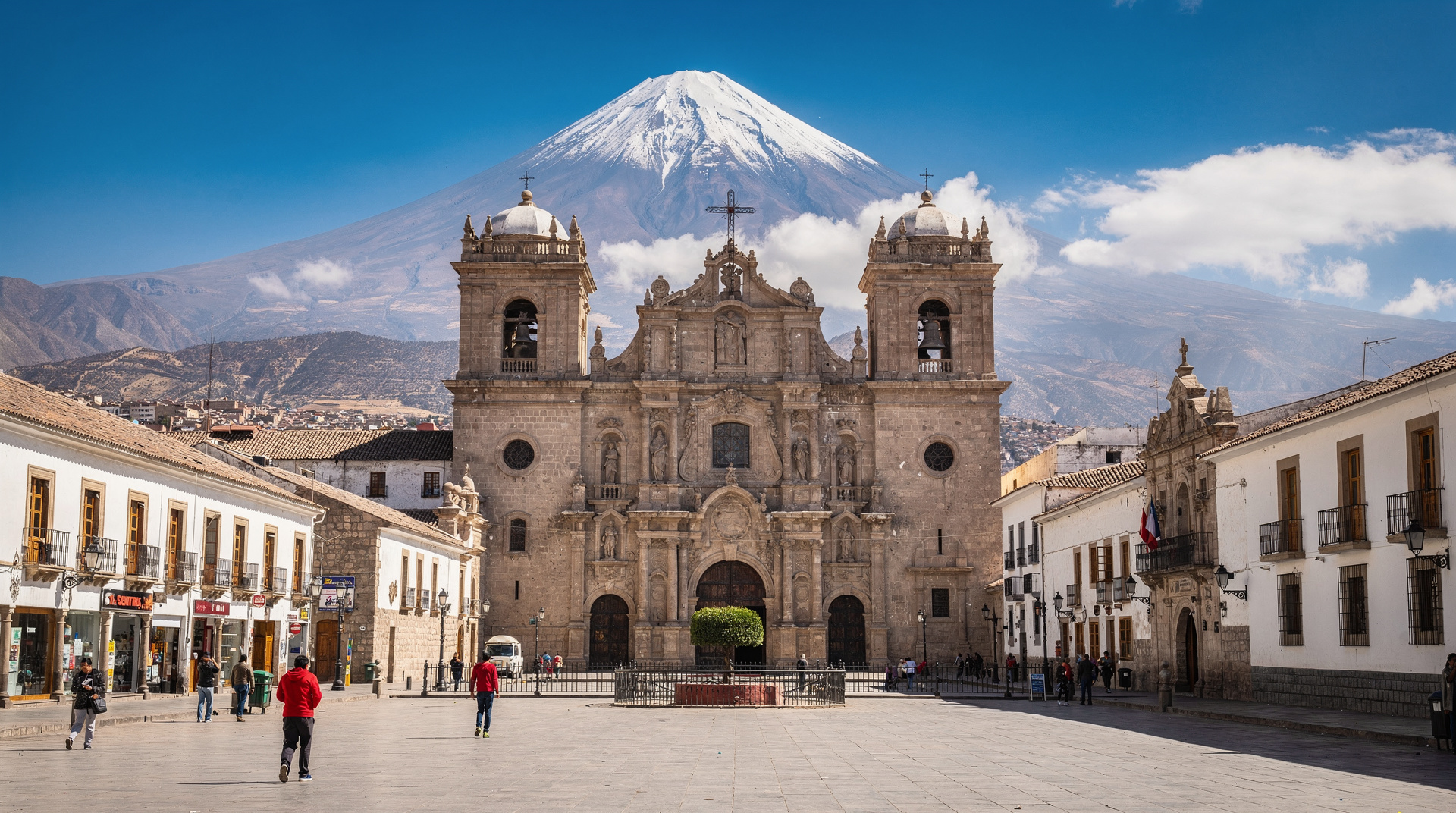
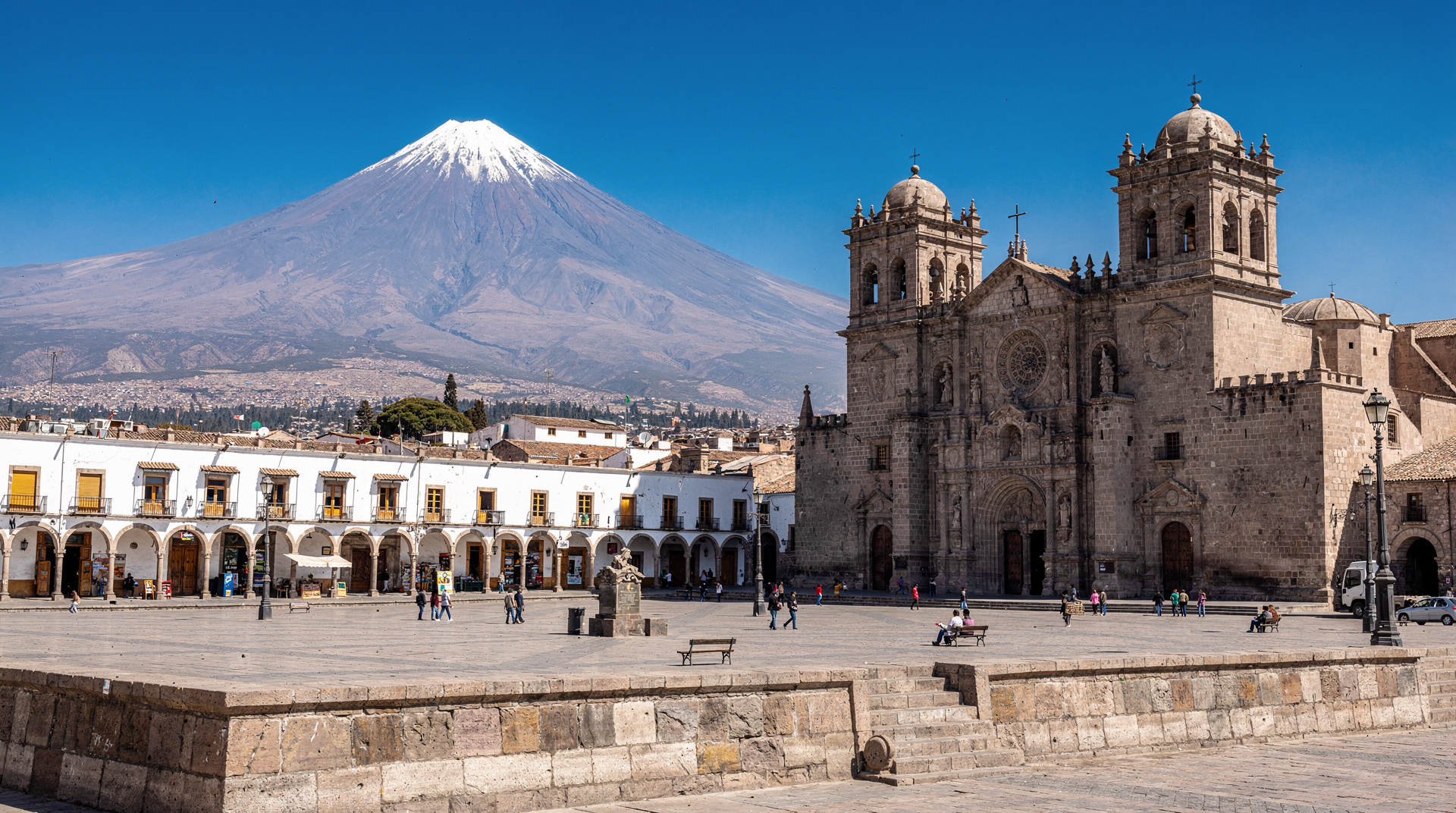
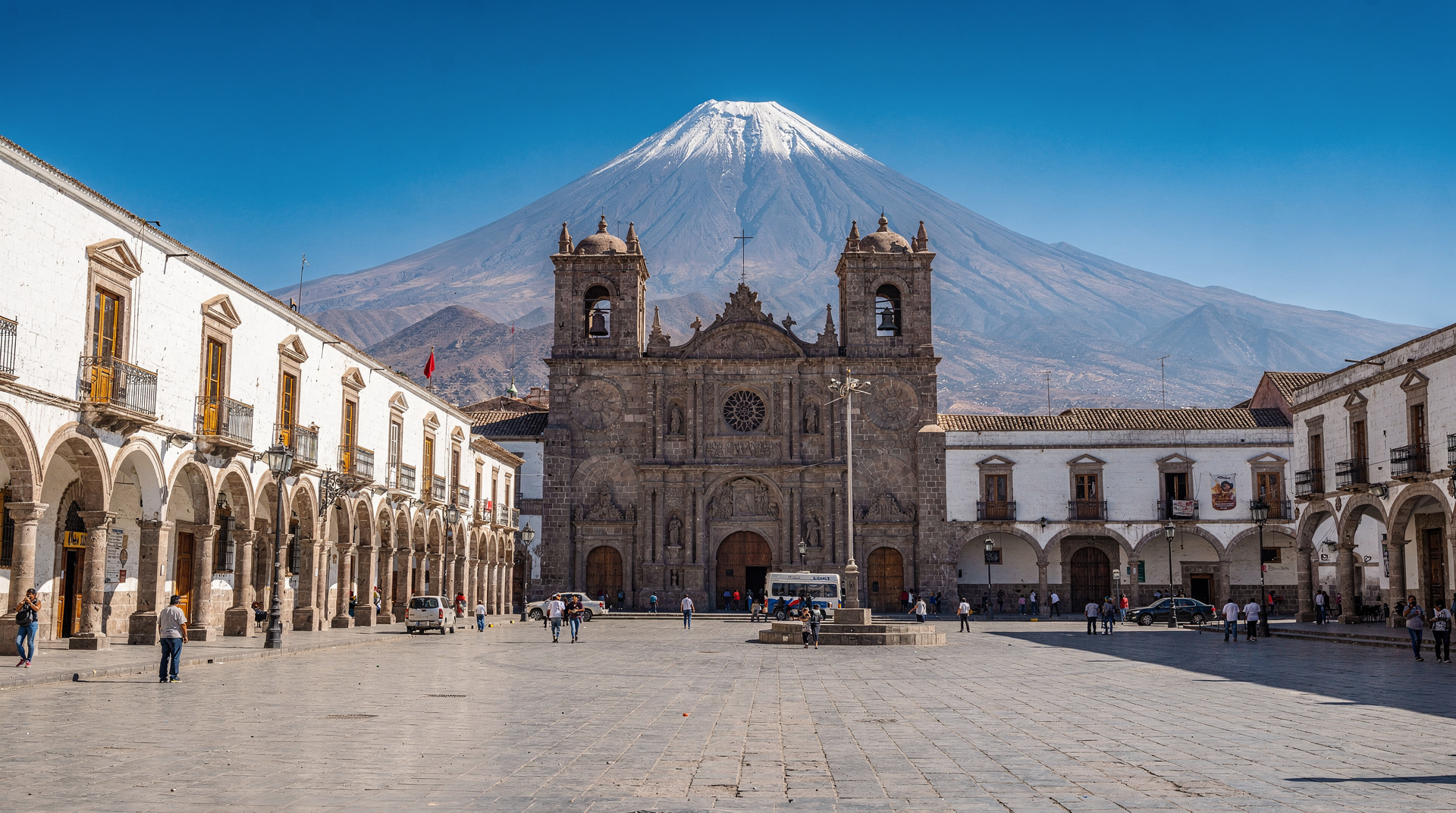
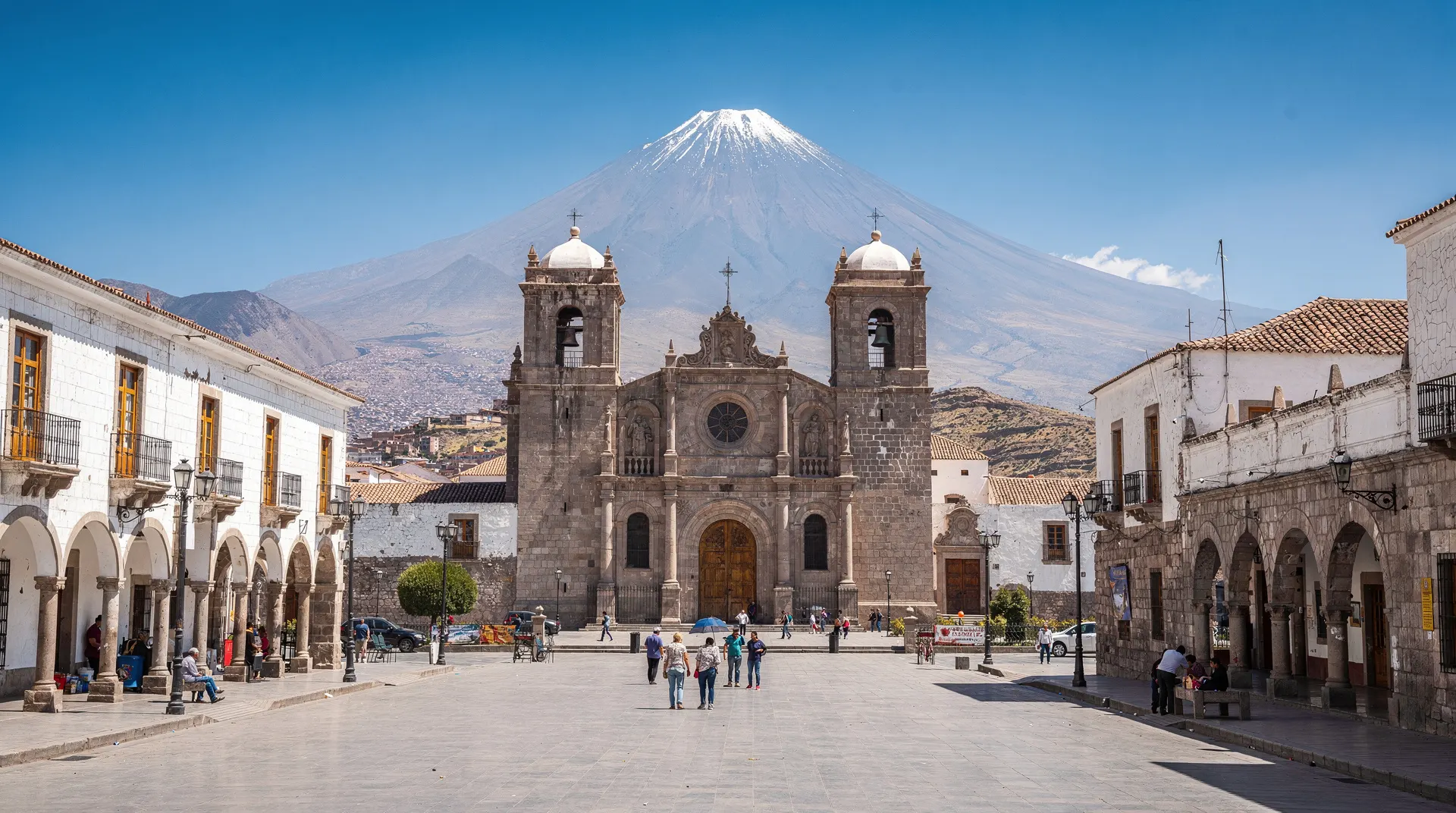
Arequipa is called the White City because its historic centre is built almost entirely from sillar — a local volcanic white stone quarried from the surrounding volcanoes. The result is a streetscape unlike any other Peruvian city: white facades, carved Baroque detail, the great volcanic cone of El Misti (5,822 m) looming directly above the eastern horizon. On a clear morning the visual effect is genuinely arresting.
The Plaza de Armas is arguably Peru’s most beautiful colonial square — more harmonious in proportions than Cusco’s Plaza, and the cathedral’s sillar facade catches the morning light extraordinarily. I arrived early enough to photograph it before the tour groups came.
The Monasterio de Santa Catalina is Arequipa’s standout attraction — a working convent occupying roughly one full city block, its interior a labyrinthine series of streets, cloisters, cells, and communal spaces that served as a self-contained city-within-a-city for the cloistered Dominican nuns from the 16th century onward. The nuns (modern-day members of the order still live in a separate section) opened the historical complex to the public in 1970. Walking through it takes two to three hours; the colours — the deep reds, blues, and terracotta of the cloister walls — are extraordinary.
The ceviche and other coastal-influenced food in Arequipa is also notably excellent. Arequipa considers itself distinct from Lima’s culinary tradition, with its own regional dishes — the rocoto relleno (stuffed spicy pepper) and adobo arequipeño (a slow-cooked pork dish) are the non-negotiables. I ate very well and cheaper than in Cusco.
The Colca Canyon two-day tour
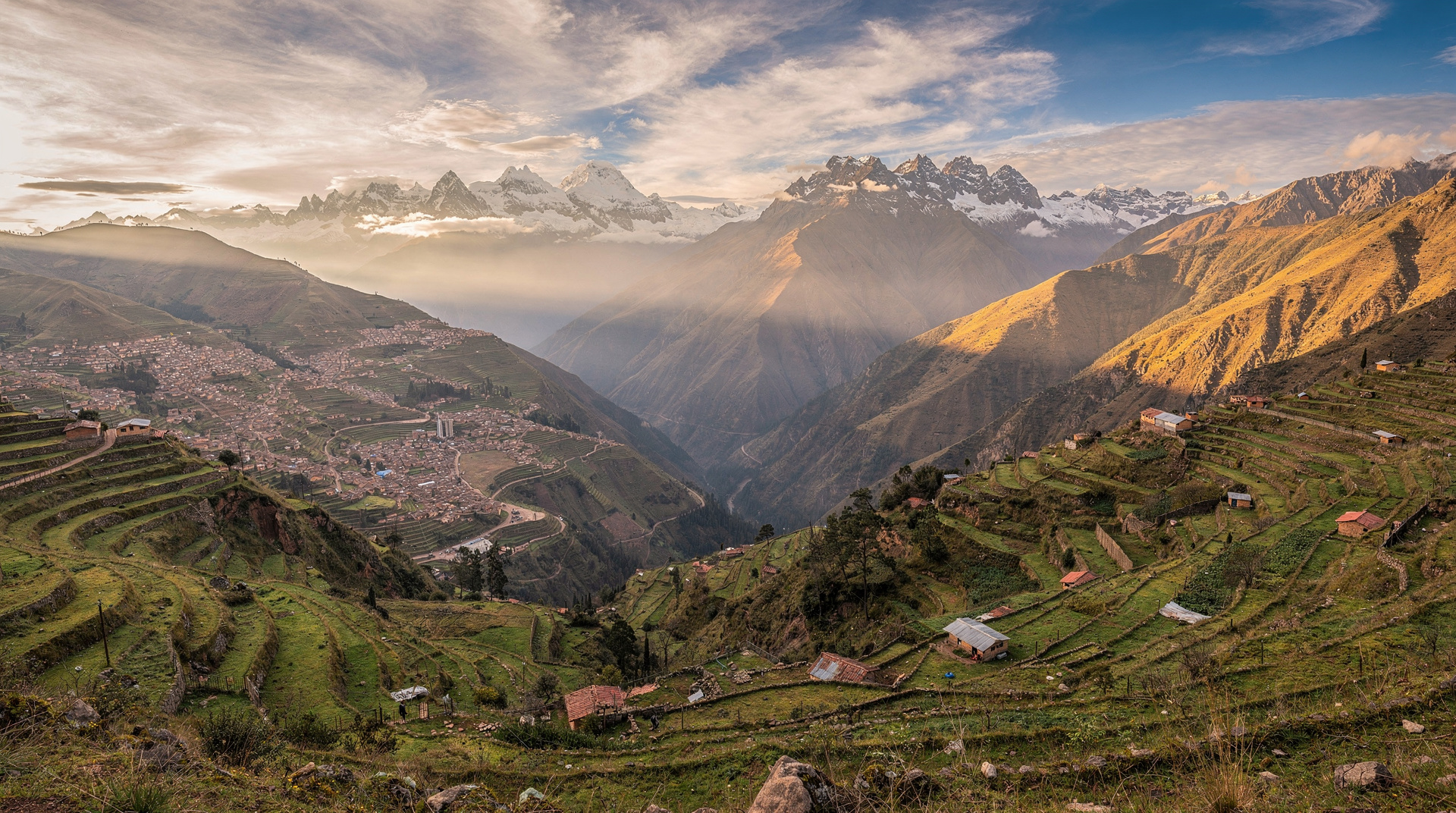
The tour departs from Arequipa at 3 am (an uncivilised hour) for the 3.5-hour drive to the canyon. The road climbs over the Reserva Nacional Salinas y Aguada Blanca — 4,800 m, where I had altitude symptoms again despite being at a lower base elevation than Cusco. The altitude on the pass is no joke.
Chivay, the main valley town, sits at 3,600 m and is the overnight stop. The thermal baths at La Calera are 4 km from town — a series of geothermal pools at 38–40°C, pure pleasure after a day of cold mountain air. I was in the water by 5 pm and reluctant to leave.
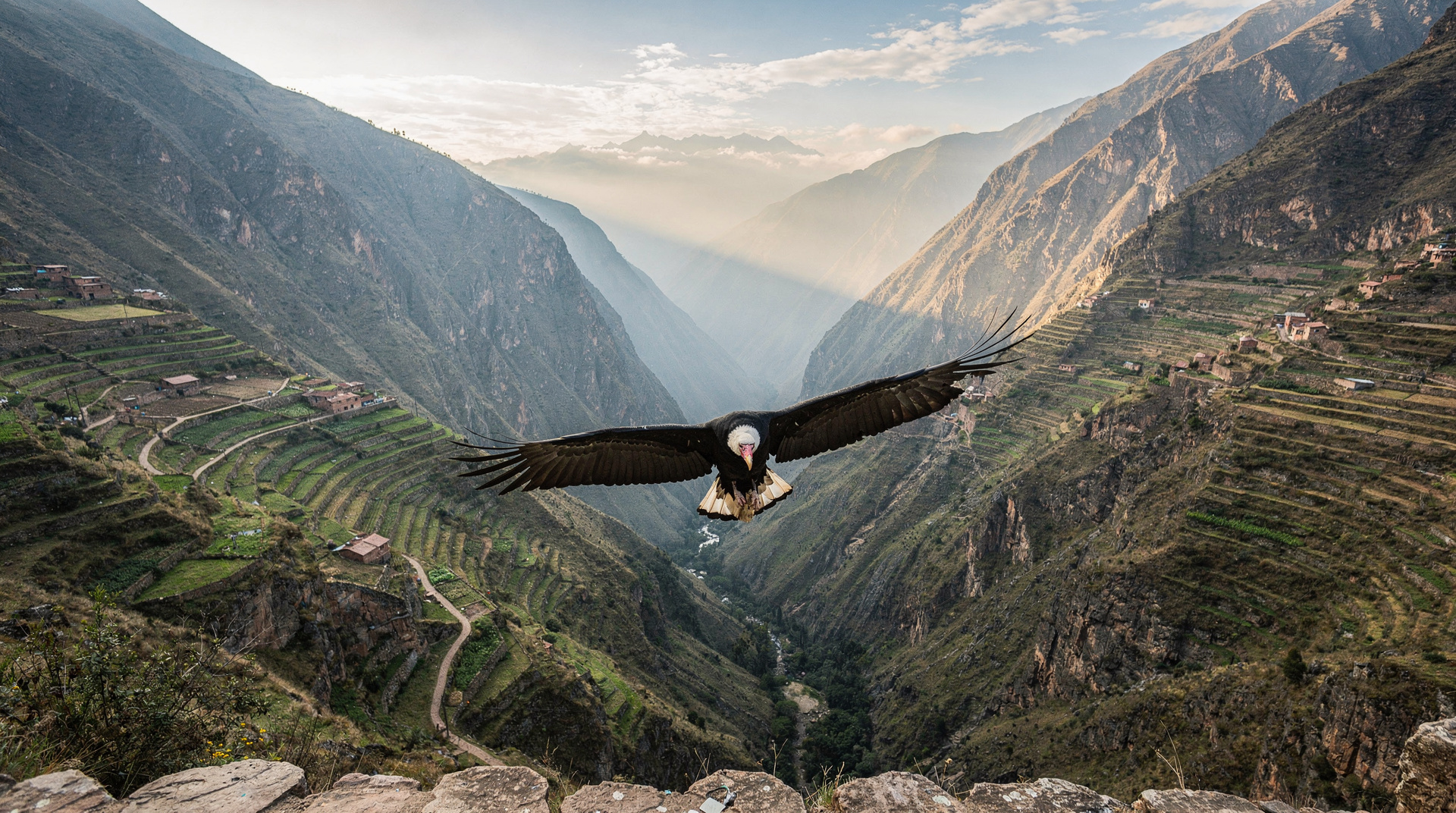
The Cruz del Condor viewpoint the next morning: I’ve written about this separately in more detail, but the condensed version is that watching Andean condors — the world’s largest flying bird — rise on thermals above a canyon deeper than the Grand Canyon, at dawn, with the Bolivian Andes visible on the horizon, is one of the definitive wildlife experiences I’ve had anywhere.
The full account is in my condor morning diary, and the Colca Canyon condors guide and Colca Canyon destination page cover the practical side of the viewpoint.
Book the 2-day Colca Canyon tour from Arequipa — the transport, accommodation in Chivay, all meals, and the guided early-morning condor visit are included. The quality of the guides varies considerably between operators; the better ones have naturalist training and can identify individual condors by wing pattern.
The altitude difference
One thing worth noting for planning purposes: Arequipa at 2,335 m feels genuinely different from Cusco at 3,400 m. After a week in Cusco I was acclimatised, and arriving in Arequipa felt like breathing became slightly effortless by comparison. The city is more relaxed to walk and easier to enjoy vigorously because your body isn’t working against altitude.
This matters for the Colca trip because the canyon tour crosses 4,800 m on the way, which is higher than you’ve been in Arequipa — the altitude response can catch you off guard if you’ve relaxed into the lower elevation. Drink plenty of water the evening before the tour.
If altitude worries you, the altitude sickness guide for Cusco and the coca tea and altitude remedies guide cover what helps. For my own experience of it, I wrote up altitude sickness: my story separately. Spending a few days in Cusco first, as in the Cusco acclimatization plan, made the Colca pass noticeably easier to handle.
Was the detour worth it?
Without qualification, yes. Four days for Arequipa and Colca added approximately S/1,200 to my total trip budget (transport, accommodation, food, tours, admissions) — roughly USD 315 — which is a reasonable investment for what you get. The Cusco vs Arequipa guide makes the case that the two cities complement rather than compete, and I’d agree.
The southern Peru 2-week grand tour itinerary shows how to structure a trip that properly includes Arequipa, Colca, Puno/Titicaca, and Cusco — which is the full circuit and, in my view, the most complete way to understand the south of Peru.
What I’d cut if time was genuinely limited: the second day in Arequipa (you can see Santa Catalina and the main plaza in one long day), and settle for the one-day Colca option from Arequipa (leaves at 3 am, returns by 8 pm, covers Cruz del Condor) rather than the overnight. If that is your situation, a single long day trip to the canyon from Arequipa keeps the condor viewpoint while freeing the second night for the city. You’d trade some depth for schedule efficiency. But if you have the time, don’t cut anything.
How it compares to staying in Cusco those four days
I asked myself, on the bus back, whether four extra days in the Sacred Valley or a slower Cusco pace would have served the trip better. My honest answer: no, and not by a small margin. Arequipa and Colca are different enough — Baroque sillar architecture, a genuinely distinct food culture, volcanoes instead of Inca stonework, condors instead of ruins — that they add breadth rather than repeating what Cusco already gives you. The Cusco vs Arequipa guide makes the same case in more depth.
If you are weighing this against other side trips, the Lake Titicaca and Puno transport guide shows the other long overland option from Cusco, and the Puno destination page explains what you would get there instead.
The one thing I’d change
I would not take the overnight bus both ways. Cruz del Sur’s semi-cama is genuinely comfortable enough to sleep through, but doing it twice in one trip (Cusco–Arequipa, then Arequipa–Cusco or onward to Puno) left me tired enough on the second sleepless night that I lost half a day recovering in Cusco afterward. If budget allows, fly one leg — the hour-long flight costs more but buys back a full day of energy for the rest of the trip.