Maras salt mines: visiting the Inca salt pans in 2026
Sacred Valley: Pisac, Ollantaytambo, Chinchero with Lunch
Are the Maras salt mines worth visiting?
Yes. More than 3,000 individual hand-worked salt pools cascade down a hillside fed by a natural brine spring — in continuous use since before the Inca. Admission is ~S/10 (separate from the Boleto Turístico). Best visited in early morning or late afternoon when the salt glows pink and white. Pairs naturally with Moray, 6 km away across the plateau.
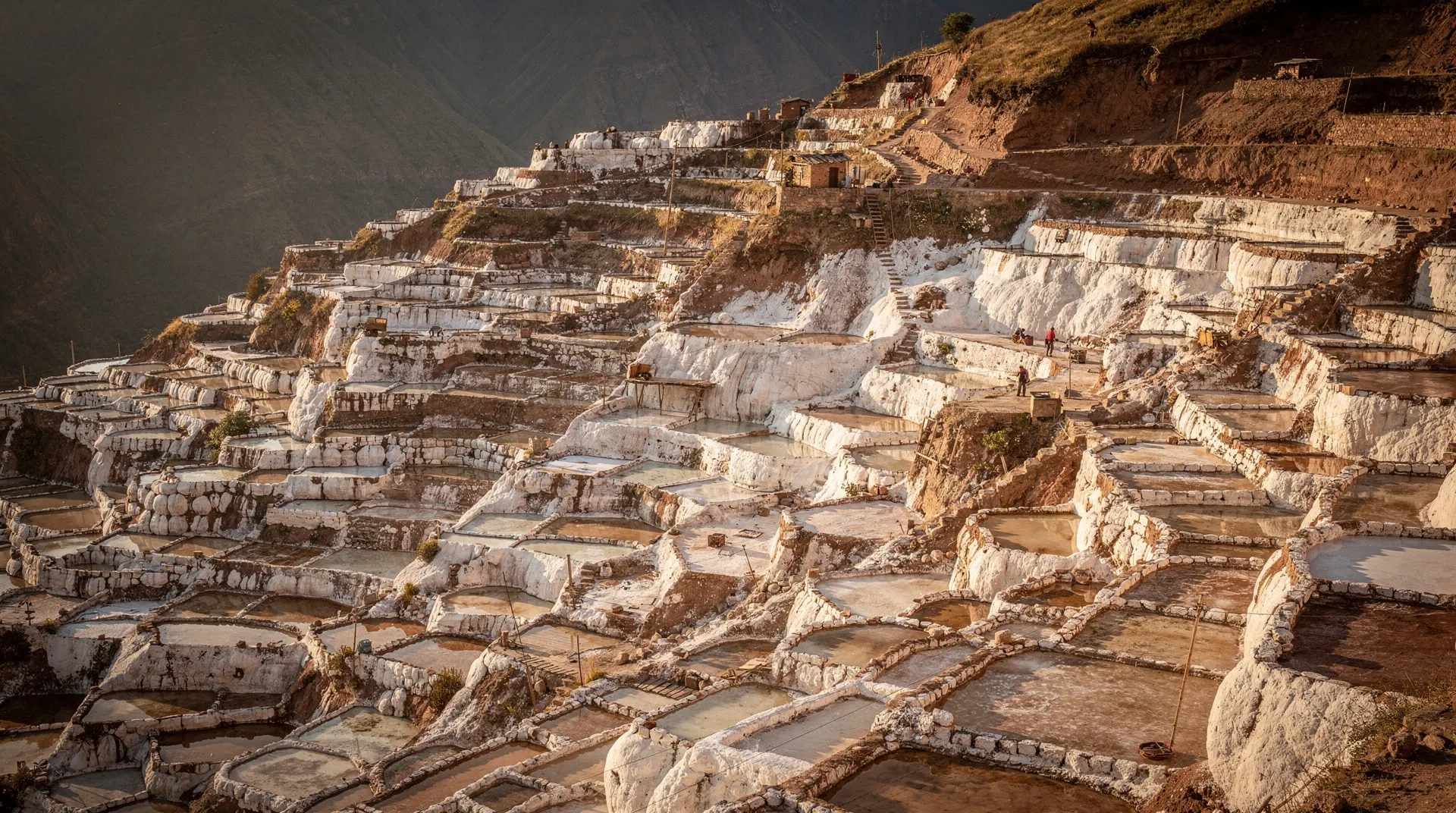
Salt pans above the valley
| Where | Chinchero plateau, ~40 km from Cusco |
| Cost | around S/10 community entrance, not covered by the Boleto Turístico |
| Best time | early morning (~7 am) or late afternoon, for the light |
| Time needed | 45–60 minutes for the viewing circuit |
| Pairs with | Moray, 6 km away, for a half-day plateau visit |
On a steep hillside above the Sacred Valley floor, roughly 40 km from Cusco on the Chinchero plateau, more than three thousand individual salt pools cascade down a slope in a visual arrangement that has no equivalent on the standard Inca-region circuit. The Maras salt pans — known in Spanish as the Salineras de Maras — have been in continuous operation since at least the Inca period and very possibly long before.
They are fed by a single brackish spring at the top of the hillside that fills each pool through a network of channels cut directly into the rock face — one of the most elegant and economical pieces of infrastructure engineering you will encounter in Peru, and one that has functioned for centuries without needing to be rebuilt.
This is working agriculture, not a museum exhibit. Local families, organised into a cooperative, own and work individual pools. Each family inherits their plot or acquires it through the cooperative system, manages the flow of brine from one pool to the next via small earthen levees and hand-adjusted sluices, rakes the forming salt crystals as they accumulate, and harvests the dried salt by hand. The white and pale pink colouring of the pans comes from the mineral composition of the spring water — particularly its iron content; the pinks intensify when the pools are shallow and the concentration is highest just before a harvest.
The scale and the silence
The numbers are difficult to visualise until you are standing at the edge of the hillside looking down. More than three thousand pools, each roughly the size of a large dining table, terraced down a slope that drops perhaps 80–100 m vertically. Each pool is separated from its neighbours by narrow earthen walls barely wide enough to walk along. The overall impression from the viewing paths at the top is of an enormous abstract mosaic in white, pale ochre, cream and pink — colours that shift as the light changes and as different pools are at different stages of the harvest cycle.
In the early morning, before the sun is fully up, the pools catch the low horizontal light and the salt surface takes on a luminous quality that is unlike anything photographable at midday. The same effect occurs in the two hours before sunset, when west-facing pools glow gold and the shadows of the earthen walls cast long striped patterns across the hillside. These are the photography windows. Midday visits — the standard slot on most organised day tours departing from Cusco at 8 am and arriving here at 11 am — produce flat, overexposed images and a significantly less dramatic overall impression.
If you have any control over your timing, arrange to be at Maras when the site opens (approximately 7 am) or in the late afternoon. This matters enough to be worth adjusting your itinerary around.
The cooperative and the families
The salt cooperative of Maras has a history that stretches back through the colonial period to the Inca and probably earlier. The Spanish colonial administration recognised and incorporated the existing Inca salt-production system rather than replacing it — a practical acknowledgement of how efficiently it worked. The cooperative system that manages the pans today is a direct descendant of the ayllu (community labour) organisation that the Inca used to structure agricultural production.
Watching a salt worker move along the narrow walls between pools — adjusting the brine flow with a handful of earth, testing the crystal formation with a finger, deciding which pool is ready to harvest and which needs another few days — is one of the more grounding experiences the valley offers. This is not a reconstructed tradition or a cultural performance. It is exactly what it looks like: a family farming salt using methods that have not fundamentally changed in hundreds of years.
The admission fee (~S/10, cash) goes directly to the cooperative. It is one of the better-justified entry fees in the region.
The viewing paths
Visiting paths run along the upper edges of the terraced area, giving views down over the pools rather than cutting through the working zones. The main circuit takes 45–60 minutes at a relaxed pace. Paths are unpaved and involve some uneven ground; ordinary walking shoes or trainers are adequate on a dry day. After rain, the narrower sections between pool edges can be slippery on descent — take the broader outer path if conditions are wet.
At the top of the site, near the entrance gate, the source spring and the primary brine-distribution channel are clearly visible. The channel is hand-cut rock, perhaps 20–30 cm wide, carrying a steady slow flow of slightly milky water that tastes strongly of salt. This single water source feeds every one of the three thousand pools below it through a branching network of sub-channels controlled by small earth levees. The engineering elegance is easy to miss unless you actively look for it.
Stalls selling small bags of Maras salt (white and pink varieties) operate near the entrance. These are a legitimate cooperative product. The pink salt in particular has become fashionable as a culinary ingredient and makes a compact souvenir.
Combining Maras with Moray
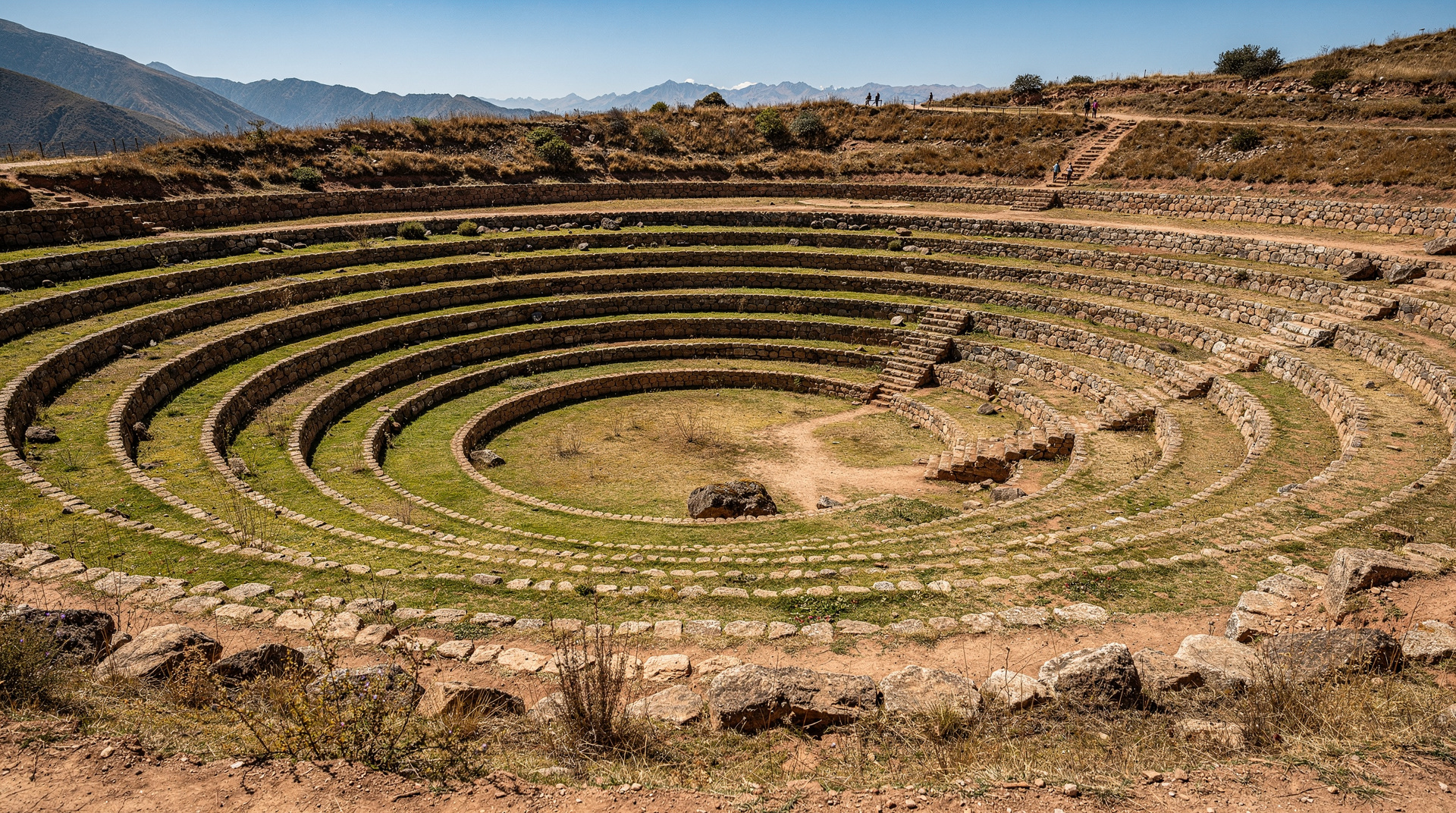
The natural pairing is Maras and Moray — two plateau sites separated by 6 km that together fill a comfortable half-day. Together they anchor the plateau section of any Sacred Valley loop, with Chinchero to the east and the valley floor (with Urubamba, Ollantaytambo) to the west.
A guided Maras and Moray tour from Cusco solves the main logistical challenge: taxis are genuinely scarce on the plateau roads, and driving yourself requires a hire car from Cusco. A guided tour provides transport, a bilingual guide who can explain the cooperative history at Maras and the agricultural-research interpretation of Moray, and the S/10 Maras admission typically included. The tour format removes the stress of finding transport on roads where flagging down a passing vehicle is not a reliable strategy.
For those doing the full Sacred Valley loop including Pisac market, a Pisac, Maras and Moray combination tour covers both the eastern valley sites and the plateau circuit in one day, typically with a traditional lunch included at a local community home. This is the most efficient format for a first-time visitor wanting to cover the main sites between Pisac and the valley’s western end.
Getting there independently
From Cusco, take a collectivo from Avenida Grau or near the Terminal Terrestre toward Urubamba (~S/5–8, 1 hour). From Urubamba’s main market area, taxis to Maras village charge around S/25–35; from the village to the salt pans is a further 4 km on an unpaved road that most taxi drivers will cover for S/10–15 additional. A round-trip taxi hire from Urubamba to Maras and Moray, with waiting time at both sites, runs S/70–90.
The drive from the valley floor up to the Chinchero plateau takes 20–30 minutes on unpaved switchback road. In dry weather this is entirely manageable in a standard taxi. After heavy rain the track can become rutted; ask the driver’s assessment before committing to the uphill journey.
From Cusco directly, a taxi to Maras costs S/60–80 one way; hiring for the full plateau circuit (Chinchero, Maras, Moray) runs S/150–200 for the day. Compare this against the cost of a guided group tour (S/60–100 per person including transport and guide) when deciding your approach.
Photographing Maras well
Beyond the general early-morning or late-afternoon rule, a few specific techniques improve results here. Shoot from the upper viewing path with a wide angle to capture the full cascade of pools rather than zooming in on individual pans, which loses the scale that makes the site distinctive. A polarising filter cuts glare off the wet pool surfaces and deepens the colour contrast between white, pink and pale ochre sections.
Including a person or a working salt farmer in the frame — at a respectful distance and without directing them — gives a sense of scale that an empty landscape shot does not convey. Drone photography requires advance permission from the cooperative and is restricted in parts of the site; ask at the entrance before flying anything.
The history behind the salt
The Maras salt pans predate the Inca. The Quechua name for the cooperative is Ayllu Maras, and the community organisation that manages the pans traces its origins to the pre-Inca communities who settled the Chinchero plateau. Spanish colonial records from the 16th century document the existing salt operation and the tribute system under which the cooperative paid salt to the colonial administration — suggesting the pans were already a significant regional resource before the Inca incorporated them into their tribute economy.
Under the Inca, salt was a valued commodity used for food preservation, leather processing and ritual offerings. The Maras cooperative almost certainly produced salt for the Inca administrative centres at Chinchero and Ollantaytambo. The specific quantities are not recorded, but the scale of the operation — three thousand pools, all continuously maintained — implies a production level well beyond local subsistence needs.
The cooperative survived the colonial period intact, paying tribute in salt to successive Spanish administrators in much the same way it had paid the Inca. The post-independence period brought changes to the ownership structure (individual family plots rather than communal allocation) but preserved the basic cooperative governance model. Today’s cooperative is a legally recognised entity that manages water rights, path maintenance, visitor admission and revenue distribution among member families.
Altitude at Maras
The salt pans sit at approximately 3,380 m — similar to Cusco’s altitude and noticeably higher than the valley floor (2,800–3,000 m). If you are on your first day in the region, the walk at Maras is relatively flat and should not cause significant problems. Move slowly, drink consistently and do not attempt any running or rushing. The altitude sickness guide covers what to do if you start feeling unwell.
Seasonal considerations
Maras operates year-round — the brine spring flows regardless of season and the cooperative harvests continuously. The visual difference between dry and wet season is worth noting: in the dry season (May–September) the surrounding hillsides are brown and the salt white-and-pink stands in high contrast. In the wet season (November–March) the grass is vivid green and the colour contrast with the salt is different but equally striking. Wet-season visits also mean fewer tourists on the viewing paths.
The salt harvest is most active in the dry season when evaporation rates are highest and crystal formation fastest. If you visit in June or July you are most likely to see the raking and harvesting in action. In the wet season the pools fill faster from the spring but salt concentration is slightly lower; the cooperative still works year-round.
How Maras fits into the Sacred Valley itinerary
In most Sacred Valley day tours from Cusco, Maras appears in the late morning after Chinchero, with Moray following immediately after. This sequence — Chinchero (weaving cooperatives and church), Maras (salt pans), Moray (circular terraces) — covers the plateau circuit logically and efficiently before descending to the valley floor for lunch and then Ollantaytambo.
The drawback is the 11 am–noon timing at Maras, which is the worst light window for the site. If you are self-organising your day and have control over timing, consider doing the plateau circuit in reverse — Maras and Moray first (arrive at Maras around 8–9 am) and Chinchero on the way back toward Cusco. This gives the salt pans their best morning light.
For a fuller picture of how Maras fits within a complete valley day, the one-day Sacred Valley itinerary shows the full sequence and explains where timing compromises are acceptable. The Sacred Valley complete guide places Maras in the context of the valley’s other sites.
What visitors consistently underestimate
The emotional quality of the site. Most visitors arrive at Maras knowing they are going to see “salt pans” and expect something that looks like a quarry or an industrial operation scaled down. What they find is something more like a painting — the geometry of the terraced pools, the gradation of colours from near-white to deep ochre, and the tiny human figures of the workers moving along the narrow paths between pans. The scale is human rather than industrial: this is agriculture at the size of a family garden, multiplied three thousand times. The combination of repetition and slight variation across all those pools is unexpectedly absorbing.
Allow a few minutes at the viewing area before starting the circuit walk. The temptation is to immediately begin photographing and moving. Standing still for two or three minutes — watching the brine trickle through channels, the crystals forming at the edges, a worker adjusting a levee with a handful of earth — gives the site its correct register before you start walking.
The Maras–Moray combination in practice
The standard sequence on organised tours is to visit Maras first, then walk or drive the 6 km to Moray. This order makes sense geographically (Maras is slightly easier to access from the main road) but produces the unfavourable midday-light timing at Maras. Independent visitors have the option of reversing: arrive at Moray first (which is equally fine at any time of day — the terraces are about form and scale rather than colour), then move to Maras in late morning when the light is improving for the salt.
Alternatively, if your schedule allows an afternoon start from Cusco rather than the standard 8 am departure, arriving at Maras around 3:30–4 pm gives the late afternoon light window. The downside is that you lose the Pisac market at its best (morning only) and the tour sequence becomes compressed. For visitors with a specific photography interest in the salt pans, the late-afternoon timing is worth the trade-off.
The one-day Sacred Valley itinerary explains how the plateau circuit (Chinchero–Maras–Moray) fits within a full valley day and where timing adjustments are possible without breaking the overall sequence.
Buying salt responsibly and what to look for
The stalls at the entrance sell small bags of both white and pink Maras salt, typically S/5–15 depending on quantity and packaging. The pink variety, prized for its mineral content and colour, has become genuinely fashionable in international kitchens — but be aware that some souvenir shops in Cusco and Pisac sell “Maras salt” sourced more cheaply elsewhere and simply rebranded. Buying directly at the site, or from vendors who can show you the cooperative’s certification, is the only way to be sure your purchase supports the families who actually work the pans. A kilogram bag packs easily in checked luggage and makes one of the more genuinely local souvenirs available anywhere in the Cusco region.
Weather and what to wear
The plateau has little shade and the sun at 3,380 m is intense even on cool or overcast days — sunscreen and a hat matter here more than the mild temperature suggests. Wind picks up in the early afternoon on most days, so a windproof layer is worth carrying even during the dry season. After rain, the narrow paths between pools become slippery; sturdy closed shoes with reasonable grip are the right footwear rather than sandals, which are common but genuinely risk-prone on the descent sections.
Honest assessment
Maras is one of those sites that photographs extremely well and delivers equally well in person — the experience of walking above three thousand hand-worked salt pools while watching a farmer rake crystals is genuinely unusual and memorable. It is also a short visit; there is no point planning more than 90 minutes here. The combination with Moray makes a half-day that justifies the journey from any base in the region.
The honest caveat: if your tour slot is 11 am and the light is flat, the impact is significantly reduced. If you can negotiate an earlier or later visit — or visit independently on your own schedule — the site rewards the timing adjustment more than almost any other place in the valley.
A guided Pisac, Maras and Moray tour covers all three sites in one day with guide explanations throughout. It is the most efficient format for visitors who want context at all three stops without the logistical overhead of arranging transport on the plateau independently.
Frequently asked questions about Maras salt mines: visiting the Inca salt pans in 2026
How do I get to Maras from Cusco?
Are Maras salt mines covered by the Boleto Turístico?
How long does a visit to Maras take?
Can you buy Maras salt to take home?
Top experiences
Bookable activities with verified prices and instant confirmation on GetYourGuide.