Pisac market and ruins: what to expect in 2026
Cusco: Pisac, Maras, Moray, Ollantaytambo Small Group Tour
Is Pisac market worth visiting?
Yes, especially on Sunday when Quechua-speaking vendors from surrounding villages bring handwoven textiles, ceramics, carved gourds and silver jewellery. Arrive by 8–9 am before the coach groups arrive at 11 am. The Inca citadel above the town is equally impressive and often overlooked — allow 2–3 hours for the ridge walk if your itinerary allows.
Two Pisacs for the price of one
Most visitors to Pisac come for the market. They arrive at the Plaza de Armas, spend an hour browsing textiles, buy a scarf and drive on to the next valley site. Some leave without discovering that the Inca citadel above the town is one of the most extensive and impressive archaeological complexes in the entire Sacred Valley — and that combining both in a single morning makes for an unusually satisfying four hours before the tour coaches have even finished breakfast in Cusco.
| Where | Pisac, eastern Sacred Valley, 33 km from Cusco |
| Cost | Market: free to browse; ruins: S/70–130 Boleto Turístico |
| Time needed | 60–90 min market; 2–3 hours ruins; 4 hours for both |
| Getting there | Collectivo from Calle Puputi (~S/5, 45 min); taxi S/40–60 |
| Best time | Sunday morning, arrive by 8 am, before 11 am coach groups |
The town sits at the eastern entrance to the valley, 33 km from Cusco along a well-surfaced road. At 2,950 m it sits a little lower than Cusco’s 3,400 m, which makes the uphill walk to the ruins more manageable than equivalent climbs in the city — though it is still a genuine ascent and should not be rushed.
The market: what you will actually find
Pisac’s Plaza de Armas market is not a local food market that happens to attract tourists. It is an established craft market with a genuine artisan supply chain. On Sundays, weavers from communities in the surrounding hills descend to sell directly alongside permanent stall-holders who trade year-round. The distinction matters: on a Sunday you are more likely to find the producer behind the goods; on other days you are typically dealing with intermediary traders.
Textiles are the strongest category. Look for pieces woven on traditional backstrap looms in alpaca or sheep wool, identifiable by the tightness of the weave and the slight colour irregularity of natural dyes. Machine-made acrylic versions exist in quantity and can look convincing from a distance — pull the weave slightly apart to check for the natural fibre variation of hand-spun wool versus the uniform sheen of synthetic pile.
Prices for genuinely handwoven alpaca scarves start at around S/40–60; larger table runners or wall hangings range from S/80 to S/200 or more for complex pieces. Opening prices from vendors are typically 40–60% above where they will comfortably settle, so negotiation is structurally built in and expected by both sides.
Ceramics painted with Inca geometric motifs and sun symbols are widely available. Quality varies significantly; the better pieces are hand-thrown and hand-painted, while most market stock is slip-cast and decal-decorated. Look for throwing lines on the inside of bowls and minor asymmetry as indicators of hand production.
Silver jewellery set with semi-precious stones (lapis lazuli, pyrite, rose quartz) from local mines is sold throughout the market. Ask to see the hallmark stamp — legitimate sterling silver should carry a 925 or 950 mark. The market for tourist-grade “silver” that is actually silver-plated base metal exists; the price difference between real and plated pieces should be a guide.
Carved gourds (mates burilados) are a traditional Andean craft with pre-Inca roots — the gourd surface is carved with fine-line scenes of valley life, agricultural cycles and Inca mythology. These are difficult to fake because the carving is labour-intensive and distinguishable from printed or stamped versions. They make a compact, lightweight souvenir with genuine cultural depth.
The optimal Sunday sequence: arrive by 8 am, when the market has assembled but before the large coach tours arrive from Cusco. The best interaction happens in the first two hours. By 10:30 am the square is crowded; by noon the atmosphere has shifted noticeably and prices at some stalls rise in response to group-tour buying patterns.
The Inca citadel on the ridge
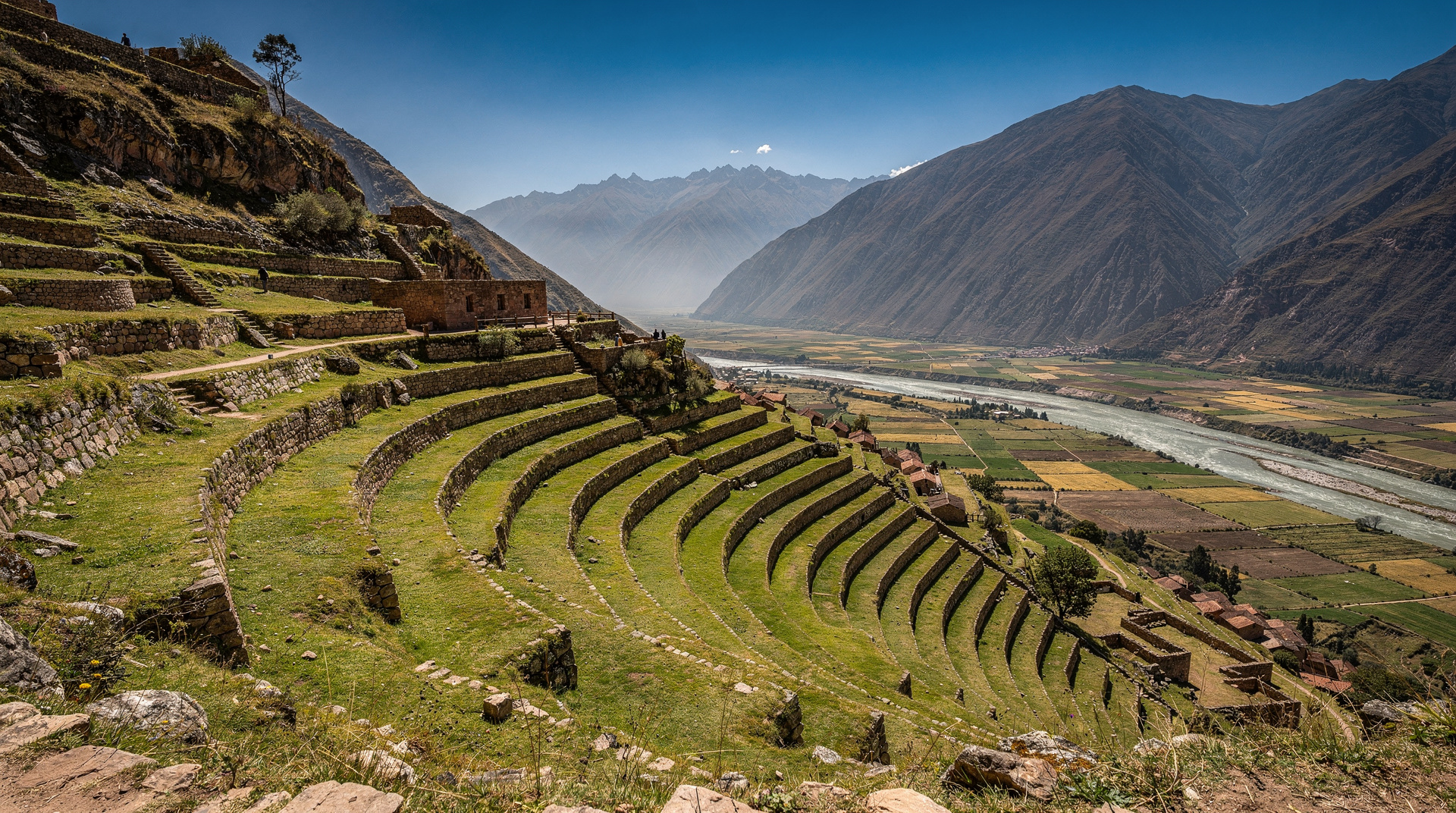
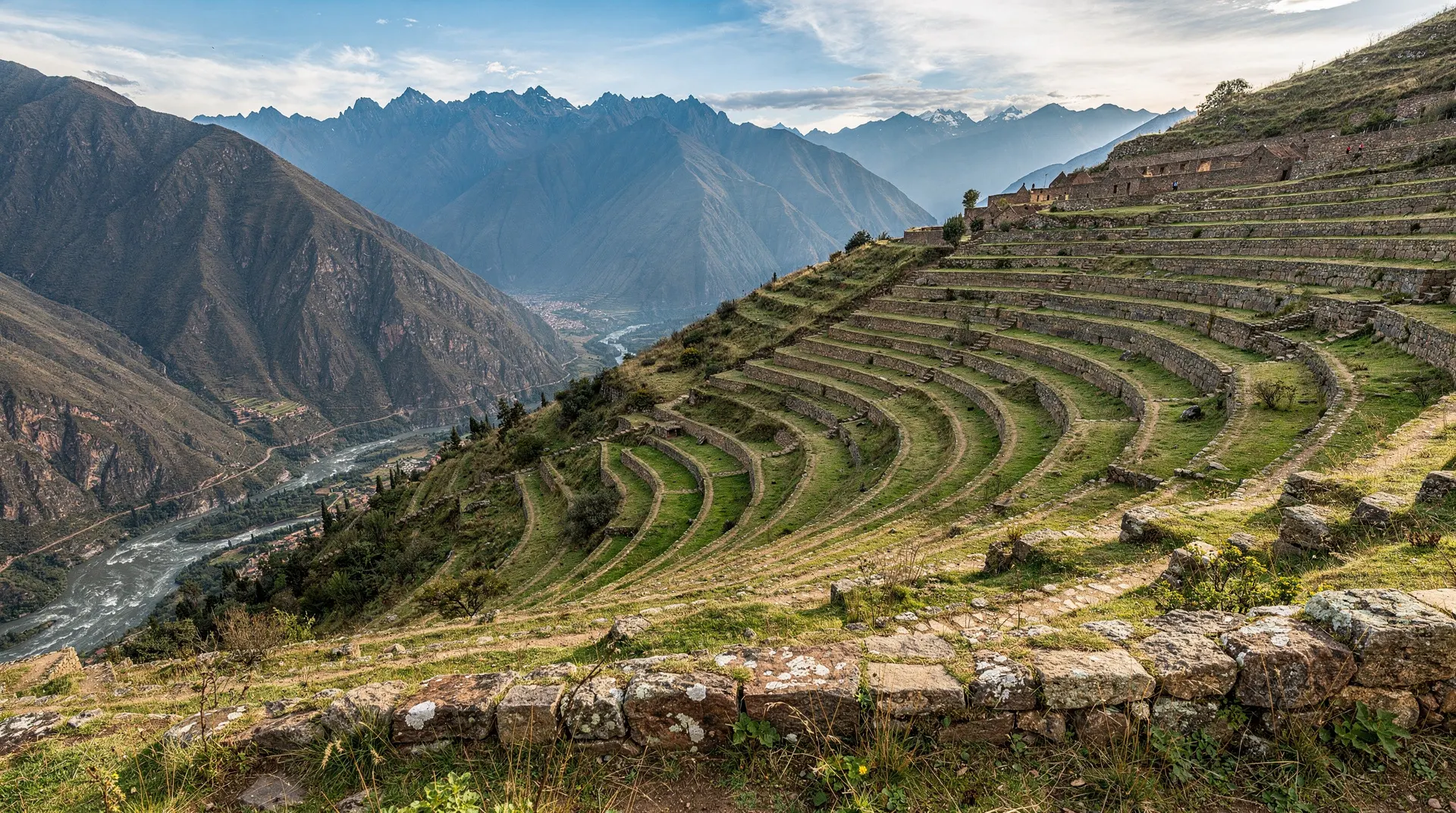
Above the town, accessible by a stiff 45-minute walk from the lower entrance (or a taxi to the top entrance, ~S/10) the Pisac Archaeological Complex stretches for several kilometres along a mountain ridge that commands the entire valley. This is not a single building or a compact site — it is a full urban complex spread across a series of ridge spurs: temples, military platforms, agricultural terraces, water channels, fountains, storehouses and burial towers.
The sequence of sectors as you walk the ridge reveals the layered functions of the site. The lower terracing is predominantly agricultural — steep, carefully engineered fieldwork supported by retaining walls. The mid-level sections include residential compounds and military installations controlling the paths that lead to the summit. The uppermost group, the Intihuatana complex, is the ceremonial heart: a sun temple with precisely cut stone alignments, a small enclosed plaza and the carved stone hitching-post of the sun (intihuatana) that features at Machu Picchu in more famous form.
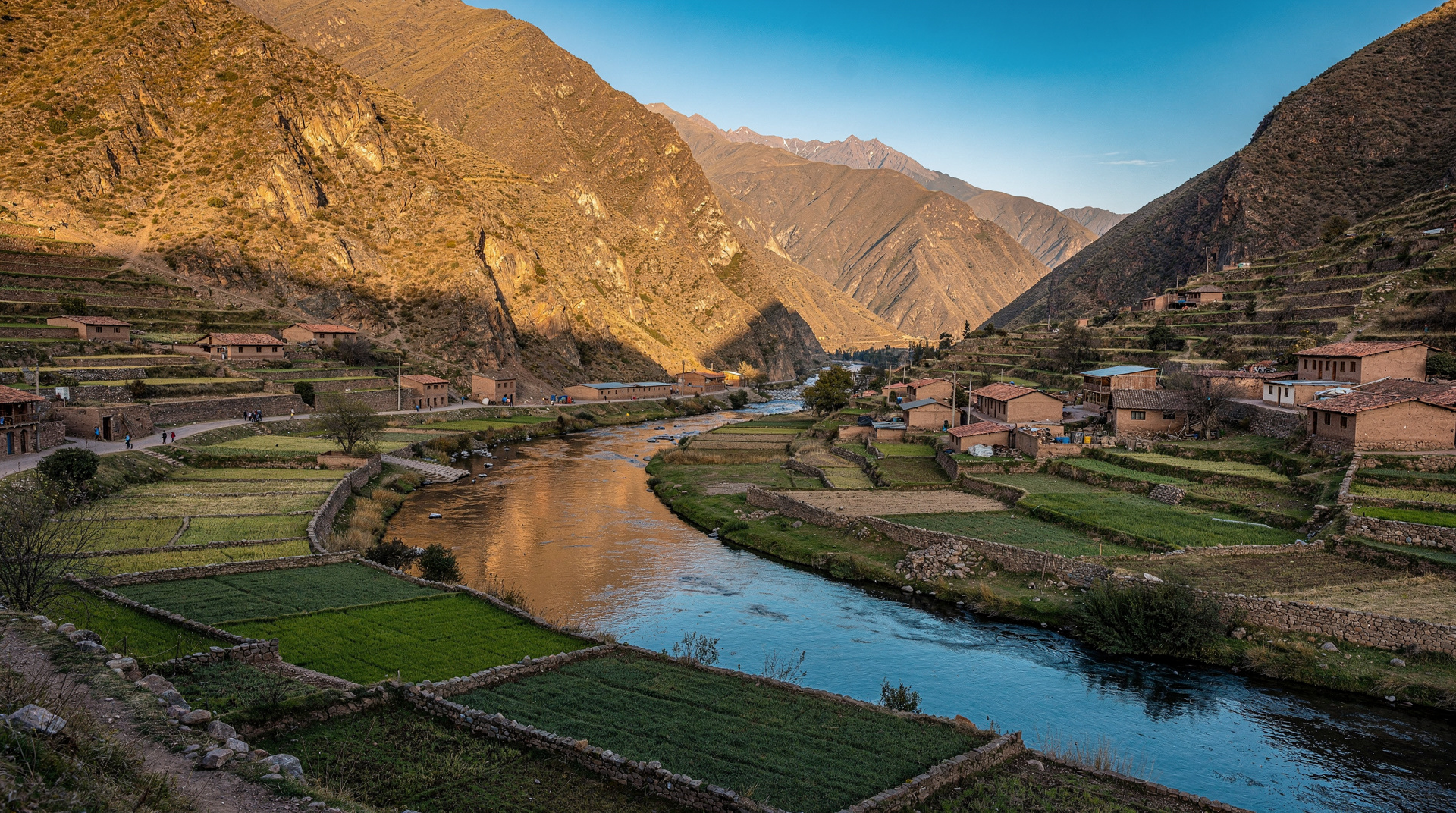
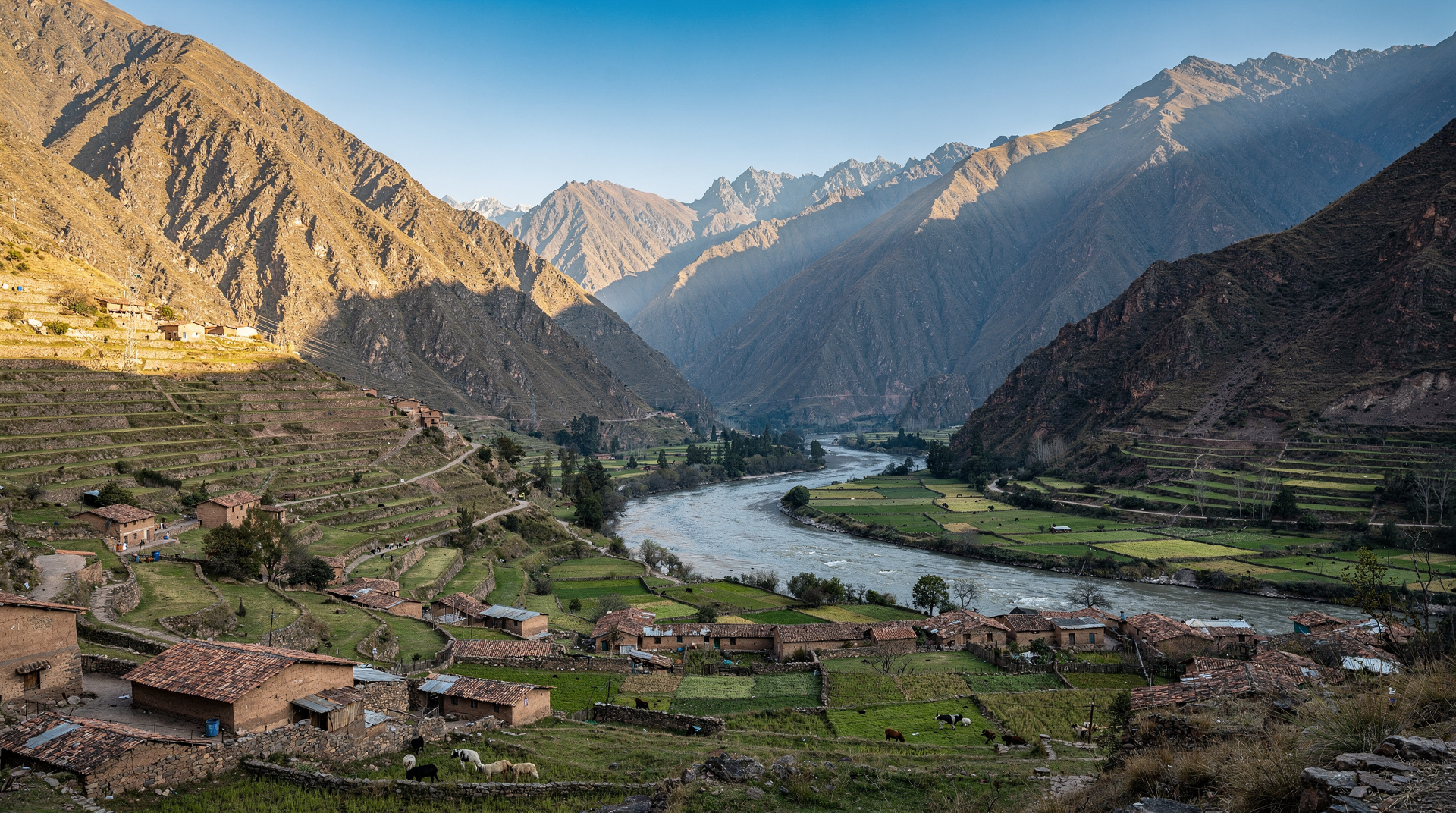
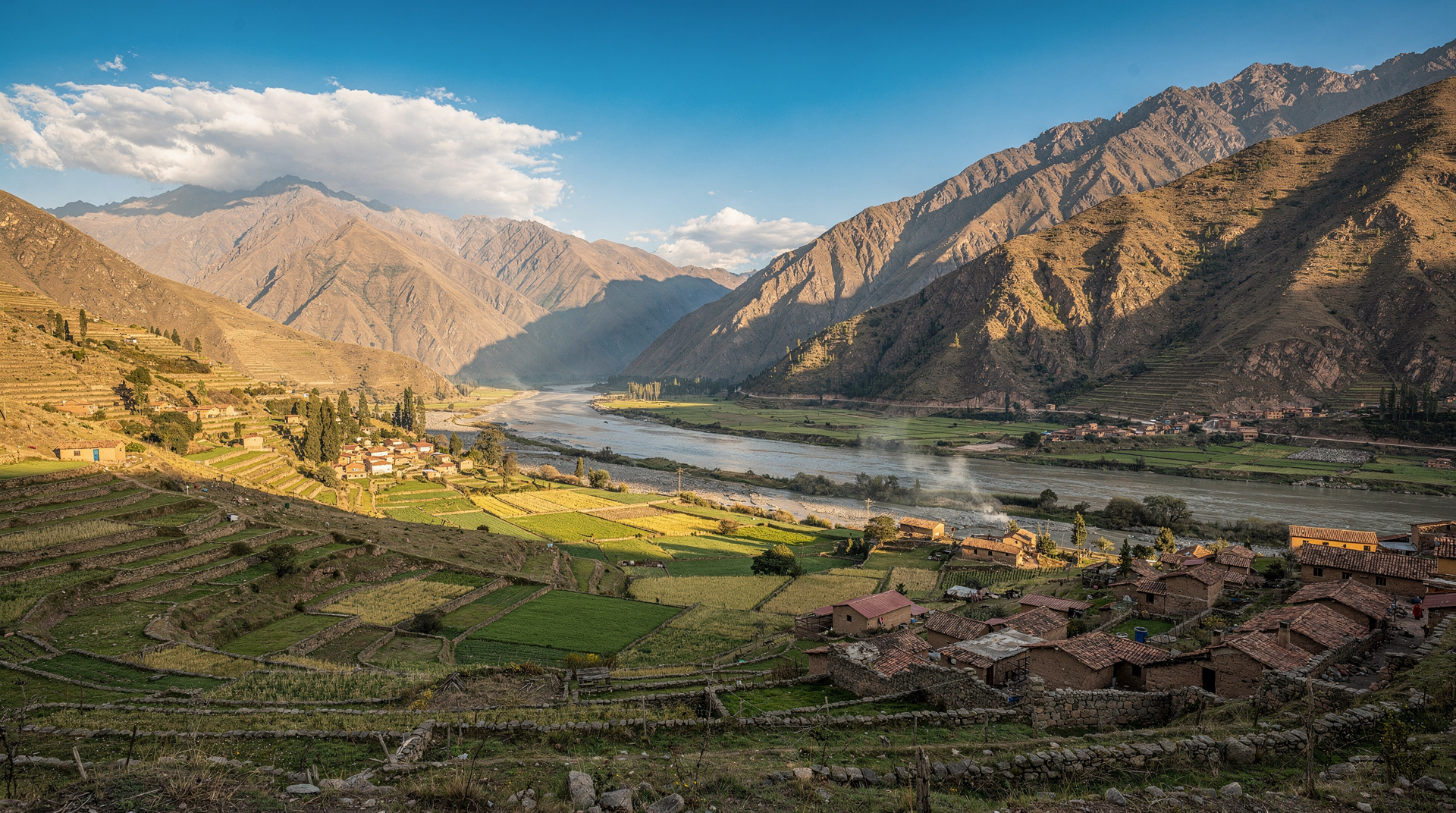
From the Intihuatana platform the views are exceptional: the entire width of the valley visible in both directions, the Urubamba River catching light in the gorge below, and on clear mornings the snow-capped peaks of the Vilcanota range to the east. This is not a view you get from the town below, and it is one of the reasons the ruins justify the climb.
The cemetery area on the slopes below the main complex contains hundreds of chullpas — burial towers — that were systematically looted by grave robbers in the colonial period. The empty niches are sobering in their scale: this was once one of the most important burial grounds in the valley, and its current emptiness is an archaeological wound that has never fully closed.
Admission to the citadel requires the Cusco Boleto Turístico (~S/130 full circuit; ~S/70 Sacred Valley partial). Buy your Boleto at the COSITUC office on Av. El Sol 103 in Cusco or at the covered sites. The Boleto Turístico guide explains all circuits and their coverage.
Combining market and ruins in one morning
The efficient sequence is market first, ruins after. Arrive at 8 am for the market, spend 60–90 minutes browsing and buying, then take a taxi or walk to the lower ruins entrance and begin the ridge circuit. The ascent goes uphill throughout; you exit near the top of the ridge, where taxis back to the town generally congregate. The whole visit — market and full ruins walk — fits comfortably inside four hours from 8 am to noon, leaving the afternoon for Chinchero and Maras.
On a Pisac, Maras and Moray guided tour the standard format incorporates the Pisac market and then continues to the salt pans and terraces at Maras and Moray in the afternoon. The guide’s commentary at the market (what distinguishes genuine handwoven textile from machine production) and at the ruins (the engineering logic of the terrace system, the purpose of the water channels, the alignment of the temple with solar events) adds substantial depth to what would otherwise be a visually impressive but somewhat opaque experience.
Getting there and getting around in Pisac
Collectivos from Cusco leave from Calle Puputi near the Tullumayu bridge throughout the morning (~S/5, 45 minutes). Return collectivos from Pisac depart from near the market square throughout the day. If you are continuing west to Urubamba or Ollantaytambo, you will need to change at Urubamba with a second collectivo (~S/3–4 each leg).
Taxis from Cusco to Pisac cost S/40–60 and are practical for families, groups or anyone with significant shopping to carry. Agree the fare before departure and confirm it is for the whole vehicle, not per person. From Pisac to Maras for the salt pans, a hired taxi costs S/40–60; the full plateau circuit (Maras–Moray–descent to the valley) typically costs S/80–100 for a patient driver who waits at both stops.
Within Pisac itself, the market and town are walkable. The distance from the Plaza de Armas to the lower ruins entrance is about 2 km on a road that can be walked in 30–40 minutes or covered by taxi (~S/5–8).
What to bring
For the market: a day bag and cash in Peruvian soles. Very few market stalls accept cards, and those that claim to often have connectivity problems. Bring small-denomination notes — S/10 and S/20 — for negotiating prices.
For the ruins: sun protection (the UV index at 3,000 m is extreme, even under cloud), at least one litre of water per person, and footwear with reasonable grip. The ridge path is uneven stone and compacted earth throughout, with some sections across loose rock. There is no food or water available on the ruins circuit itself — buy snacks in the town before you start.
A light jacket is worth carrying regardless of morning temperature: the ridge sits higher than the town, and temperature drops quickly if cloud comes in.
Pisac as part of a longer Sacred Valley day
Pisac is almost always the first stop on any Sacred Valley loop from Cusco — geographically it sits at the valley’s eastern entrance, 33 km from the city, making it the logical starting point before continuing west through Chinchero, Maras, Moray and Ollantaytambo. The one-day Sacred Valley itinerary sequences all five sites and explains the timing trade-offs between market time and ruins time at Pisac specifically.
If your schedule allows two days in the valley rather than one, Pisac becomes much more satisfying. On a two-day approach you can spend a full morning at the market — arriving at 8 am, browsing without rushing, eating breakfast in the plaza, talking to weavers about specific pieces — and return the following morning for the ruins circuit without the pressure of five further sites waiting. Two days in the valley also allows you to sleep overnight at lower altitude than Cusco, which the Sacred Valley versus Cusco base guide argues is the single most practical decision for first-time high-altitude visitors.
On a single day, the trade-off is clear: the Pisac ruins circuit takes 2–3 hours and would absorb your entire morning, leaving only the afternoon for Chinchero, Maras, Moray and Ollantaytambo. For a first visit, choosing the market over the ruins in the morning and saving the ruins for a possible return visit is the reasonable call — the market is time-sensitive (morning-only, before crowds) while the ruins can be visited at any time of day.
Altitude, hydration and practical preparation
The Pisac ruins sit at approximately 3,350 m at their highest point, some 400 m higher than the town below. Even if you have had two or three days in Cusco already, the uphill sections of the ridge circuit will feel noticeably harder than equivalent climbs at sea level. The standard altitude advice applies: walk at half your normal pace on uphills, take genuine rest stops rather than pretending fatigue is not happening, and drink water continuously rather than waiting until you are thirsty.
The views from the upper citadel are worth the effort. The Urubamba valley visible in both directions from the Intihuatana ridge is one of the great Andean panoramas: the river catching morning light in the gorge 500 m below, terracing covering the hillsides on both sides, and the mountains behind Ollantaytambo visible as a smudge of peaks on the western horizon. Morning is when this view is at its best; by afternoon the light flattens.
The Pisac ruins in their archaeological context
The Pisac Archaeological Complex is one of the largest intact Inca sites in the Cusco region, covering roughly 30 km² across the ridge and surrounding slopes. Despite its scale and quality, it receives fewer visitors than Machu Picchu or even Ollantaytambo — partly because the full site requires a genuine uphill walk rather than a level stroll, and partly because it is typically fitted into a morning slot on a Sacred Valley day tour rather than given a dedicated day.
Understanding what you are looking at requires a basic grasp of how Inca royal sites were organised. Pisac was almost certainly a royal estate — probably built by or for one of the later Inca emperors, possibly Pachacutec — combining ceremonial, residential, agricultural and military functions in the integrated manner characteristic of Inca planning. The Intihuatana group at the top is the ceremonial heart; the terracing below produced agricultural surplus; the military platforms at the ridge edges controlled access to the valley; the residential compounds housed the administrators, priests and agricultural workers who maintained the estate.
This multi-functional organisation is typical of major Inca sites and differs from European medieval fortresses or religious complexes, which tended to separate military, ceremonial and agricultural functions into distinct structures. The Inca integration of all these functions in a single site complex — visible clearly at Pisac, Ollantaytambo and Machu Picchu — is one of the most distinctive features of their urban planning. Once you understand it, the layout of any Inca site becomes considerably more legible.
Photography at Pisac market and ruins
Pisac is one of the most photographed destinations in the Cusco region and both the market and the ruins offer very different photographic opportunities. At the market, the most interesting subjects are the vendors themselves — women in traditional dress with intricately embroidered blouses and layered skirts, selling goods spread on colourful aguayo cloths on the ground or draped over stall frames. Always ask before photographing individuals; most vendors are accustomed to the request and will agree, sometimes asking for a small propina (tip of S/1–2) in return. This is fair and the practice has a long-established social contract.
At the ruins, the best photography is from the upper Intihuatana terrace looking down the valley, ideally in the first hour of morning when the valley is still partly in shadow and the light is directional rather than flat. The Pisac Archaeological Complex is large enough that the crowds who arrive in coaches at 11 am rarely make it to the upper citadel before the afternoon — the ridge walk filters out casual visitors — which means the upper site can still feel relatively uncrowded even on a busy Sunday.
Cloud cover is actually an advantage at altitude for ruins photography: the softer light reduces harsh shadows in the deep stonework channels and niches that characterise Inca construction. A lightly overcast morning often produces better ruins photographs than a clear midday.
Honest assessment
The Pisac Sunday market at its best — early on a clear morning before the groups arrive — is one of the most enjoyable hours in the Cusco region. The interaction is relaxed, the quality of handcraft at the better stalls is genuinely high, and the mountain backdrop is spectacular. The ruins above are serious archaeology that reward the climb and the effort. The combination of both in a single morning is exceptional value for a first-time visitor to the valley.
The honest caveats are real but manageable. The market has become increasingly tourist-facing over the years, and a significant proportion of what is sold was produced in a workshop in Cusco or Arequipa rather than in a weaver’s home above the valley. The ruins require genuine physical effort at altitude and are harder work than they look on a map. Both experiences are better with some advance knowledge — the Sacred Valley complete guide provides the broader context, and the one-day itinerary shows how to sequence Pisac against the other valley sites.
A guided Pisac, Maras and Moray day tour is the most efficient format for a single-day visit that includes all the eastern valley and plateau sites. The guide at Pisac provides the context for both the market and the ruins that independent visitors often have to reconstruct from inadequate site signage.
Pisac market days compared
| Day | Character | Notes |
|---|---|---|
| Sunday | Largest, most authentic | Weavers from outlying communities join permanent stalls |
| Tuesday | Smaller, more local | Fewer crafts, more everyday produce |
| Thursday | Smaller, more local | Similar to Tuesday |
| Other days | Craft stalls year-round | Agricultural/produce element is weak |
Buying directly from producers
On Sunday specifically, weavers from surrounding communities bring goods to sell themselves rather than through the permanent intermediary stall-holders who trade daily. Asking directly whether a piece was made by the person selling it is a normal and welcome question — most vendors are happy to confirm, and the conversation often reveals more about technique, dye source and community origin than the price tag alone. On non-Sunday days, you are more likely dealing with an intermediary trader, which is not a problem in itself but changes the nature of the interaction and the room for negotiation.
A useful habit for genuine interest rather than a purely transactional visit: ask which community a piece comes from, and whether the natural dyes were made on-site. Weavers are generally proud to explain the process — cochineal insects for red, indigo for blue, local plants for yellow and green — and the conversation often becomes the more memorable part of the purchase than the object itself. This kind of exchange is one of the genuine cultural benefits of visiting on a Sunday rather than a quieter weekday, when fewer producers are present in person.
Choosing Pisac if you can only pick one Sacred Valley site
If your itinerary genuinely allows only one Sacred Valley stop, Pisac is one of the two strongest single-site choices alongside Ollantaytambo. Pisac’s advantage is the pairing of craft culture and serious archaeology in one location — a market morning and a ruins afternoon (or vice versa) gives a rounder sense of the valley than either Chinchero or Maras-Moray alone, which are each strong on a single dimension (weaving, or landscape and salt production respectively) rather than combining several.
Ollantaytambo’s advantage is the living Inca town grid adjacent to the fortress, which Pisac’s ruins lack. Choose Pisac if craft and market culture interest you as much as archaeology; choose Ollantaytambo if you want the more concentrated, dramatic single site.