South Valley day trip: Tipón and Pikillacta
Route of the Sun: Bus Trip from Cusco to Puno with Stops
What is the South Valley day trip from Cusco?
The South Valley route heads southeast from Cusco along the road toward Puno, stopping at Tipón (Inca water-management terraces) and Pikillacta (a remarkable pre-Inca Wari city). Both sites are covered by the Boleto Turístico and lie within 30 km of Cusco. It is the least crowded of the major Cusco day trips.
The quiet alternative to the Sacred Valley
Most visitors to Cusco head north or northwest — up to the Sacred Valley, northeast toward Pisac, or further afield to Rainbow Mountain and Machu Picchu. The south valley route along the road toward Puno is far less travelled, which is a shame, because it contains two of the most intellectually interesting sites in the region: Tipón and Pikillacta.
| Where | 23–30 km southeast of Cusco, toward Puno |
| Cost | Boleto Turístico partial circuit S/70 |
| Time needed | Half-day (4–5 hours) |
| Getting there | Colectivo, taxi S/100–150, or guided tour |
| Best time | Year-round, no altitude concerns |
Tipón is not well-known outside specialist circles, but among archaeologists and engineers it is the most admired example of Inca hydraulic design in Peru. Pikillacta is something entirely different — a Wari city from before the Inca period that provides an essential historical counterpoint to the Inca-centric narrative that dominates most tourism in the Cusco region.
Neither site requires significant physical effort, neither attracts large crowds, and both are covered by the Boleto Turístico. This is the honest local’s recommendation for a half-day excursion when you want something real without the tour-bus traffic.
Getting to Tipón and Pikillacta
Both sites lie along the same road, southeast of Cusco toward the town of Urcos and beyond.
Tipón is 23 km from Cusco, signposted from the main highway. The turn-off is in the town of Oropesa (famous for its bread — buy some from the roadside stalls). A taxi or colectivo from Cusco costs S/15–25 per person one way, or hire a private vehicle for S/100–150 ($27–40 USD) for a half-day covering both sites.
Pikillacta is 30 km from Cusco, just off the main Cusco–Puno highway. It is visible from the road and easily accessible. Colectivos run regularly from Cusco’s Terminal Terrestre to the highway junction near both sites; ask to be dropped at “Tipón” or “Pikillacta” and you will be within a 10-minute walk.
Guided tours covering the South Valley are less widely advertised than Sacred Valley tours but available through agencies in Cusco. Expect to pay S/70–120 ($19–33 USD) per person for a half-day with a guide and transport. Independent travel here is particularly viable since both sites are small enough to appreciate without expert commentary, though a guide who can explain the hydraulics at Tipón or the Wari chronology at Pikillacta adds significant depth.
Tipón: water as architecture
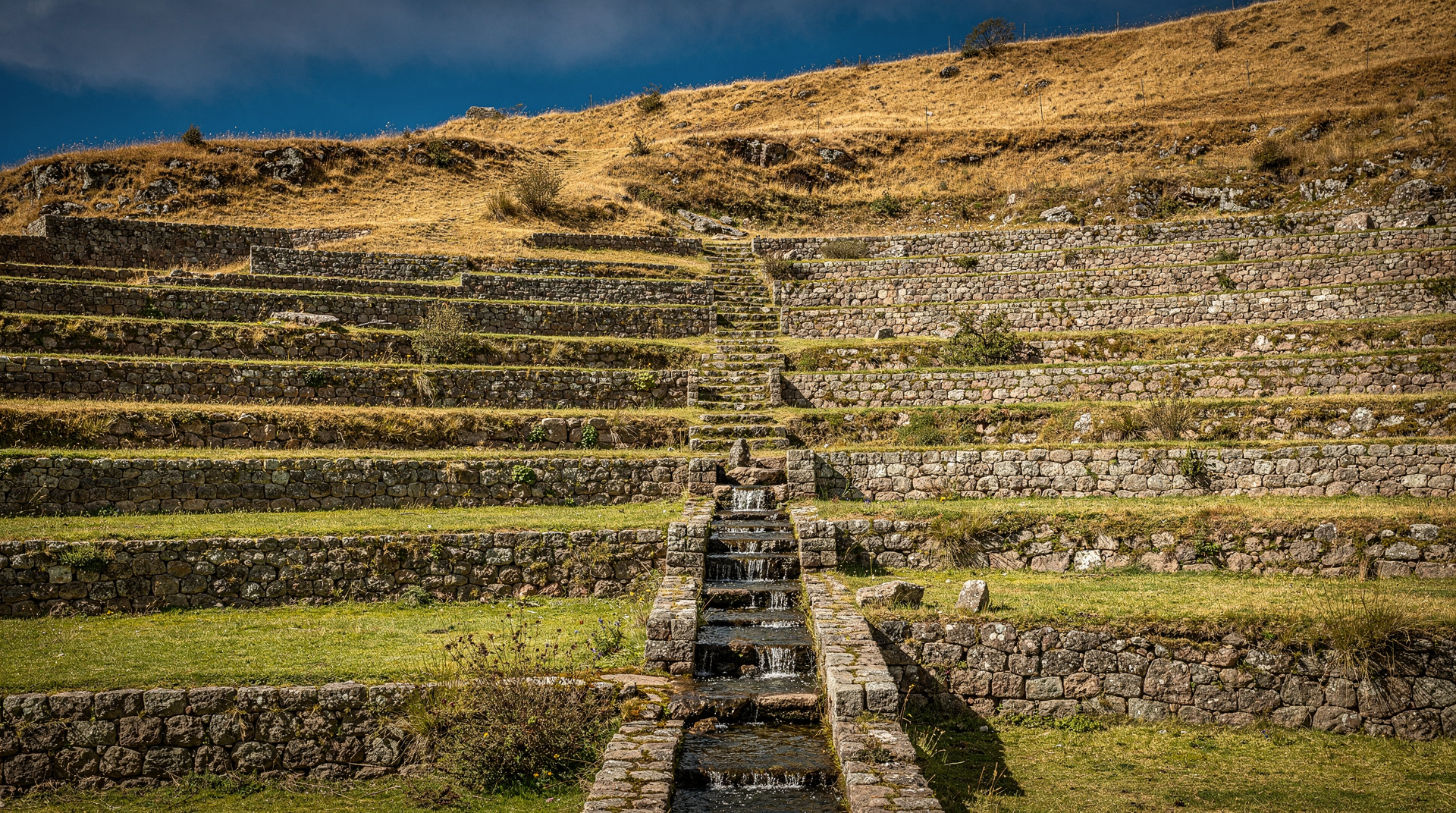
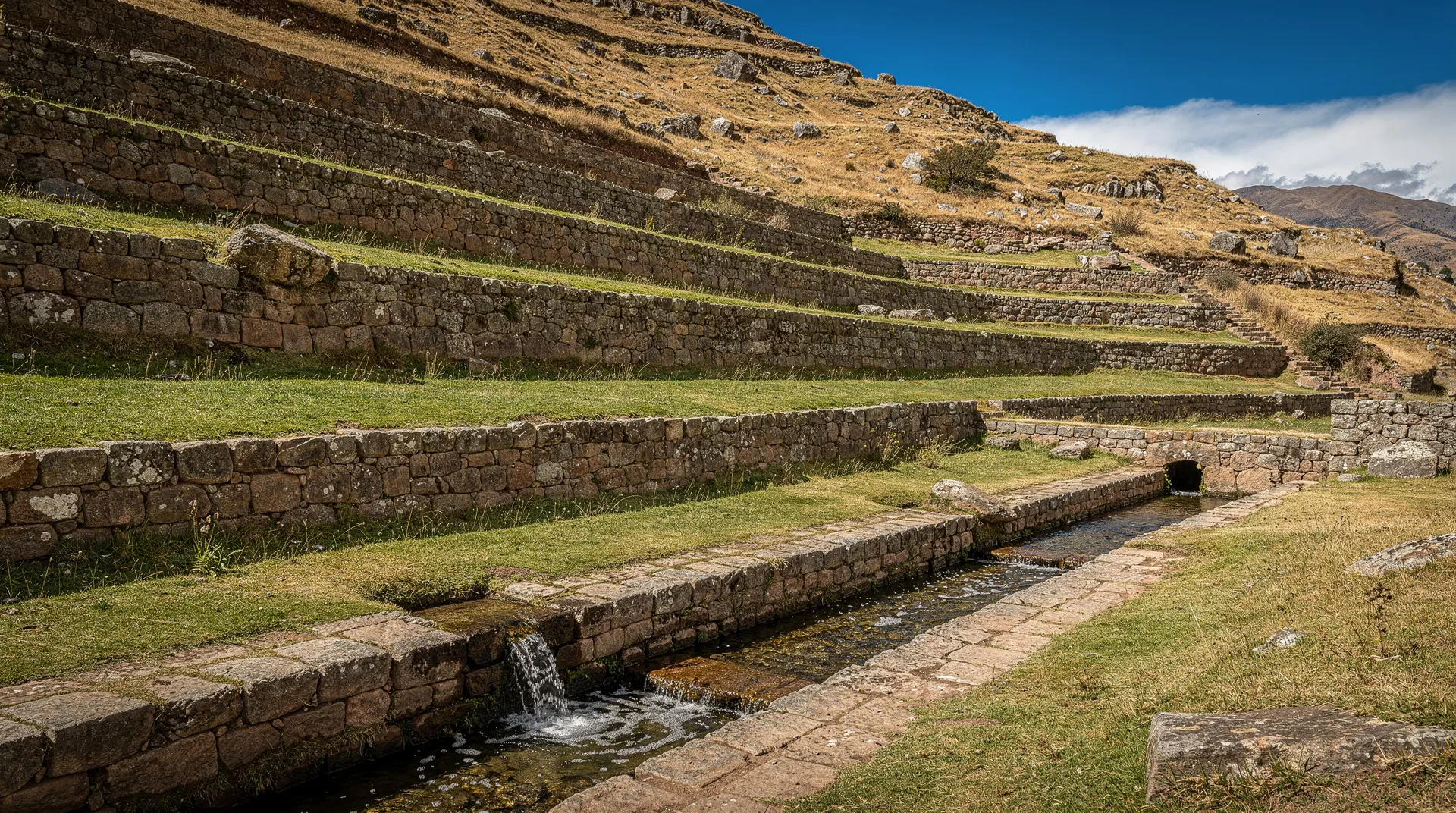
Tipón (Tipon) sits at around 3,560 m on a hillside above Oropesa, and the first sight of it from the upper terrace is genuinely arresting: a cascade of precisely engineered fountains and water channels running through twelve agricultural terraces, the water flowing as cleanly today as it presumably did when the Inca engineers designed it.
The water source is a natural spring diverted through a system of underground aqueducts into the main ceremonial fountain at the upper platform. From there, channels distribute water across the terraces in a carefully calculated sequence of flows and pressures. The main ceremonial fountain — the “wall of water” — sends a continuous sheet over a carved stone face into a pool below. It is one of the most elegant pieces of functional architecture in the Inca repertoire.
The terraces themselves are substantial: twelve platforms supported by well-cut stone retaining walls, with a residential and administrative sector at the top level. A processional staircase links the levels. The whole complex covers around 15 hectares and represents a royal estate — some scholars believe it was the estate of the Inca Yahuar Huacac, though this remains debated.
What to allow: 60–90 minutes. The site is compact but rewards careful looking; the water features in particular need time to appreciate. Bring water and sun protection — there is minimal shade.
Entry: Boleto Turístico partial circuit (S/70) or full circuit (S/130). There is no single-site ticket.
The Andahuaylillas church: a detour worth taking
Halfway between Tipón and Pikillacta, the village of Andahuaylillas holds a colonial church that is legitimately extraordinary and almost always overlooked by visitors. Built in the 17th century, the interior of the San Pedro Apóstol church is painted from floor to ceiling in elaborate baroque frescoes, with a gilded portal and intricate woodwork. The comparison with the Sistine Chapel is hyperbolic but not entirely wrong as a way of conveying the impact of all that painted surface in a small space.
Admission is around S/10–15. The church opens in the morning and has a midday break; check times locally as they vary. This adds 30–45 minutes to the South Valley route and is well worth including.
Pikillacta: before the Incas
Pikillacta sits at 3,250 m just off the highway, 7 km past Andahuaylillas. It is a Wari site — Wari (or Huari) being the culture that dominated much of the central Andes from roughly 600 to 1000 CE, predating the Inca by several centuries. Understanding that the Inca were not the first empire-builders in this region adds essential context to the history you are experiencing at every other site.
The city covers over 2 km² in a grid plan of extraordinary regularity: straight streets dividing rectangular compounds, each compound entered through a single narrow doorway. The walls, built from roughly dressed stone, stand up to 8 m high in places. Storage buildings and large plazas are the dominant features — this was clearly an administrative and supply centre rather than a ceremonial capital.
What makes Pikillacta particularly interesting is what it is not. It lacks the fine stonework of Inca construction, the religious iconography you see at Qorikancha, and the defensive sophistication of Sacsayhuamán. Instead, it has the feel of a functional administrative city — organised, practical, scaled for storage and distribution. The contrast with Inca aesthetics is instructive.
What to allow: 45–60 minutes. The site is large enough to walk around substantially, though fully exploring every compound takes longer. A guide makes the Wari chronology comprehensible; without one, bring background reading.
Entry: Boleto Turístico partial circuit (S/70) or full circuit (S/130). There is no single-site ticket.
A lagoon nearby: Laguna Lucre
Immediately beside the Pikillacta ruins lies Laguna Lucre (also called Laguna Huacarpay), a wetland lake attracting migratory birds including flamingos in certain seasons. It is visible from the Pikillacta entrance area and can be walked around on a rough path. This adds a nature element to the cultural programme at no extra cost. Birders should bring binoculars.
Building a South Valley half-day
A sensible South Valley sequence from Cusco: depart Cusco by 8:30–9:00 am, arrive Tipón by 9:30 am, visit for 75 minutes, drive to Andahuaylillas (20 minutes), see the church (40 minutes), lunch in Andahuaylillas or Oropesa (sopa de maní, bread from the local ovens), drive to Pikillacta (15 minutes), visit for 60 minutes, return to Cusco by 3:00–4:00 pm. This fits comfortably within a half-day and leaves the afternoon free for Cusco city exploring or rest.
Alternatively, combine the South Valley in the morning with an afternoon visit to the Cusco city ruins — Sacsayhuamán, Q’enqo, Puca Pucara, Tambomachay — for a full day of Boleto Turístico coverage.
Tipón’s water engineering in detail
The engineering at Tipón is not merely impressive — it is instructive about how the Inca state thought about water. Most Inca monumental construction is discussed in terms of stone: the fitted walls, the trapezoidal doorways, the massive terrace retaining walls. Tipón redirects attention to the other great Inca engineering obsession: hydraulics.
The main Tipón spring was diverted by Inca engineers into an underground aqueduct system that feeds the ceremonial fountain platform at the upper level. The pressure is managed by channel dimensions — narrower channels increase flow speed, wider ones reduce it — producing the consistent sheet-like flow of the “wall of water” feature. This was deliberate engineering, not a natural accident.
The terraces served multiple purposes: agricultural production, display of state power (through the scale and expense of the construction), and the management of water in a region where reliable irrigation was the difference between abundance and scarcity. The presence of a residential sector and what appears to be an administrative compound at the upper level suggests this was also a royal estate, with the water system as much about prestige as practicality.
Modern Peruvian hydrological engineers have studied Tipón specifically for its water management principles; there have been proposals to rehabilitate the full system, parts of which were damaged in the colonial period. Walking through it with any background in engineering produces a different kind of awe than most archaeological sites generate.
Pikillacta and the Wari empire
The Wari (also spelled Huari) were the first true empire-builders in the Andes, preceding the Inca by 500 years. At their peak (700–900 CE), the Wari state extended from the Ecuador border in the north to the Atacama in the south — roughly the same territory the Inca later controlled. They built administrative cities across this network as instruments of control: Pikillacta in the Cusco region, Huiracochapampa near Huamachuco, Jincamocco in Ayacucho.
What the Wari did not do is leave written records. Their material culture — particularly the distinctive geometric textiles and the grid-planned urban form of their cities — is well-preserved but their political history must be reconstructed from archaeology and from references in later Inca oral tradition. Some Inca origin stories reference the Wari as predecessors; others simply absorb their material achievements without attribution.
Understanding this context transforms Pikillacta from “some old ruins” into a genuine historical marker: the point at which a regional Andean culture in the Cusco valley collided with a large imperial state and was reorganised around it. The Lucre lagoon beside the ruins may have been a sacred body of water associated with the Wari settlement — the name Lucre relates to a deity in some interpretations.
The bread of Oropesa
A small but genuine cultural pleasure on the South Valley route: the town of Oropesa, 7 km from Cusco on the road to Tipón, is known throughout the region as the “bread capital” of the Cusco department. Roadside stalls and bakeries sell pan de yema (egg yolk bread) and other traditional Andean breads baked in wood-fired ovens. The round, slightly sweet loaves cost S/1–3 each and are excellent with a piece of the sharp local cheese available at the same stalls.
This is the kind of small, non-ticketed cultural experience that day trips miss entirely when they race between major sites. Building 15 minutes into the route for Oropesa bread costs nothing and adds something genuinely local to the day.
If you would rather book than improvise
Independent travel suits this route, but not everyone wants to haggle with a driver. If you prefer a ready-made plan, the same road toward Puno is followed by a bus trip along the Route of the Sun with stops between Cusco and Puno, which suits travellers already heading to the lake and wanting to see something along the way instead of a straight transfer.
If you have a free day and the South Valley leaves you curious about the northern side of the region, a full-day guided tour of the Sacred Valley is the natural contrast, and a small-group day through Pisac, Maras, Moray and Ollantaytambo covers the better-known terraces that pair well with what you saw at Tipón. Booking through a platform lets you compare itineraries and read recent traveller reviews before you commit.
Practical tips
The South Valley route works year-round. Unlike Rainbow Mountain, there are no altitude concerns above what you already experience in Cusco. Rain in the wet season (November–March) can make the Tipón terraces slippery, but does not prevent access.
Carry small-denomination soles for the Andahuaylillas church entry, any street food at Oropesa, and tips for drivers and guides. A packed lunch from Cusco is a good idea if you want flexibility; Andahuaylillas has a couple of basic restaurants but limited choice.
The Boleto Turístico guide explains which Cusco sites the pass covers and helps you decide whether the full or partial circuit offers better value for your itinerary.
Why the South Valley stays quiet
The honest answer is marketing momentum rather than merit. Rainbow Mountain and the Sacred Valley circuit dominate every Cusco tour agency’s front-window posters, and most first-time visitors book from that limited menu without knowing the South Valley exists as an option. Tipón in particular deserves far more attention than it receives — travellers with an engineering or archaeology background who happen to stumble onto it consistently rank it among their most memorable Cusco-area sites, precisely because they arrive with low expectations and no crowds to compete with.
The trade-off is that South Valley tours are less common in agency windows, so independent transport (colectivo or taxi) is often the more practical route unless you specifically ask an agency to arrange a private half-day. This quiet reputation is likely to persist — there is no major infrastructure investment planned for the route the way there periodically is for the Sacred Valley — which is good news for anyone reading this guide now rather than in a few years’ time.
Combining the South Valley with a longer Cusco stay
For travellers spending 5 or more days in the region, the South Valley works best slotted into a day that already includes acclimatisation activities in the city — it involves no significant altitude gain and no strenuous walking, which makes it a good choice for day two or three when energy is still limited. The 4-day Cusco and Machu Picchu itinerary and similar longer itineraries have natural gaps for exactly this kind of lower-effort half-day; slotting the South Valley in rather than a second consecutive day of intense city sightseeing gives your body a gentler rhythm without wasting the day.
How the South Valley fits with the rest of your plans
The South Valley pairs naturally with other quiet, low-effort days. If you are still adjusting to the height, the Cusco acclimatization plan and the altitude sickness guide explain how to pace your first days, and this route sits comfortably in that rhythm. The destination page for Tipón and Pikillacta gives a shorter overview if you only need a quick reminder of what each site offers.
Travellers who like the idea of seeing a place without crowds may also enjoy Maras and Moray or the Maras and Moray day trip, though those are more established stops. For a gentler contrast with Tipón’s water terraces, the Moray agricultural terraces guide shows another side of Inca farming and experimentation. If you want to see how the Wari and Inca stories connect, the Inca empire guide for travelers gives the wider background, and Sacsayhuamán shows what Inca building looked like when it was designed to impress and defend rather than to store and distribute.
Families can find other easy outings in the family-friendly day trips guide, and the South Valley is a reasonable candidate among them because the walking is gentle and nothing about the route is rushed. If you are weighing it against other excursions, the best day trips from Cusco puts the options side by side. Anyone building a longer stay can slot it into the three-day Cusco itinerary as the calm day between busier ones, and the Sacred Valley vs Cusco base comparison helps decide where to sleep so that mornings like this start easily.
Before you leave, it is worth reading the Cusco taxi and money tips, because independent transport on this route means negotiating fares and carrying small cash. The Cusco tourist traps guide is a useful companion for the same reason: a quiet route with little tour-bus traffic still has its share of people ready to overcharge a visitor who has not checked the basics. Pair that with the Cusco archaeological sites guide and a quick read of Qorikancha and you will arrive in the South Valley with enough context to see why the Wari, the Inca and the colonial builders each left such different marks on the same landscape.