PeruRail vs Inca Rail: which train operator to choose for Machu Picchu
Excursion to Machu Picchu + Huayna Picchu Mountain
Which is better: PeruRail or Inca Rail for Machu Picchu?
Both are legitimate operators running the same Ollantaytambo–Aguas Calientes route. PeruRail has more departures, more service tiers, and the luxury Hiram Bingham train. Inca Rail is slightly cheaper in economy class, has a more flexible cancellation policy, and offers the exclusive 360° train with panoramic roof. For most visitors the practical differences are minor — choose based on departure time and price on your specific dates.
The only two trains to Machu Picchu — and what actually separates them
There is only one rail line to Aguas Calientes and Machu Picchu. Two operators run services on it: PeruRail and Inca Rail. They share the track, serve the same stations, and take the same amount of time. The essential journey — descending from Andean highland into cloud forest alongside the Urubamba River — is identical on both.
The differences are in service classes, prices, flexibility, and booking experience. This guide covers all of them without the promotional language that each company’s own website naturally applies to itself.
| Where | Ollantaytambo → Aguas Calientes (most common route) |
| Cost | $55–85 economy return; $90–200+ for panoramic/luxury classes |
| Time needed | ~1.5 hours each way from Ollantaytambo |
| Getting there | Book direct on perurail.com or incarail.com |
| Best time | Book weeks ahead for June–August; 1–2 weeks is often enough in shoulder season |
The route: what both operators are actually doing
The train journey that matters for most visitors is Ollantaytambo to Aguas Calientes — approximately 1.5 hours. Ollantaytambo at 2,792 m is in the Sacred Valley, 1.5 hours by road from Cusco. It is the closest practical train departure point to Machu Picchu.
Both operators also run services from Poroy (a station near Cusco at 3,400 m) — a longer journey of approximately 3.5 hours to Aguas Calientes. Poroy is convenient if you are not going to Ollantaytambo first, but the longer journey and limited frequency make it less common. PeruRail additionally runs a very slow service from Cusco San Pedro station, primarily for locals.
The vast majority of visitors use the Ollantaytambo departure, and this comparison focuses on that route.
PeruRail: the main operator
PeruRail is the larger operator with the most departures and the widest range of service classes. It has been running the Machu Picchu route since the 1990s and has the most mature booking infrastructure.
PeruRail service classes:
Expedition (economy class):
- Standard seats, standard windows
- Basic snack service
- Return fare: approximately $60–85 USD from Ollantaytambo
- Most departures, most availability
- The default choice for budget-conscious travellers
Vistadome (mid-range):
- Panoramic windows including sections of roof glazing
- Better views on the descent through the canyon
- Snack and light meal service
- Return fare: approximately $90–130 USD from Ollantaytambo
- Worth the upgrade if the scenery is the point of the journey
Vistadome Observatory (premium economy):
- Observation coach with extended glazing
- Return fare: approximately $110–150 USD
Hiram Bingham (luxury):
- Runs from Poroy only (near Cusco), not Ollantaytambo
- Includes full brunch on the way to Aguas Calientes, a Belmond hotel afternoon tour of Machu Picchu, cocktails, and a three-course dinner on the return
- Return fare: $400+ per person
- Named after the American historian who brought Machu Picchu to international attention
- A special-occasion or honeymoon experience rather than standard transport
Booking PeruRail: perurail.com. The booking process is straightforward. Spanish-language option available but the English interface works well. Visa and Mastercard accepted.
Inca Rail: the competitor
Inca Rail is a Peruvian private operator that has been running since 2009. Smaller fleet than PeruRail, fewer daily departures, but a genuine alternative with competitive pricing and some distinctive products.
Inca Rail service classes:
Tourist/Explorer:
- Standard seats, similar to PeruRail Expedition
- Return fare: approximately $55–80 USD from Ollantaytambo
- Often marginally cheaper than PeruRail Expedition on the same dates
Executive:
- Wider seats, more comfortable, meal service
- Return fare: approximately $80–110 USD
The 360° (premium):
- The signature Inca Rail product: panoramic observation train with transparent roof and sides
- Full 360-degree views including upward through roof glazing
- Return fare: $200+ USD
- A genuinely different experience, particularly dramatic in the canyon section
- Limited departures — check availability early
First Class:
- Business-class equivalent, meal service, wider seats
- Return fare: approximately $120–160 USD
Booking Inca Rail: incarail.com. Interface is clear. Inca Rail’s cancellation and change policy is often noted as somewhat more flexible than PeruRail at standard service levels — check current T&Cs before booking.
Which station, which operator: a practical matrix
| Your situation | Recommended approach |
|---|---|
| Based in Cusco city, early departure | PeruRail from Poroy or Ollantaytambo (transfer from Cusco by road first) |
| Spending night in Ollantaytambo | Either operator from Ollantaytambo — compare prices and times |
| Want cheapest economy option | Compare both on your specific dates; Inca Rail Tourist often narrowly cheaper |
| Want panoramic views, mid-budget | PeruRail Vistadome or Inca Rail The 360° (the latter is more dramatic but costs more) |
| Luxury experience | PeruRail Hiram Bingham (only one in this tier) |
| Want flexible booking/cancellation | Check Inca Rail’s current fare conditions, which have often been more lenient |
The booking process: direct vs agents vs packages
Booking the Machu Picchu train directly through the official operator websites (perurail.com or incarail.com) is always the right approach for independent travellers. Both booking systems are functional and straightforward.
Why not book through agents: Cusco has hundreds of tour agencies selling train tickets. All of them charge a markup — typically $5–20+ per ticket — for no additional service. Some resellers charge 2–3× the official price, particularly to travellers who do not know what the correct price is. Always check the official price on the operator website before agreeing to any agent’s quoted fare.
Why not delay booking: Peak-season early-morning departures from Ollantaytambo (the 5:50–7:00 a.m. trains that allow full-day visits to Machu Picchu) sell out weeks to months ahead. Book as soon as your dates are confirmed — there is no benefit to waiting.
Side-by-side fare comparison, Ollantaytambo return
| Tier | PeruRail | Inca Rail |
|---|---|---|
| Economy | Expedition: $60–85 | Tourist/Explorer: $55–80 |
| Mid-range | Vistadome: $90–130 | Executive: $80–110 |
| Premium/panoramic | Vistadome Observatory: $110–150 | The 360°: $200+ |
| Business | — | First Class: $120–160 |
| Luxury | Hiram Bingham (Poroy only): $400+ | — |
These are guide figures that move with season and lead time; always cross-check the live price on perurail.com and incarail.com for your actual travel dates before deciding.
One pattern worth knowing: prices on both operators rise the closer you get to peak-season departure dates, particularly for the early-morning slots. A ticket bought two to three months ahead for a July departure can cost noticeably less than the same seat bought two weeks out, if it is even still available. Shoulder-season fares (April–May, September–October) move less dramatically with lead time, since demand pressure is lower across the whole booking window. Rainy season (November–March) fares can occasionally be found even cheaper close to departure, though the trade-off is a higher chance of weather-related delay affecting the line.
Luggage and what to carry on board
Both operators limit hand luggage — PeruRail to one backpack up to 8 kg (100 cm, height + length + width) or one carry-on up to 12 kg (115 cm), Inca Rail to one piece up to 8 kg (118 cm) — that is a day bag, not a suitcase. Extra bags on PeruRail cost extra; check the operator’s luggage policy before travelling. For a straightforward day trip this is not a real constraint: passport, camera, water, a light jacket for the cooler evening return, and snacks fit easily. If you are travelling on to or from a multi-day trek or a longer Sacred Valley stay, leave the bulk of your luggage at your Cusco or Sacred Valley hotel rather than trying to bring it — PeruRail offers free storage at Machu Picchu station, and Inca Rail has a custody service only at its Ollantaytambo office.
Practical differences that actually matter
Frequency of departures: PeruRail runs more trains per day from Ollantaytambo in both directions. If you have a specific return time requirement, PeruRail likely offers more options.
Cancellation/flexibility: Check both operators’ current fare terms. Inca Rail has historically offered free changes with advance notice on some fare classes; PeruRail’s terms vary by service class. This matters if your Cusco schedule has any uncertainty.
Reliability: Both operate on the same track, which has the same vulnerability to weather and maintenance issues. Neither has a materially better on-time record. In rainy season (November–March) both occasionally face delays or cancellations due to landslides; both provide rebooking assistance when this happens.
Luggage: Both operators restrict hand luggage — PeruRail: one backpack up to 8 kg (100 cm, height + length + width) or one carry-on up to 12 kg (115 cm); Inca Rail: one piece up to 8 kg (118 cm). Larger bags can be left at your Aguas Calientes hotel; PeruRail stores bags free at Machu Picchu station, and Inca Rail offers custody only at its Ollantaytambo office.
The scam to watch for
Both PeruRail and Inca Rail sell tickets through street-level resellers at inflated prices in Cusco. Some resellers present themselves as official representatives. Some present printed “tickets” that turn out to be unofficial reservation slips rather than the actual tickets.
Always book direct through perurail.com or incarail.com. If you must book in person (some travellers prefer this), go to the official station ticket offices — PeruRail has an office in central Cusco and at Ollantaytambo station; Inca Rail has offices in Cusco and at Ollantaytambo. The Machu Picchu train ticket scams guide covers the specific reseller patterns to avoid.
The experience on the train
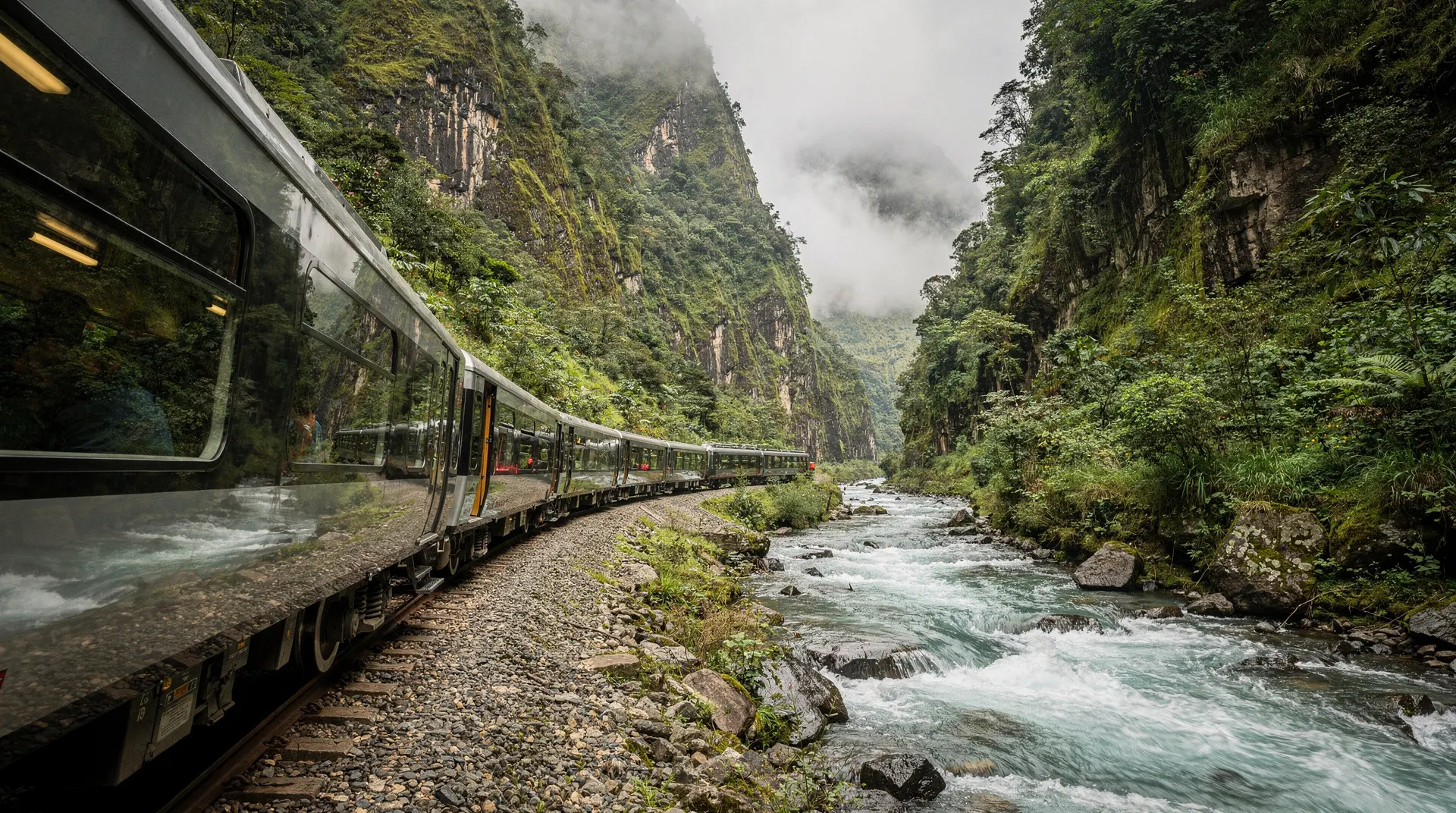
The train journey itself is one of the pleasures of visiting Machu Picchu — not just transport but an experience in its own right. From Ollantaytambo, the line follows the Urubamba River as it descends 750 m over 1.5 hours. The valley walls close in as the highland opens into gorge; the vegetation transitions from golden highland grass to cloud forest; the river becomes more turbulent. In the Vistadome, Vistadome Observatory, or 360° carriages, the roof glazing makes the canyon visible above you as well as through the side windows.
The food service varies — snacks on the economy services, a light meal on premium. Neither is a destination in itself, but neither is bad.
On arrival at Aguas Calientes, the official shuttle buses to the site entrance depart from Av. Hermanos Ayar. The bus journey takes 25 minutes and costs $24 return from the official booths. Do not accept offers from individuals in the street — all official buses depart from the same clearly marked location.
Our honest recommendation
For most visitors, the difference between PeruRail and Inca Rail on the Ollantaytambo–Aguas Calientes route is minor. Both get you there in 1.5 hours on the same track.
Book PeruRail if:
- You want the most departures and flexibility
- You are specifically interested in the Hiram Bingham luxury experience
- You value the larger operator’s more established customer service infrastructure
Book Inca Rail if:
- The 360° panoramic train is specifically appealing and available on your dates
- Inca Rail is meaningfully cheaper on your specific dates (compare both)
- You value Inca Rail’s cancellation terms on your fare class
In all cases: Book direct on the official websites, book as early as possible for peak season, and cross-reference your train dates with your Machu Picchu entry ticket dates — both must match.
How the train fits into a full Machu Picchu day trip
For travellers doing a day trip from Cusco to Machu Picchu — the most common itinerary — the train is one leg of a longer day. The full journey typically works as follows:
Departure day:
- 5:00–5:30 a.m.: Leave Cusco by taxi for Ollantaytambo (approximately 1.5 hours)
- 7:00–8:00 a.m.: Train from Ollantaytambo to Aguas Calientes (1.5 hours)
- 8:30–9:30 a.m.: Arrive Aguas Calientes, take bus up to site (25 minutes)
- 9:00–10:00 a.m.: Enter Machu Picchu at booked time slot
- 12:00–2:00 p.m.: Lunch in Aguas Calientes after exiting the site
- 3:00–5:00 p.m.: Return train to Ollantaytambo
- 5:00–6:00 p.m.: Taxi back to Cusco; arrival approximately 7:00–8:00 p.m.
This is a 14–16 hour day. It is long but entirely standard; thousands of visitors do it daily. The early start is unavoidable — the best entry slots for Machu Picchu are 6:00–8:00 a.m., and to reach those slots you must be on the first or second morning train from Ollantaytambo.
An overnight in Aguas Calientes: If the day trip feels rushed or you want to be at Machu Picchu for both the early morning and early afternoon (a full second entry slot on some circuits), spending one night in Aguas Calientes gives you a much more relaxed experience. You arrive the evening before, use the hot springs (genuine thermal pools in the town), and enter Machu Picchu at sunrise the next morning. The return train leaves mid-afternoon. Aguas Calientes is a small town with limited charm but sufficient comfortable hotels for one night.
Train ticket security: avoiding resellers
This merits repeating: a significant number of travellers overpay for train tickets by buying through tour agency resellers in Cusco. Some resellers operate from legitimate-looking offices in the historic centre and present printed documents that look like official tickets but are unofficial booking confirmations that may or may not be honoured.
The verification is simple: all legitimate PeruRail and Inca Rail tickets carry a unique booking reference that can be verified on the respective operator’s website. If an agent-sold ticket cannot be verified this way, do not board.
For the complete picture on train ticket reseller risks, the Machu Picchu train ticket scams guide covers the specific patterns — markups, fake tickets, and how to verify before you commit.
Frequently asked questions about PeruRail vs Inca Rail: which train operator to choose for Machu Picchu
What routes do PeruRail and Inca Rail serve?
How much do the trains cost in 2026?
Can I book PeruRail or Inca Rail on short notice?
Is there a difference in reliability between the two operators?
Can I buy train tickets from agents in Cusco rather than directly?
What happens if I miss my train?
Can I book different operators for the outbound and return journey?
Is there luggage storage at Ollantaytambo or Poroy station?
Top experiences
Bookable activities with verified prices and instant confirmation on GetYourGuide.